The Next Spike in Oil Prices Could Be Around the Corner
 |
| By Bob Czeschin |
Ever since the internal combustion engine displaced horses and mules on the modern battlefield, oil has been a strategic military resource.
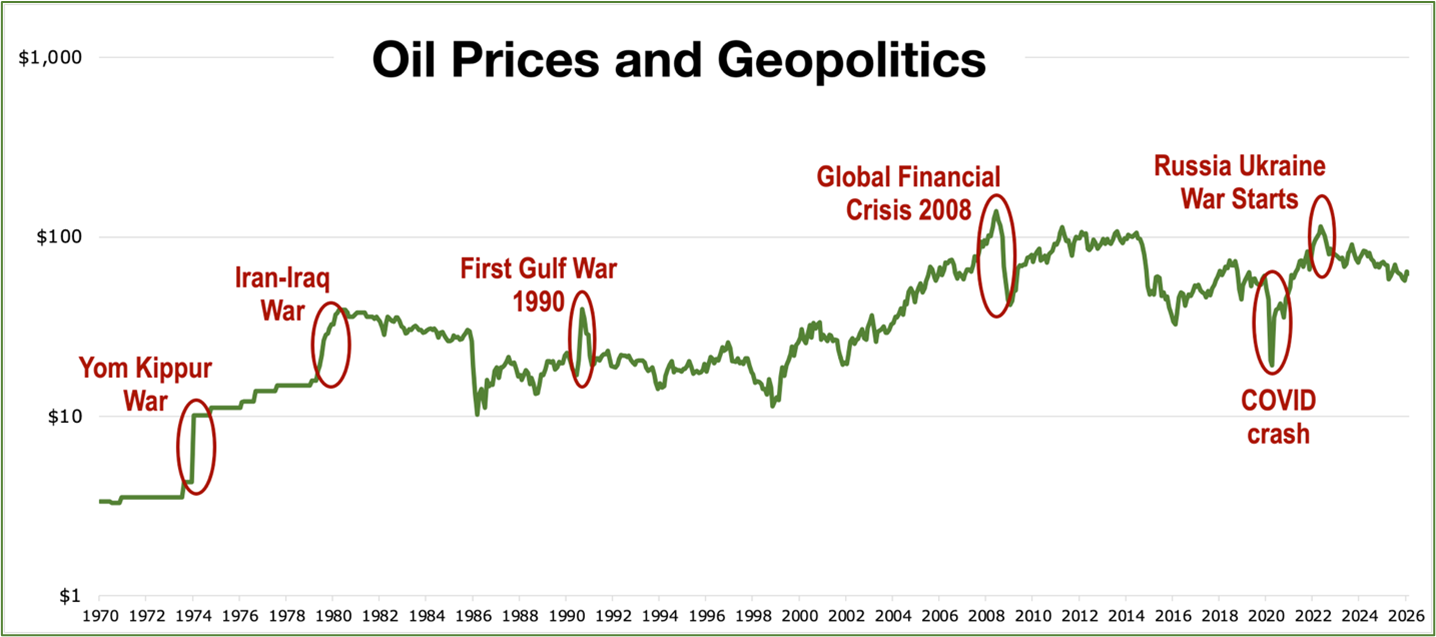
Indeed, you can almost see the arc of 20th-century geopolitics written in the ebb and flow of petroleum prices.
At the time of writing, the price per barrel is about $66. While that’s an increase since the start of the year, it’s down roughly 6.4% over the past year and 44% from its five-year peak in June 2022.
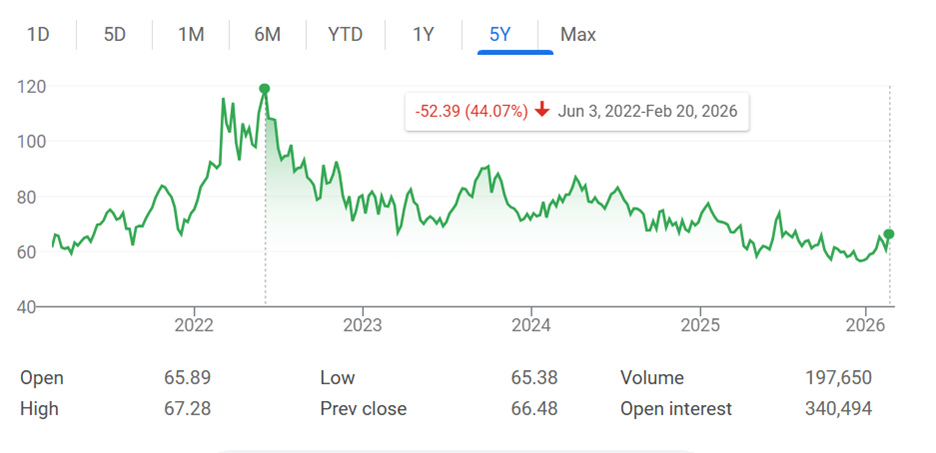
But look at the right end of this chart. You can see that starting in January 2026, prices began to climb again.
And I don’t think that will change any time soon. In fact, it could skyrocket.
Fill Up Your Tank Now
Headlines over the past several weeks have been dominated by the Epstein document dump and the Nancy Guthrie kidnapping case. So naturally, few have noticed the U.S. has begun to move key pieces on the geopolitical board.
And I expect this move will ripple through the price of oil.
The Pentagon has sent the biggest armada in 20 years racing to waters near Iran as a precaution should talks over the Iranian nuclear program fall apart.
It includes …
The Nimitz-class carrier USS Abraham Lincoln with
- 3 squadrons of F/A-18 Super Hornet fighters,
- a squadron of F-35 Lightning II stealth fighters,
- support aircraft including E/A-18G Growler electronic warfare jets,
- 3 destroyers, each with 96 vertical launch tubes for Tomahawk cruise missiles and anti-ship missile defenses.
Nuclear aircraft carrier USS Gerald R. Ford with
- 4 squadrons of F/A-18 Super Hornets,
- a squadron of E/A-18G Growlers and
- 3 Arleigh Burke-class Aegis guided missile destroyers equipped for anti-air, anti-submarine and anti-surface warfare.
This is nothing like preparations we saw for last June’s Operation Midnight Hammer. It’s the biggest buildup since America’s 2003 Gulf War.
That’s because it’s unlikely that any action against Iran will be a one-and-done move like we saw last year, according to Ali Vaez, an Iran expert at the International Crisis Group.
In other words, the Pentagon isn’t just planning a show of force to gain an edge in negotiations. It seems to be preparing for an open-ended, all-out war with Iran should talks fail.
It’s not just the U.S. that’s making moves. Indeed, a number of warning signs point to a possible escalation.
On Feb. 16, Iran began naval drills in the Strait of Hormuz, a choke point for oil tankers transiting the Persian Gulf. Closing the Strait would usher in worldwide oil shortages not seen since the days of long lines at filling stations across America.
Which is why it’s notable that, days later, Russian and Chinese navies joined the Iranian maneuvers.
In these confined waters, even small firefights between U.S. defended tankers and Iranian drone swarms could result in collateral damage to nearby Russian or Chinese warships … who then might shoot back, triggering a broader war.
Success Is the Father of Hubris
Oil prices are up about 9% year to date. But the last time Tehran’s ruling mullahs fought a full-scale war (against Iraq, see Figure 1, above), prices quadrupled.
So why does the Trump White House — and indeed the oil market itself — not seem more worried that something similar could happen this time?
I am old enough to remember the Iran-Iraq war. But the vast majority of those sitting behind trading screens in today’s oil market are not.
They only know what they’ve experienced — which is far tamer oil prices.
And while President Trump is also old enough to remember the Iran-Iraq war, his point of reference regarding this situation is likely much more recent: June 2025, when Israel dealt handily with Iran’s vaunted ballistic missile attacks and convinced him to send B-2 stealth bombers against Iran’s underground nuclear sites.
An operation, he kept repeating afterward, that was flawlessly executed.
More importantly, however, there was little, if any, meaningful military or political blowback. And there was no traumatic spike up in oil prices that might have ignited inflation or annoyed U.S. voters.
The same was true of the lightning operation to abduct Venezuelan President Maduro. Venezuela has more petroleum in the ground than Saudi Arabia. But the oil market still had almost no visible reaction.
However, as an investor, you know that past performance is no guarantee of future results.
That’s as true of politics and war as it is of commodity prices. Indeed, one of the most dangerous thoughts an investor can entertain is certainty.
Instead, we weigh possibility against probability. And in this calculation, a full scale war would likely cause chaos around the planet … as both the Yom Kippur and the Iran-Iraq Wars did.
Investment Implications
If you see merit in my assessment, you may want to consider adding an oil exploration and production play to your portfolio. One good way to do that is with an ETF — such as the SPDR S&P Oil & Gas Exploration & Production ETF (XOP).
XOP buys U.S. stocks in the S&P Oil & Gas Exploration & Production Select Industry Index.
Or, if you want to ensure you have a hedge against future geopolitical volatility, safe haven assets like gold and Bitcoin (BTC, “B+”) are an option.
Both can be found on the blockchain — via the PAX Gold (PAXG) stablecoin in gold’s case — and stored in your crypto wallet.
Best,
Bob Czeschin