 |
| By Marija Matic |
A lot of what kept developers built over the bear market didn't show up in price.
Which is why many retail investors haven’t adjusted their portfolios just yet.
But as my colleague Mark Gough recently explained, tokenization and tokenized stocks themselves are set to be one of the biggest narratives of the coming bull market.
You may have heard us say that tokenized stocks are public assets that have been converted to digital tokens, tradable 24/7 on the blockchain.
That definition is accurate, but not all encompassing.
See, tokenized assets technically fall into four categories, and each means something completely different.
The 4 Ways to Own Stocks On-Chain
Here’s the different ways you can own stocks on the blockchain …
1. Pure tokenized spot. These are what most people think of when we say “tokenized stocks.” They’re real shares that you legally own. Your name is on the cap table. The blockchain is just the settlement layer.
2. Brokerage-Wrapped Spot. These are versions where a broker holds the shares and you hold a claim. This is similar to how most brokerage accounts already work. The only difference is the asset is wrapped in a token.
3. Tracker Certificate (hybrid). Then there are structured products, usually issued through European vehicles, where real shares sit in custody and the token tracks them. You don’t own the stock directly, but you’re not just trading a number either.
4. Synthetic Perpetuals. These are perpetual futures that just follow the price. No shares, no claims, no link beyond the chart.
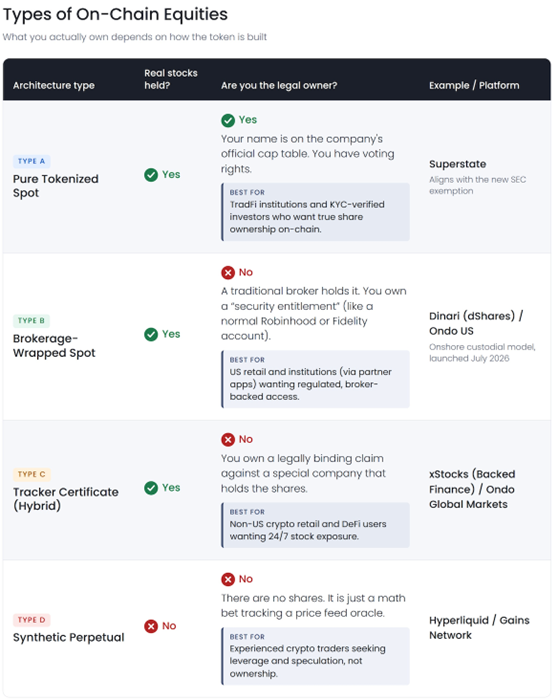
All four are live and growing. But each behaves very differently from the next.
Especially that fourth category.
Because if you look at where the activity actually is in 2026, it is not in ownership. It is in trading.
I call it "perp-ification" of traditional assets.
Perpetual futures on traditional assets have been pulling volume across both centralized and decentralized exchanges. On Hyperliquid (HYPE), they now make up about 30% of total volume. On Binance, they've reached about 20% of the futures book during peak weeks.
Why? They're always open, and you only trade the price.
A regulated tokenized share has to respect market hours and compliance rules.
But tokenized perp futures allow you to trade Tesla (TSLA) at 3 a.m. on a Sunday, with leverage, from a crypto wallet that doesn't need to explain itself.
So, the flow followed the product that behaves more like crypto.
The Trade-Off
The moment you move away from synthetics, friction comes back.
Real tokenized shares come with identity checks, permissions and constraints that mirror the underlying market.
They're coded to be permissioned: If trading halts in the U.S., it halts on-chain, too.
This makes them usable for institutions … but less appealing to those of us who actually want to benefit from blockchain utility and freedom.
That's why the volume split looks the way it does.
Traders ran about $175 billion of stock perps through DEXs in Q3 alone.1 But the whole market for asset-backed tokenized stocks sits at about $5.48 billion as of Sept. 25.2
The Middle Layer: Where It Gets Interesting
It’s important to note, however, that the most active part of the market right now isn’t the pure synthetics OR the fully regulated tokenized equity.
It’s the hybrid layer.
That’s where real shares are bought and held by a custodian — a token is then issued against it through a structured vehicle. That token then trades freely on-chain.
From the outside, it feels like a normal token. You can swap it on a DEX, hold it in a wallet, move it whenever you want.
Under the hood, it’s tied to something real — but not in a way that gives you direct ownership.
That structure shifts the compliance burden away from the trader and onto the issuer. Which is why these markets can exist without turning every user through a know-your-customer (KYC) flow.
It’s also where most of the confusion comes from.
These assets look simple on the surface. But rely heavily on legal and custodial plumbing in the background.
Take xStocks, for example, which is now owned by Kraken.
When a token like TSLAx or NVDAx is minted, a real share gets bought and held 1:1 with a regulated custodian. The token then trades freely on-chain.
But you don’t own the asset. The custodian does.
What you have to trade is a certificate — a debt instrument, issued by a Jersey company, under an EU prospectus approved in Liechtenstein. Which means any dividends don't get paid out. They get reinvested into the token's value.
The Real Winner of the Tokenization Supercycle
You can hold tokenized stocks.
Or you can hold a token tied to the infrastructure that issues them.
Ondo Finance (ONDO) has long been one of our favorite real-world asset infrastructure plays.
Recently, it gave us another reason to be bullish: It's now the only issuer that sits in two boxes of the table.
- Its offshore Ondo Global Markets tokens are loan notes for global DeFi users (Type C).
- Its U.S. product, launched in July, holds shares in the regular U.S. custody chain, with voting through Broadridge (Type B).
It's building for both worlds at once.
And it's going beyond single stocks.
Ondo just launched three portfolio tokens built on strategies BlackRock developed for Ondo. One token is a whole rebalanced portfolio:
- BLKHIon: High Income (bonds)
- BLKDIGon: Diversified Growth (70% stocks, 25% fixed income/alternatives, 5% BTC)
- BLKGRWon: High Growth (95% stocks, 5% BTC)
Think of these tokens as a fund you can hold in your wallet. That means you get institutional portfolio construction with 24/7 transfers and self-custody.
And, because it’s verifiable on the blockchain, you can check the holdings and rebalances on-chain.
What Retail Actually Gets Out of This
For crypto-native users, the decision is simple …
- If you want to trade, synthetics already do it better.
- If you want exposure without friction, hybrids fill that gap.
Fully compliant tokenized shares are accessible. But for most people, they don't justify the extra steps.
That doesn't make them irrelevant. They're just built for a different user.
And that’s the important takeaway: These models aren't replacing each other. They're stacking.
Perps might keep absorbing trading volume because they fit how crypto markets work.
Hybrids could keep growing because they're the easiest bridge between real assets and open access.
And fully tokenized equities will plug into the biggest pools of capital.
Finally, portfolio tokens, like the three just launched by Ondo, will turn whole allocations into something that lives in your wallet. Not a brokerage account.
This space will grow fast.
For the typical retail investor, the best angle isn't picking which version wins.
It's backing the infrastructure they all run on.
Best,
Marija Matić
P.S. Tokenization also means more ways to trade the latest stocks to IPO.
But to get access to the data that’ll help you sort which IPOs to trade, you’ll want to join Startup Investing Specialist Chris Graebe’s briefing Apex IPOs: The 25X Advantage.
At 2 p.m. Eastern tomorrow, he’ll dive into the latest Weiss data to show you how to spot the 10% of IPOs that actually paid off for first-day investors.
It’s free to attend. Just click here to save your seat.
1https://crypto.news/rwa-perp-dexs-reach-365b-as-stocks-lead-trading/