The U.S.’s Yen Intervention Just Cleared the Way for Crypto’s Next Rally

 |
| By Juan Villaverde |
In all the frenzy that comes with following the crypto market, many investors lose sight of a fundamental truth …
Bitcoin (BTC, “B+”) is fundamentally a monetary asset.
It has no earnings. It pays no dividends.
So what drives its price? More than anything else, it’s the global ebb and flow of liquidity. Or more specifically, the supply of dollars relative to the rest of the world's currencies.
And in 2026 — more than any other year I can remember — one currency has mattered more than all the rest combined: the Japanese yen.
I covered why this is so in prior issues. So, there’s no need to repeat it here. But there is one key takeaway you need before I dive deeper into my update:
The yen price against the dollar moves roughly 84 -87 days before Bitcoin mirrors that move. So, watching the yen can reveal Bitcoin's future price path.
Which makes the yen falling to 40-year lows against the greenback a big concern for Bitcoin holders.
What caused the freefall? The yen carry trade.
Investors borrow yen at roughly 1% interest, convert the proceeds into U.S. dollars yielding about 3.5%, and pocket the difference.
Selling increasing amounts of yen to buy more dollars creates relentless, structural downward pressure on the Japanese currency. And it’s been going on for years.
But this year, Japan’s Ministry of Finance stepped in. Just as the yen approached 40-year lows to the foreign exchange market.
The first move was in January, the second in late March to early April. Each time, it dumped tens of billions of dollars to buy yen and prop it up on world foreign exchange markets.1
Each time, roughly 84 to 87 days later, Bitcoin responded in kind …
- The January intervention helped push Bitcoin higher starting in early April.
- The March/April intervention helped lift prices into the late June/early July window.
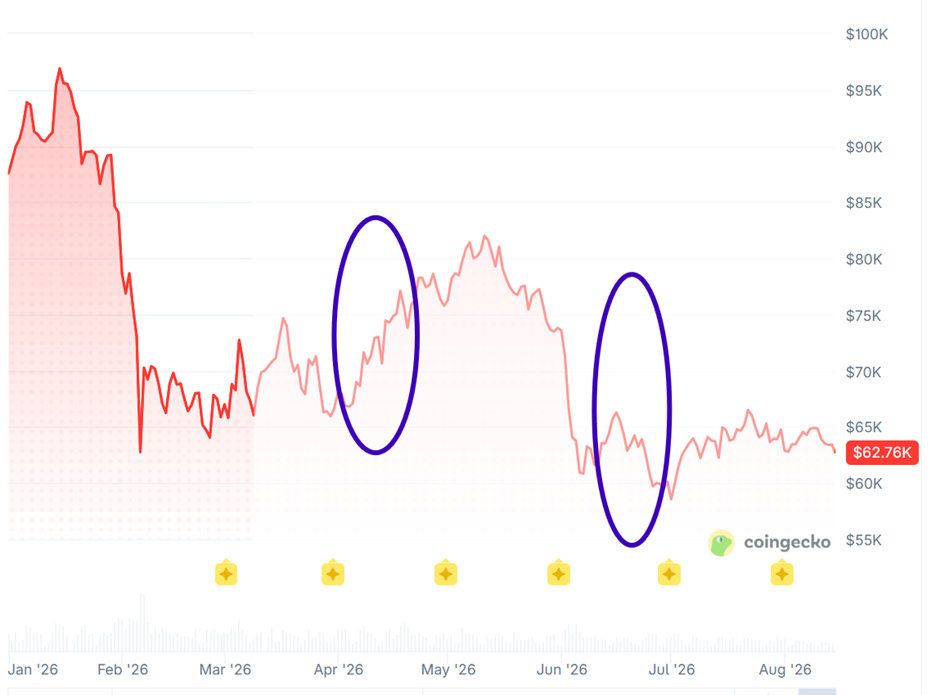
Now, a third intervention began last weekend. And initially, this round looked no different than the others: The Ministry of Finance sold roughly $70 billion to push the currency up about 4% in short order.2
But this time, the U.S. Treasury played a surprise role.
An alert photographer with a telephoto lens captured a now-famous hand-written memo-to-himself, among Treasury Secretary Scott Bessent’s private papers …
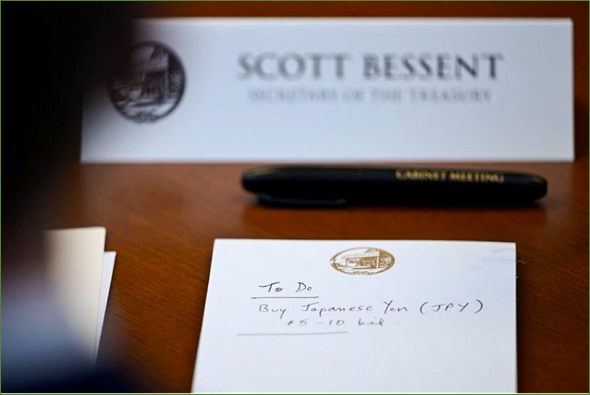
Whether genuine or elaborate political theater — and I lean toward the latter — the message this sent was unmistakable. The U.S. is now actively involved in managing the yen's decline.4
Why does this matter to Washington?
Because a weak currency could force Tokyo sell U.S. Treasurys to get the dollars it needs to shore up the exchange rate.
That’s the last thing Washington needs.
What makes this intervention structurally different from previous ones is where the dollars to Japan come from. Indeed, it has already confirmed the source will be the Fed's Foreign and International Monetary Authorities (FIMA) repo window.5
In plain English: Japan can now pledge its Treasurys as collateral and borrow dollars directly from the Fed.
The implications of this are significant. When the Fed lends dollars through the FIMA facility, it effectively creates those dollars out of thin air.
That is quantitative easing (QE) by another name.
It may be indirect. It may be quiet. And it may not show up in the Fed's headline balance sheet figures right away. But make no mistake, the Federal Reserve is now printing money to support the Japanese yen.
And there is nothing — nothing — more bullish for crypto than debasement of the world’s No. 1 reserve currency.
This is why I believe the October low that Japanese M2 is now pointing to — Oct. 17 – 18 — may be Bitcoin's final capitulation low before a new bull market begins.
Every Bitcoin bull market I've studied has started with a similar catalyst. Monetary authorities, for one reason or another, return to the business of printing money.
This always happens eventually. Because debt is so large, paying the interest on it becomes financially crippling.
Japan has too much debt. The U.S. has too much debt. And the path of least resistance is, as always, to inflate it away. And that’s precisely the environment in which Bitcoin and cryptocurrencies thrive.
And now, the Fed is quietly restarting its money printer.
The Bank of Japan is raising interest rates — albeit reluctantly — while the Fed holds steady. This narrows the interest rate differential that’s been the lifeblood of the yen carry trade.
And so, the conditions are falling into place for a more sustained yen recovery.
A sustained yen recovery is exactly what we need for a sustained rally in Japanese M2. And a sustained rally in Japanese M2 is exactly what we need to see Bitcoin enter its next bull market.
We're not quite there yet. But we're closer than we've been all year.
Best,
Juan Villaverde
P.S. My Crypto Timing Model has accurately called the start of the past three long-term cycles. That’s when prices are still low, and the market shifts from bear mode to bull.
Here’s the thing most investors miss: This moment doesn’t happen in the middle of a market panic. It happens quietly, when almost no one is paying attention.
If you want to get alerts the moment my Crypto Timing Model confirms a strong floor, click here.
1https://www.fidelity.com/news/article/default/202607302321RTRSNEWSCOMBINED_KBN3TR09M-OUSBS_1
2https://www.japantimes.co.jp/business/2026/08/12/markets/yen-intervention-fiscal-policy/
3https://www.rawstory.com/scott-bessent-treasury/
5https://thehill.com/opinion/finance/6028150-us-japan-yen-intervention/