This Crypto Fights the Hidden Credit Risk in Tokenized AI Yields

 |
| By Marija Matic |
When Anthropic filed its S-1 for a Nasdaq listing under the ticker ANT, the headlines fixed on a potential $2 trillion valuation.
But for crypto investors, there’s a more revealing number buried in the fine print.
The company behind Claude reported $16.3 billion in revenue for the first half of 2026 — alongside an $80.7 billion net loss. Most of which was a non-cash accounting charge on its convertible notes rather than money out the door.
But it alludes to the real pressure that lies ahead: More than $600 billion in infrastructure commitments, most of them non-cancellable.
The company named power grid failures and spreading data center construction moratoriums as material threats to business continuity.
That warning lands as AI infrastructure debt across the industry passes $500 billion.
And lenders are starting to flinch.
Banks, wary of "stranded compute" — expensive chips that sit idle because there isn't enough power to run them — are tightening credit to independent data center builders.
The operators squeezed hardest are now looking for capital elsewhere.
And that’s where investors should pay attention.
Neoclouds: Musk's Shakeout Warning
Neoclouds are compute landlords.
They buy thousands of high-end AI chips, install them in specialized facilities, and rent the capacity to startups and research labs training models.
But the business is capital intensive and balance sheets are thin. Exactly the kind of borrower banks are backing away from.
The weakness of neoclouds was pushed to the front of the AI conversation earlier this week.
On Sunday, Oct. 25, Elon Musk sent a jolt through the sector with a post on X predicting a brutal culling: "200+ neoclouds are going to see guppy-level death and consolidation. Some will make it through, but not many."
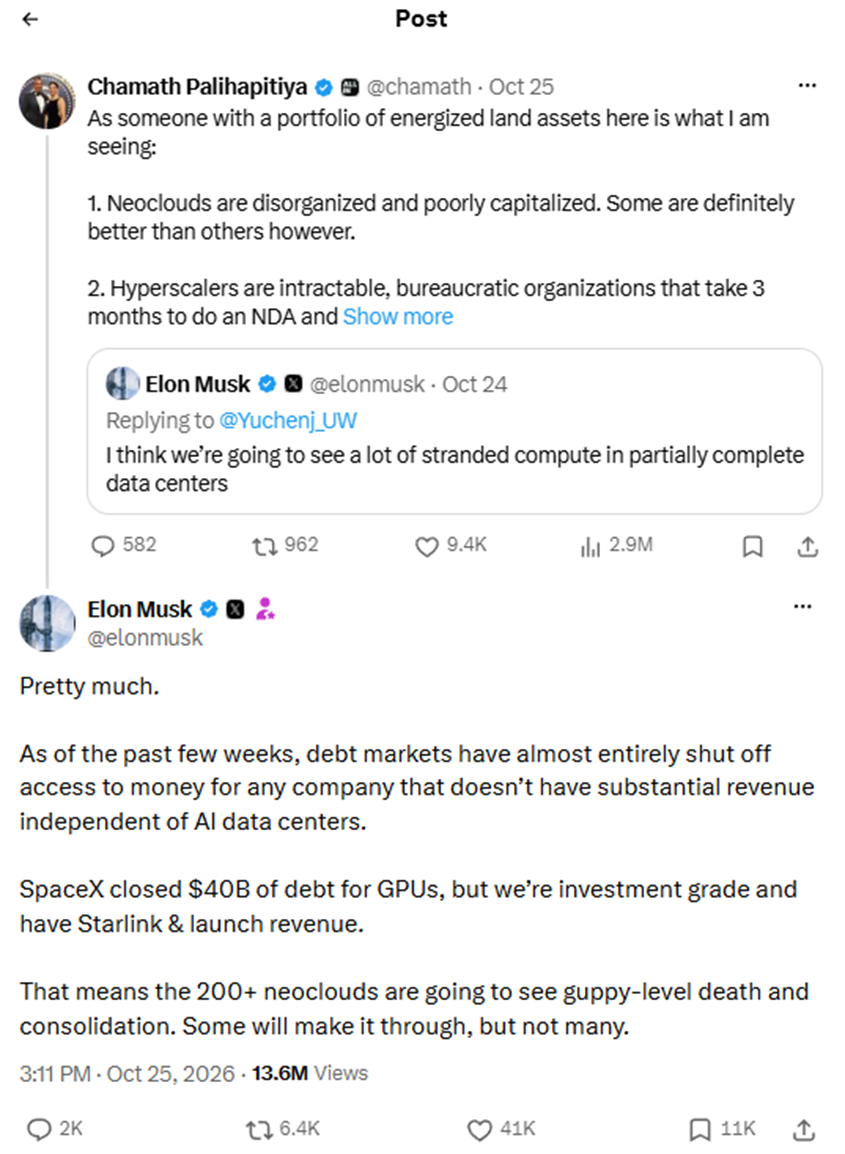
In the same breath, he revealed that SpaceX had secured $40 billion in debt financing to buy Nvidia GPUs for its own AI ambitions.
The contrast is the point.
SpaceX can borrow on investment-grade terms because it has large, cash-generating businesses behind.
Pure play neoclouds, however, have no such backstop. So, they’ve been shut out of traditional debt markets as underwriting tightens.
The Search for New Lenders
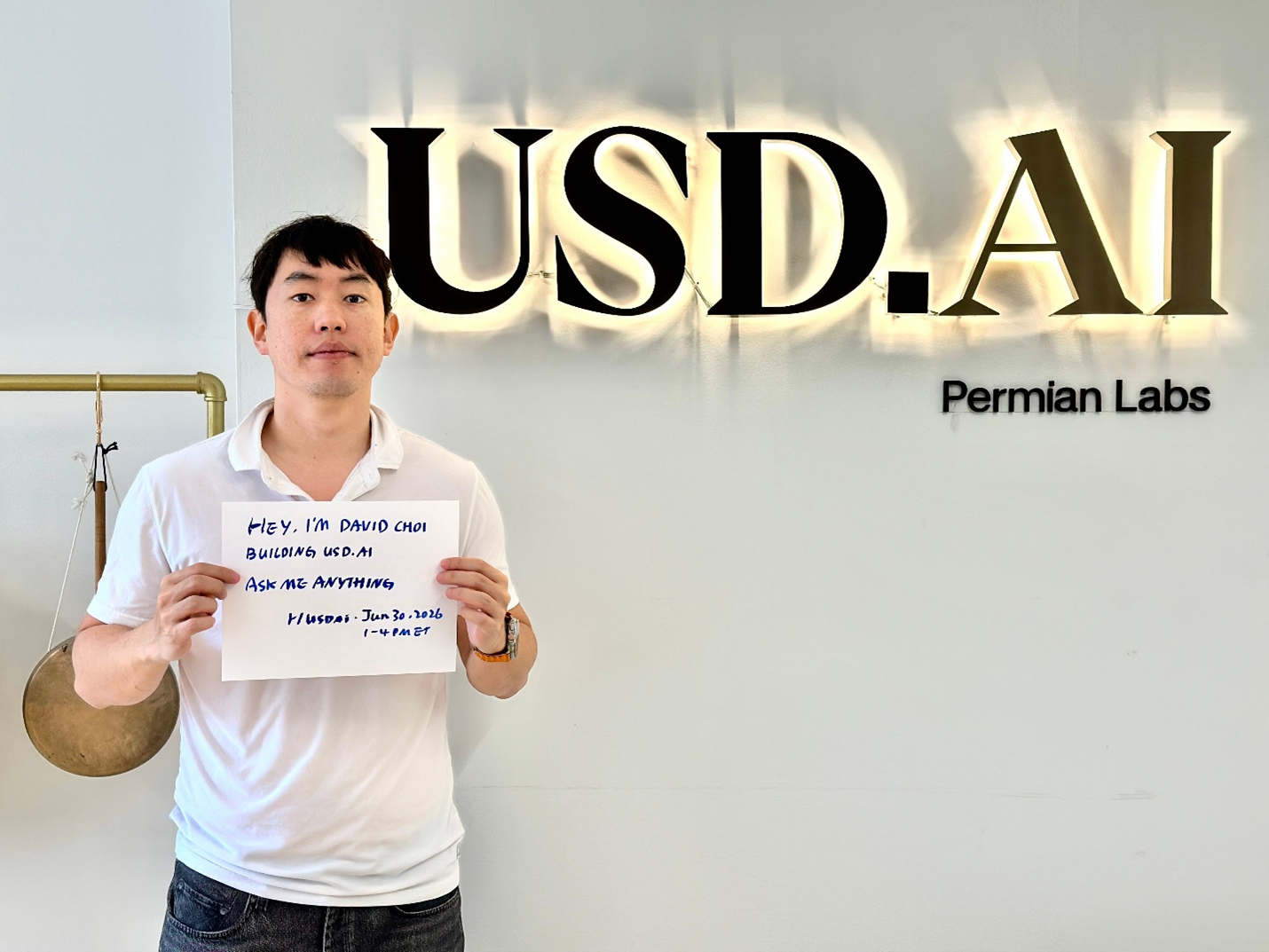
So attention is turning to alternatives. Like USD.AI, a crypto protocol that lends exclusively against physical AI hardware.
Its founder, David Choi, began his career at Deutsche Bank underwriting illiquid, hard-to-price assets such as fine art and timeshares.
The idea for USD.AI came in 2023, when he tried to buy AI GPUs.
At the time, AI infrastructure was first becoming one of the most valuable asset classes in the world without a functioning credit market.
No traditional lender would accept them as collateral.
The hardware cost as much as a luxury home, yet banks had no framework for valuing it.
That’s the question that needed answering. How do you lend programmatically against an asset that has no reference price?
So, he built one: a "GPU mortgage" for independent operators.
In a sector where most yield is recycled from token incentives and leverage, a protocol lending against real, revenue-producing hardware stands out.
USD.AI is one of the few protocols addressing a real-world financing gap with productive, high-demand collateral.
It uses a legal structure that uses on-chain tokens to represent the title to the machines. It originates, underwrites and structures GPU-secured loans directly to operators.
Its stated mission is "financing the next 10,000 neoclouds."
How the Yield Works
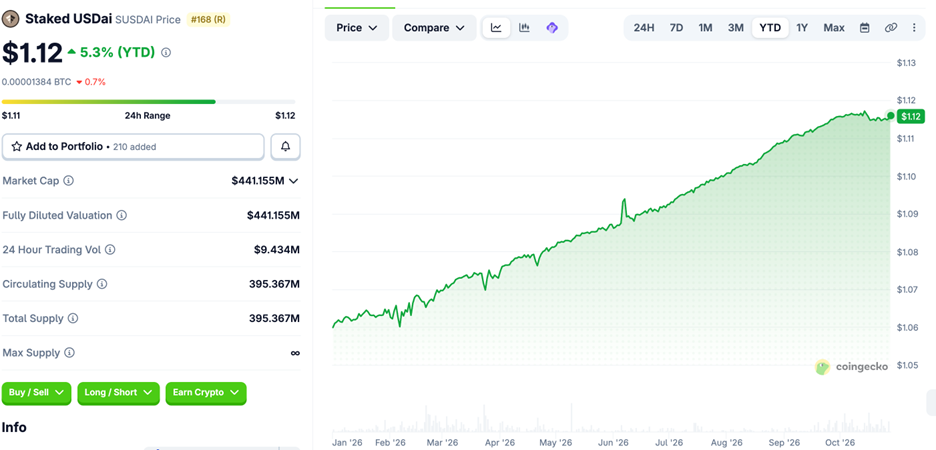
Depositors earn through sUSDai, the protocol's yield-bearing token. That yield is currently floored at 7% by the CHIP Hurdle Rate. When loan income falls short, a Yield Reserve makes up the difference.
The design has two layers:
- The loan risk is ring-fenced inside the sUSDai staking layer.
- Meanwhile, the base stablecoin is kept insulated from it.
That yield is funded by borrowers paying an average rate of 11.5% on their loans. That leaves a margin to cover operating costs and risk buffers.

The protocol reports $578.1 million in total value locked and most of it spread across 16 loans and 2 escrowed allocations.
Since April, it generated $29.35 million in cumulative yield — a credible proof of concept for institutional allocators.
The Question That Matters: Borrowers or Collateral?
A 7% stablecoin yield backed by GPU loans looks like a clean bet on the AI boom.
But the real test will happen if the borrowers fail all at once.
For sUSDai holders, the core credit question is simple to state and hard to answer …
Does the model depend on its borrowers surviving? Or can it survive on the liquidation value of its hardware alone?
The answer will tell us whether this is just the right product for right now … or if USD.AI has the power to create a lasting niche for itself.
The loan book so far is clean, which suggests the underwriting has filtered out weak borrowers during the early buildout.
But the protocol has never had to execute a multimillion-dollar physical liquidation during a market-wide data center crunch.
Until it does, the speed and reliability of that process remain theoretical.
And with a neocloud shakeout widely predicted, that test is no longer a remote possibility.
The Correlation Trap
Defaults in a downturn rarely arrive one at a time.
If tightening credit triggers simultaneous failures across independent data centers, the ITAD market that is supposed to absorb repossessed chips would be flooded with supply.
That, in turn, would push resale prices down precisely when the protocol most needs to sell.
There are mechanics in place to cap the pain. But none completely eliminates the risk.
Insurance offers less comfort than it may appear to in that scenario.
Private credit policies often come with long claims-processing windows and complex carve-outs. In a correlated shock, those frictions could choke the protocol’s liquidity.
CHIP token stakers provide a first-loss buffer as well. But in a downturn, that token would likely be falling just when it’s needed.
And a recent governance proposal would let the protocol sell loans before maturity through GLX, adding another exit.
However, buyers for those loans would likely be scarce in the same conditions.
If all of these backstops strain at once, sUSDai holders could face withdrawal queues at the exact moment they want their capital back.
There is also the question of price.
An 11.5% average borrowing rate produces a healthy net interest margin on paper. But institutional credit frameworks suggest that rate may not compensate for the true probability of default in the case of non-investment-grade, venture-backed borrowers concentrated in a single sector.
Exactly the area AI GPU finds itself in.
Bottom Line
USD.AI sits where two powerful demands meet:
- AI operators' hunger for infrastructure financing
- And DeFi's appetite for yield backed by something real.
That positions it for rapid growth.
Growth and resilience, however, are different tests.
After all, a clean loan book during a boom says little about performance in a bust.
If data center credit stress continues to widen, an 11.5% borrower rate may prove too thin a cushion to protect sUSDai holders when neocloud defaults come in clusters rather than one by one.
Still, USD.AI is tackling a problem few others have tried to solve.
I’ve kept USD.AI’s yield-bearing token, sUSDai, on my watchlist for a long time, waiting to see the project mature and prove itself.
I’m not there yet.
But it remains one of the more interesting projects in the space.
For anyone weighing it, I’d suggest the same approach: keep it on your radar and watch how it handles its first real stress test.
Best,
Marija Matić