 |
| By Marija Matic |
In September, the SEC opened a legal path for trading tokenized stocks on-chain.
Its new "Innovation Exemption" lets qualifying Tokenized Securities Venues (TSVs) use automated market makers and liquidity pools to trade tokenized U.S. stocks without registering as national securities exchanges.
In plain English, this is a temporary, five-year order that lets approved venues trade tokenized versions of stocks.
That’s real progress.
But it leaves out the part of crypto that matters most: decentralized finance (DeFi) itself.
And in an Oct. 16 comment letter to the SEC, the DeFi Education Fund made exactly that case.
An Exemption Built for the Middlemen
The Innovation Exemption assumes someone is in charge.
A TSV selects the pools. It sets the rules. And it can halt trading.
Its conditions — such as permissioned access, trading halts, volume limits and consent to examination — make sense for that kind of operator.
In short, it’s an exemption made for middlemen.
Former SEC Commissioner Hester Peirce has said as much in a statement on the exemption in September. Securities rules, she noted, exist to protect people from relying on a middleman who might fail them.
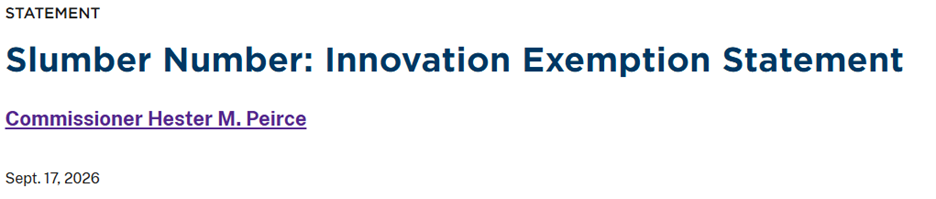
But truly decentralized systems — like DeFi — have no such middleman. So, in her view, they don’t need the exemption at all.
She's right.
Securities law defines an exchange as an organization or group of persons that constitutes, maintains, or provides a marketplace.
A true DEX doesn't fit that definition.
Once its smart contract is deployed, no person or group under common control can unilaterally change it. It's open to anyone.
And it doesn't bring together the orders of buyers and sellers. In an AMM-based DEX, each user trades against a liquidity pool, not against an identified counterparty.
Even the SEC's own order cites research noting that AMMs eliminate the matching of two parties.
Transparency points the same way.
The SEC conditioned the TSV exemption on smart contracts that are public and auditable, because open code lets anyone verify how a system works.
A DEX offers exactly that: Its code and full transaction history are visible to anyone, with no trusted party in between.
But "you don't need an exemption" is not the same as legal certainty.
Which leaves the developers who build decentralized exchanges and the interfaces that connect to them with two open questions.
- Could DeFi platforms be treated as an unregistered exchange?
- Could they be treated as an unregistered broker?
The Innovation Exemption answers neither for them.
And forcing developers to register as exchanges … would make them gatekeepers of systems they don't control.
That would create the very intermediary risk regulation is meant to prevent.
Why This Matters Beyond Tokenized Stocks
The Innovation Exemption covers only tokenized versions of U.S.-listed stocks. But the questions it leaves open are much broader.
Exchange and broker registration rules apply whenever securities are traded. That includes tokenized stocks. And it also includes any crypto tokens that qualify as securities.
As more securities move on-chain, they'll increasingly trade on the same DEXs and through the same interfaces as everything else.
Now, that doesn’t directly impact crypto assets that aren't securities, like Bitcoin (BTC) or Ethereum (ETH).
The problem is that a single DEX or wallet interface can handle both kinds of assets.
Without clear rules, every developer whose software might touch a security has to wonder whether they're running an unregistered exchange or broker.
That’s why the DeFi Education fund has called for a regulatory safe harbor for DEXs.
Two Safe Harbors, One Principle
Before the Innovation Exemption was announced, the DeFi Education Fund and a16z had already put forward two proposals built on the same idea …
If a system doesn't carry the risks a regulatory regime was designed to address, it shouldn't be forced into that regime.
The exchange safe harbor proposal (September 2026) covers DEXs and DEX apps. To qualify, a protocol must …
- Be non-custodial. That is, the platform never owns the assets,
- Execute trades automatically rather than through human discretion,
- Be open to anyone without approval from a central authority,
- And show "credible neutrality," meaning no party enjoys discretionary privileges or outsized control.
Front-end apps would also need to source market data from objective, publicly available sources rather than proprietary feeds.
The broker safe harbor (August 2025) covers DeFi applications.
It applies to apps that are non-custodial, exercise no discretion over user transactions, and don't actively solicit users or make investment recommendations.
Both rely on a rebuttable presumption. A qualifying DEX or app is presumed not to be an exchange or broker unless the SEC shows otherwise.
This wouldn't be a blanket pass.
Builders would get clear rules up front. The regulator would keep the power to act when a project only looks decentralized.
Answering the Critics
Not everyone agrees DeFi should get special treatment.
Some traditional market participants — including Citadel Securities — have argued that trading in tokenized securities should stay within the existing framework of registered brokers and exchanges.
Two objections come up most often …
The first is that many projects are only decentralized on paper. This is true. Which is why the safe harbor is designed for exactly that problem.
A protocol that a person or group can change unilaterally or whose operators can manipulate transaction ordering, set fees at their discretion, or favor affiliated apps, wouldn’t qualify.
As DEF, a16z and others pointed out in their reply to Citadel, protocols with that kind of control are excluded from the safe harbor in the first place. Because defining a narrow category of qualifying DEXs signals that everything outside it stays within the SEC’s enforcement perimeter.
Clear criteria make it easier, not harder, to separate real decentralization from marketing.
The second is the fear that a safe harbor would open the door to money laundering and sanctions evasion. This conflates two different legal concerns with two different regulatory bodies.
Anti-money-laundering rules and sanctions are governed by the Bank Secrecy Act and Office of Foreign Access Control (OFAC).
Not by the Exchange Act’s registration requirements.
OFAC sanctions apply to U.S. persons — regardless of whether they’re registered as a broker or an exchange. A safe harbor from exchange or broker registration doesn’t change that.
Interfaces can and do screen transactions with know-your-transaction (KYT) tools. The question of whether a developer is running a stock exchange should be answered on its own terms.
Make It Permanent
In April 2026, SEC staff issued a statement on when crypto user interfaces — websites, apps and wallets that help users prepare their own transactions in crypto asset securities — can operate without registering as brokers.
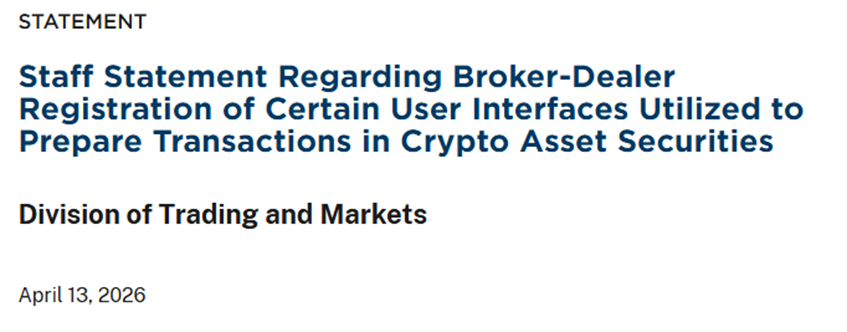
The DeFi Education Fund called it an important step. But it’s also a narrow one: Interfaces may display trading routes, but those that route orders or default users into a route remain in a gray zone.
Put simply, that leaves many aggregators — platforms that test several routes to find the best prices — exposed.
In addition, the statement reflects staff views only. It has no legal force, and it will be withdrawn in five years.
Developers making multi-year bets on building in the U.S. need something clearer and more durable.
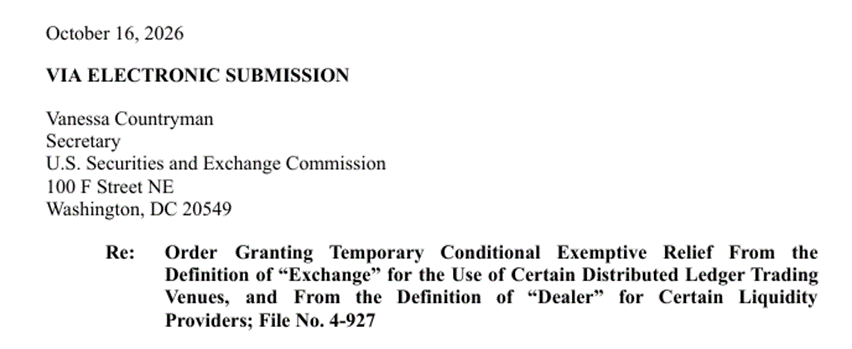
That's why the DeFi Education Fund is asking for three things in its Oct. 16 comment letter:
- Adopt the exchange safe harbor through notice-and-comment rulemaking;
- Codify the user interface staff statement into a permanent rule, building on the broker safe harbor;
- Address both in a single rulemaking, so the same software isn't held to inconsistent standards under two parts of the Exchange Act.
Finish the Job
The SEC deserves credit for recognizing that on-chain markets shouldn't be squeezed into old regulatory molds.
But the work shouldn’t end there.
The next step is to apply that same logic to the developers who build disintermediated systems. Software that no single party controls, that holds no one's money, and that makes no decisions on anyone's behalf is not a middleman.
The law needs to say so, clearly and permanently.
Best,
Marija Matić