Why Binance’s $6 Billion Hack Didn't Break the Market

|
Key Takeaways
|
 |
| By Sandeep Kaur Reviewed by: Beth Canova |
On Thursday, crypto had its worst security day ever.
Hackers broke into Binance, the world's largest centralized crypto exchange. In about 20 minutes, they drained billions of dollars.
The total sits near $6.3 billion.
Within hours, social media filled with fear. People warned that the real drop always comes later.
Then something odd happened. Bitcoin (BTC) barely moved. It slipped 2% to 3% and has held there since.
Four days later, we know a lot more. And so far, the market's calm looks justified.
My view is simple: This hack is a serious failure at one company.
But it is not a crack in crypto itself.
The real near-term risk sits in leveraged trading and in the stolen ETH still held by the hackers. Not in lost trust.
Which means the long-term story being built by institutions did not change on Thursday.
Here is the evidence.
What Actually Happened
Binance says its early investigation points to one weak spot: A DevOps engineer's laptop was compromised.
That allowed TraderTraitor — now confirmed by the FBI to be behind the attack — to access an internal system that processes withdrawals. From there, they pushed through unauthorized transactions.

(In case you’re keeping score, TraderTraitor was the same North Korean group tied to last year’s Bybit attack.)
Binance says it found no evidence that wallet private keys were stolen.
That matters. It means the vault wasn’t cracked. Someone just got hold of the key to the mailroom.
TraderTraitor then raced to move the money.
It swapped stablecoins into ETH, which no company can freeze.
The FBI expects them to keep laundering it through DeFi apps and instant swap services.
The Response Was Fast
Tether froze about $1.57 billion in its stablecoin, USDT. Circle (CRCL) froze more than $800 million in USDC.
In total, roughly $3 billion is now locked up.
Binance then refilled the missing assets with its own funds. It says the top ten coins on its platform — including BTC, ETH, USDT and Solana (SOL) — are now backed 100%.
It says about 95% of the loss is covered. The last 5% is harder-to-find tokens.
Binance also temporarily paused withdrawals.
And as of Monday morning, resumed withdrawals have now hit $4.6 billion, though deposits have reached $1.01 billion. Which brings the total outflow to roughly $3.64 billion.
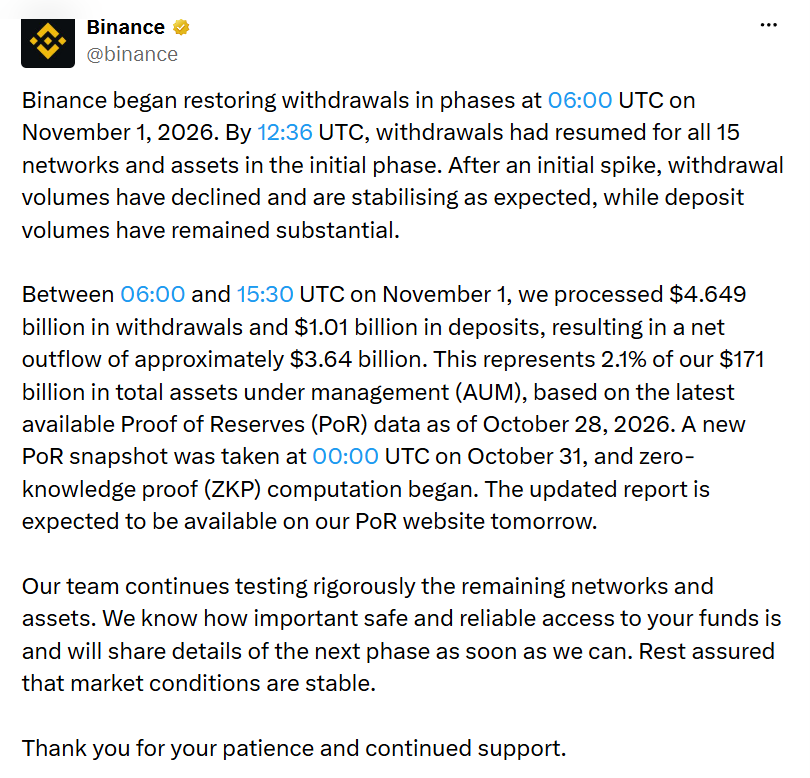
That sounds large. But it is only 2.1% of Binance's total assets.
That is not a bank run. That is people checking that the door works.
Binance also took a fresh Proof of Reserves snapshot on Oct. 31.
Users holding those ten coins can now check, on their own computer, that their balance is backed at least 1-to-1.
Another snapshot covering more coins is planned for Nov. 4.
Why the Market Didn't Panic
Compare this to the FTX crash in 2022.
FTX did not just lose money. It lost customer money it had secretly used.
That set off a chain reaction. Lenders failed, funds went bust, and prices sank for months.
This time there is no chain.
The victim is the richest player in the industry. It paid. No other firm is on the hook.
Which keeps this attack — despite its size — contained.
The Bybit Comparison
The facts on the chain haven’t calmed the talking heads, however.
Bearish traders point to Bybit. In February 2025, Bybit lost about $1.5 billion in a hack. Bitcoin fell only 3% to 5% that day. But it then fell 20% or more over the following weeks.
And that’s a fair point. But context matters.
In early 2025, the bigger driver was macro set up. Tariff fears hit stocks and crypto at the same time.
The hack added to the mood. It was not the whole cause.
Another popular claim said Binance would wait for lower prices before buying back what was stolen.
That did not happen. Binance bought quickly and covered 95% within days.
The real supply risk is different. The hackers still hold a large amount of stolen ETH. If they sell it in size, that could pressure ETH prices.
The Real Risk: Leverage
Over the course of Oct. 30, $1.65 billion in leveraged positions were liquidated according to CoinGlass. About 87% were longs.
Bitcoin longs alone lost about $580 million. More than 250,000 traders were wiped out.
Even after that flush, about 72% of accounts on Bitcoin futures are still long.
In plain terms, many traders are still betting on higher prices with borrowed money.
That said, it also carries a note of risk: If prices slip again, more leveraged traders will get forced out.
That can push price lower in a hurry.
That is the short-term danger. It comes from crowded bets, not from the hack itself.
Loud Feeds, Quiet Money
Some cycle traders say hacks like this kill trust. They argue new buyers will stay away.
That concern is fair. Every big hack makes it harder to win over newcomers.
But many of these same voices have been bearish for a year.
They waited for BTC to fall back to $48,000 or $52,000. So, when Bitcoin ran from $62,000 to $87,000 in August, many were not in the trade.
It’s a good reminder for us that a narrative can serve the person telling it.
And it’s a good reminder that it’s important to look past the headlines and make your calls based on the real data.
Because when I spent three days at crypto conferences in New York last week, the tone was nothing like my social media feed.
The banks, funds and builders who attended were not focused on the FUD.
They talked about payments, tokenized assets, custody and settlement. They were building products.
Nobody was planning their future moves around one exchange's bad week.
This tells me loud and clear that crypto is no longer just retail speculation driven by influencer posts. Institutions are building real infrastructure on it.
That shift did not stop on Thursday.
Conclusion
This was the biggest hack in crypto history. In all financial history, in fact. And it exposed a real weakness.
One compromised laptop opened a door to billions.
But it is a company failure, not a system failure. The losses look covered. About half the funds were frozen. Binance is covering the rest itself. Withdrawals reopened without a run.
And no other firm is falling.
That’s not to say there was no impact. But the real near-term risk is leverage. Traders are still crowded on the long side.
There’s also the remaining stolen ETH.
So, here’s what I suggest you keep an eye on …
- If you hold coins on Binance, verify them yourself. Use the free tool on Binance's Proof of Reserves page. Don't rely on anyone's word, including Binance's.
- Watch funding rates and the long/short ratio. If funding turns negative, shorts have become the crowded side. That often signals a flush is close to done.
- Watch TraderTraitor’s wallets. Large sales of the stolen sales could hit ETH prices.
- Watch the Nov. 4 reserves snapshot and the next phases of withdrawals.
- Treat social media as noise to check, not signals to follow. Do your own research before acting on any viral post.
The volatile shakeout from the hack not be over. So some caution is a good rule of thumb.
But the foundation institutions are building has not moved. Which means your plans to build your portfolio for the bull market should still be in play.
To your wealth,
Sandeep Kaur