Why I Expect Bitcoin to Fall Before the Next Bull Run

 |
| By Juan Villaverde |
I went live with my Weiss Crypto Portfolio subscribers earlier this week.
Together, we looked at where Bitcoin (BTC, “A-”) stands right now — and where I expect it to go next.
My framework centers on a simple idea: Japanese M2 money supply tends to lead Bitcoin's price by roughly 84 days.
Bitcoin recently ran ahead of that pattern for a few weeks, but I expect it to snap back into alignment.
What does that mean, in plain terms? I expect Bitcoin to correct into mid-to-late October, with a chance the low doesn't arrive until early November.
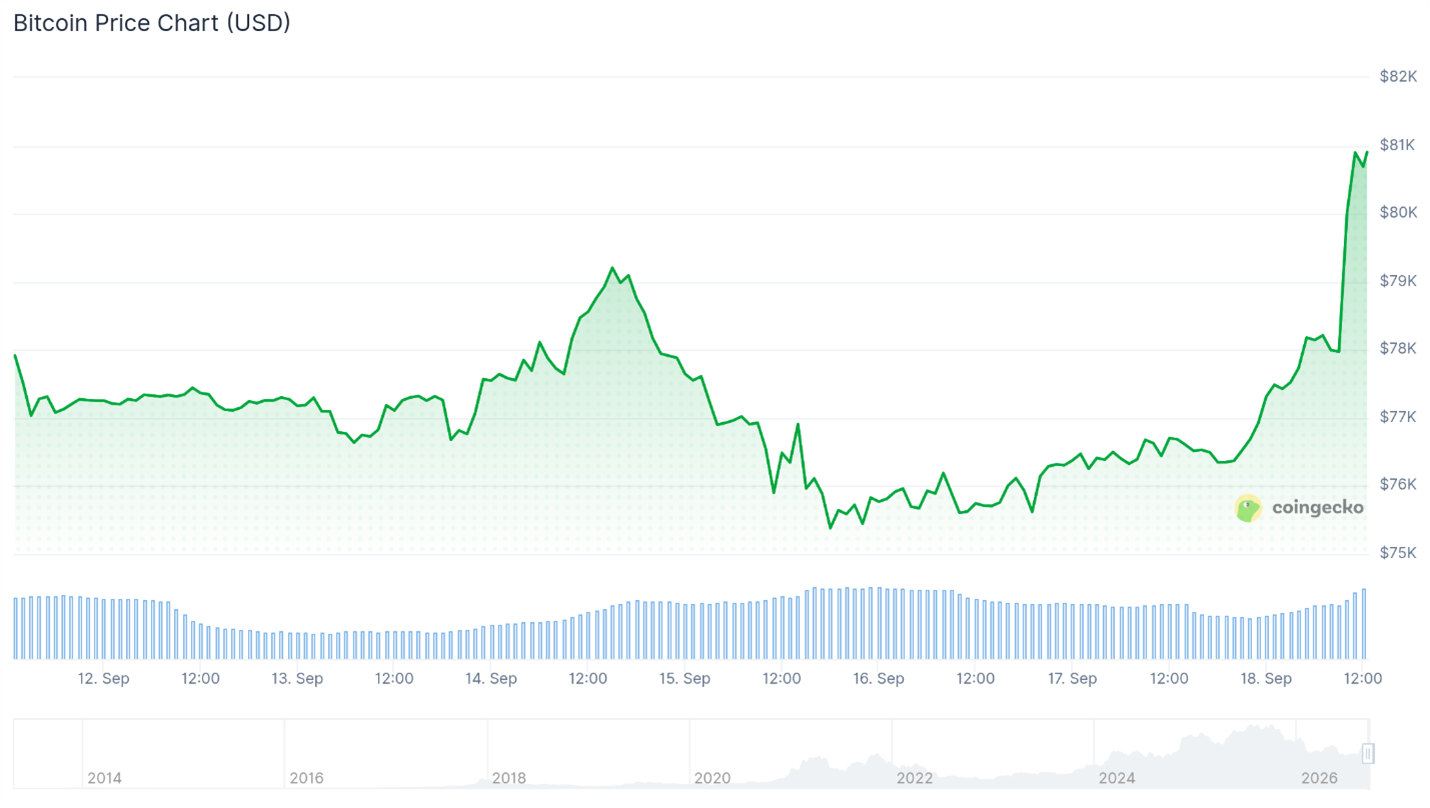
On price, I'm watching for roughly a 15% pullback from the recent high — which would put support in the neighborhood of $70,000. I do not expect a return to $60,000.
Bitcoin also recently tested, but didn't clear, its last major cycle high.
My take: The bear-market bottom is behind us. But despite this week’s spike above $80,000 for Bitcoin, we're not yet in the confirmed bullish phase of this cycle.
On the Fed and the Clarity Act
The Fed hiked rates this week, tracking the 2-year Treasury yield as it historically does.
Our live Q-and-A webinar for members had concluded just beforehand. At the time, I didn't think a hike would shift crypto's broader trend, since markets had already priced it in.
That's exactly what happened. No sell-off, no disruption to the rally already underway.
On the Clarity Act's failure this week, I said I never expected it to pass in 2026. I’d also predicted that a failure wouldn’t change much for crypto's trajectory either way.
After all, Wall Street was already building crypto infrastructure under the existing stablecoin framework, regardless of what happened with market-structure legislation.
What the SEC and CFTC Actually Did
This is the real story of the week.
Two days after Clarity failed, the SEC issued what it's calling an "Innovation Exemption."
It’s a five-year order that lets approved trading venues trade tokenized versions of regular stocks (think Apple, Microsoft, anything on a major exchange) through on-chain liquidity pools instead of a traditional order book.
And just a couple hours later, the CFTC issued its own relief.
It aims to let crypto wallets and trading apps connect users to regulated derivatives, without registering as brokers themselves.
Neither of these needed a single vote in Congress. Both agencies used authority they already had.
In other words, Congress failed to deliver a permanent law. A day later, two agencies delivered temporary rules. Temporary because a future commission could unwind either one. Still, temporary is still forward movement.
Just like the crypto markets can function without Clarity, institutional money moves when the path opens.
And the path opened this week. Just not the way some hoped it would.
Quick Update Since We Went Live
Bitcoin has spiked since our live chat.
It's now trading in the $78,000–$81,000 range, up from the mid-$70,000s earlier in the week, following the Fed's rate decision and this week's regulatory news out of Washington.
This doesn't change my framework.
I flagged on the call that Bitcoin was testing, but hadn't cleared, its last major cycle high around $82,000–$83,000 — and breaking above that level would be a genuinely bullish signal, not just noise.
We're closer to that level now than we were a few days ago.
Credit Where It's Due
I don't spend much time on headlines. My work is liquidity, cycles, models — not politics. But my colleagues Marija Matic and Mark Gough also called this week correctly.
Before Tuesday's Clarity Act vote even failed, Mark told his Next Crypto Superstars members that the SEC and CFTC already had contingency rules drafted and ready to deploy the moment Congress dropped the ball.
Two days later, both agencies did exactly that.
Marija made a similar call in her own breakdown — she said Wall Street didn't need Congress's permission to keep building, and named Coinbase and Chainlink as the names that would prove it.
They did.
That's not luck. That's understanding how these institutions actually operate, which is a different skill than reading a chart, and it's one my team is good at.
Here's how it connects to what I actually track …
Regulatory clarity — even the improvised, agency-issued kind we got this week — tends to pull institutional capital off the sidelines faster than it otherwise would.
That's a liquidity tailwind sitting on top of whatever Japanese M2 is already doing. It doesn't change my framework. It supports it.
What I'm Watching Next
Should you try to time the bottom? This came up repeatedly from subscribers.
My answer: Be careful trying to trade around a forecast, even my own.
My models can be wrong, and the potential savings from selling now usually isn't worth the risk of missing a move if the forecast doesn't play out exactly as expected.
That said, I’m looking beyond Bitcoin for opportunities.
- Ethereum (ETH, B+) and Solana (SOL, “B”): Both are holding up better than Bitcoin on a technical basis right now. I expect both to outperform Bitcoin on the way up in the next phase of the cycle.
- Newer tokenomics models: I've flagged a handful of projects experimenting with buyback-funded tokenomics — where real application revenue flows back into the token — as a trend worth watching across the altcoin space broadly.
- Long-term, higher-risk bets: I hold a small, long-term position in a newer privacy-focused project tied to a well-known crypto builder's track record — the kind of bet I think of as a call option with no expiration.
- Real-world usage coins: I continue to favor a couple of established altcoins with genuine, everyday use cases — particularly for cross-border stablecoin payments — given their comparatively shallow drawdowns during past bear markets.
In the meantime, here’s how we are going into the weekend …
A vote failed. Two agencies moved anyway.
The Fed hiked and nobody blinked.
Bitcoin is sitting right below the level that would confirm we're actually in the next bull phase. Not just past the bottom of the last one.
None of that changes what I'm watching: liquidity, cycles, and whether Bitcoin can clear $82,000–$83,000 with conviction.
But it's the best backdrop I've seen all year for that breakout to actually happen once liquidity lines back up.
Regulatory headwinds or tailwinds —and this week brought both — don't replace my framework. They just make the case for what comes after October's low a little stronger.
I'll keep you posted.
Best,
Juan