 |
| By Bob Czeschin |
Every app on your phone tracks your data — what you look at, for how long, and what you buy is all tracked, traced and traded.
Analysts have found dating apps were the most aggressive aggregators of your personal data. Closely followed by shopping apps.
With this much personal information swirling around, your privacy has come under assault.
And not just from the small-fry apps on your phone.
Equifax is one of the three credit rating pillars in the United States. Everyone’s information is on it.
And in September 2017, 147.9 million Americans had their names, Social Security numbers, birth dates, addresses and more stolen from the site by hackers.
That’s everything someone would need to steal an identity or use one in a phishing scam. Which is exactly what happened when those hackers happily sold all that data on the black market.
The worst part?
This is a crime that can continue for years.
Because the data is already out there.
And while you can lock and freeze your credit, there’s no clawing your information back from the darkest corners of the internet.
The numbers back this up. A survey by the Identity Theft Resource Center, found that an astounding 71% of those impacted by identity theft reported being re-victimized by cyber criminals.
And soon, we’ll all be a little more vulnerable to these attacks.
Your Car Is Watching You
This year will be one where even more of your information — things you never consented to going online — could be at risk.
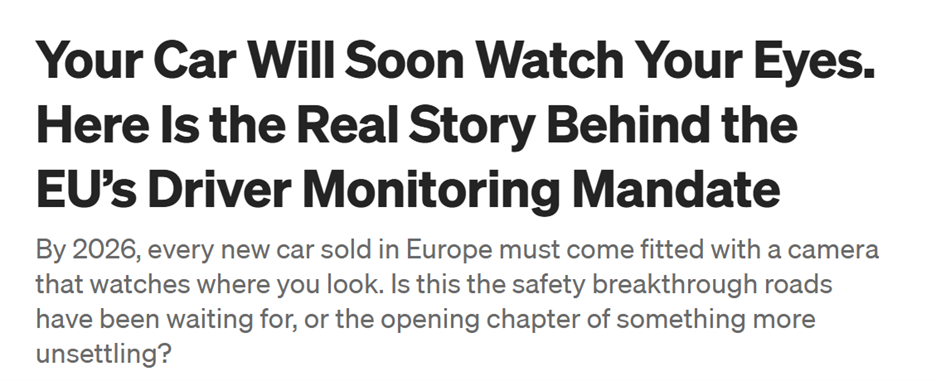
Starting in July, every new car sold across the UK and Europe must have a close-up camera, focused on the driver’s face and monitored by AI.
The goal is to prevent tired or inebriated drivers from hitting the road.
The unintended but almost inevitable impact?
Even more of your personal conversations, recordings of your voice and images of your face will end up sitting in a storage cloud …
A single point of failure waiting to be exploited.
With AI tools now able to compile convincing deepfakes in record time, the concern of that data ending up who-knows-where is justified.
This isn’t just happening across the pond, either.
Similar legislation has been signed into law here in the U.S. Though we get another year before surveillance is just the latest feature in your new car checklist.
In this environment, it’s no wonder privacy technology has come roaring back to life!
It was one of the hot button issues discussed on Consensus Miami 2026 last week, dominating panels alongside tokenization and AI.
I believe it’s a narrative that’ll only continue to dominate the headlines and on-chain demand.
And Zcash (ZEC, “B-”) is the No. 1 privacy coin riding this wave.
Bitcoin Plus Cutting-Edge Privacy
Launched as a fork of Bitcoin’s (BTC, “A-”) codebase, Zcash inherited …
- Bitcoin’s Proof-of-work (PoW) consensus.
- The same 21 million hard cap on the maximum number of coins that can ever be created.
- And the same scheduled halving of block rewards — roughly every four years.
But developers also spliced in new code for privacy and security.
The driving motivation was simple: Bitcoin was engineered to be transparent. Which means the payer, payee and amount of every transaction ever made is available to anyone with the right software and an internet connection.
This radical transparency gave powerful support to Bitcoin’s claim to be honest money.
But it also opened the door to snoops and financial busybodies of every stripe.
That’s a problem for anyone who doesn’t want every single financial move tracked. And it’s a big sticking point for institutional asset managers who want to keep their strategy under wraps in real time.
That’s why Zcash founders thought users should have the option to keep transaction information private.
Just as one might by making a purchase with physical cash instead of a credit card.
Two Types of Addresses
That’s why Zcash maintains two distinct address types for each wallet.
The first is your typical transparent addresses, also called T-addresses. These work like Bitcoin addresses, with all details on public on the ledger.
The second is called shielded addresses, or Z-addresses. These encrypt the sender, receiver and amount.
What gets posted to the blockchain is only a cryptographic proof that the transaction occurred. This verifies the transaction’s legitimacy without exposing its contents.
Users can transact freely between transparent and shielded addresses, giving the flexibility to choose privacy when needed.
Investment Implications
Zcash likely still has plenty upside ahead.
It’s a leading asset in a popular narrative that will likely remain relevant throughout the coming cycle.
And it has held up remarkably well during the crypto winter.
While BTC now sits -35% off its cycle high of $125,000 …
ZEC is only about 20% away from its November 2025 high near $698.
More important than past performance though is how ZCash is positioning itself for the future.
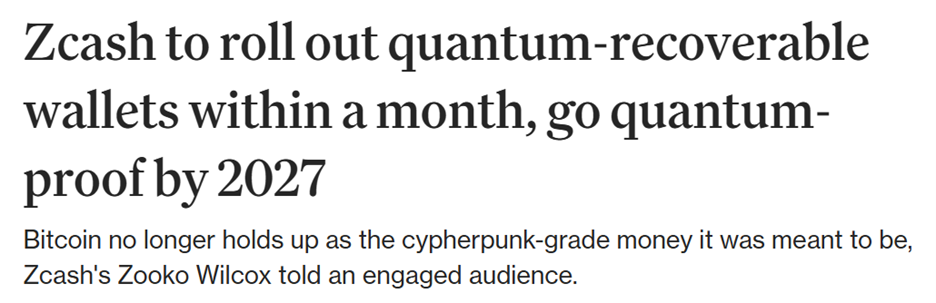
Recently, it announced development of a digital wallet un-crackable by quantum computing. Which I believe is an industry first.
That’s not all.
The protocol’s narrative that it is a regulation-compliant privacy network is paying off: The recent rising tide of institutional interest in ZEC has rumors of a potential ETF circulating.
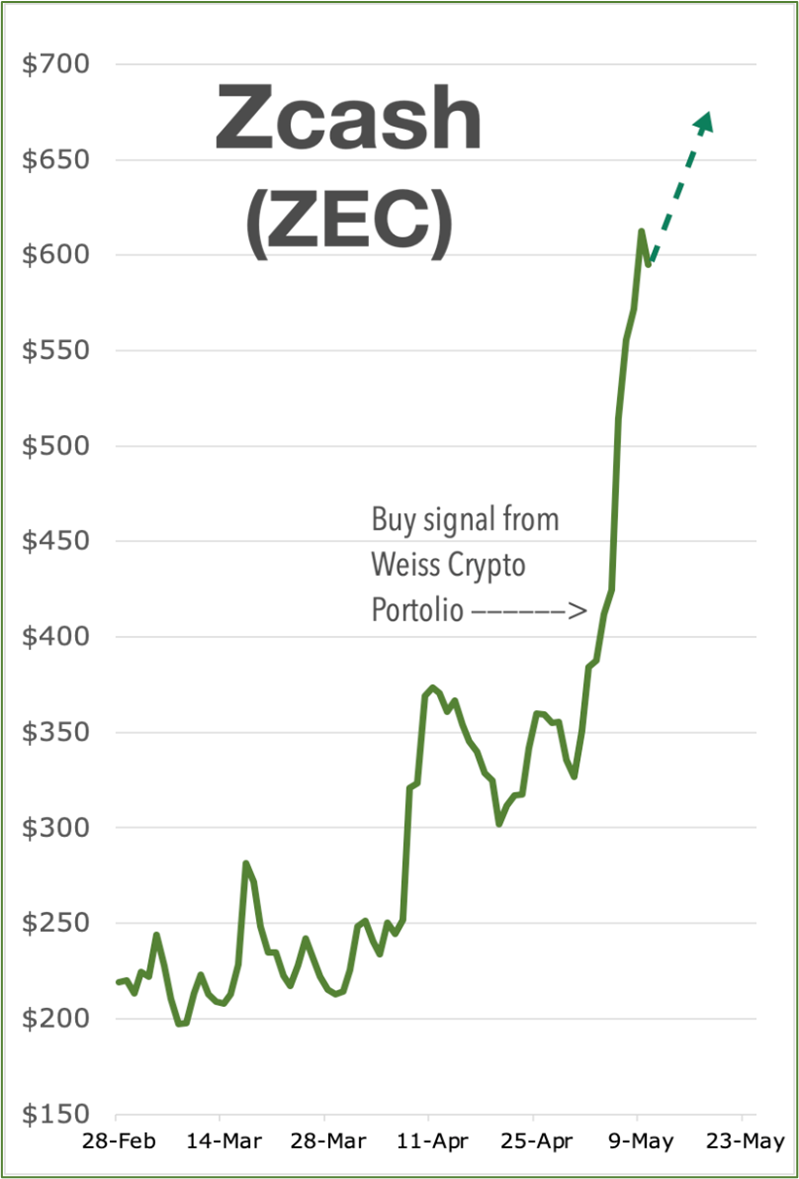
All this, plus a nudge from his Crypto Timing Model, is why Juan Villaverde told his Weiss Crypto Portfolio members to buy ZEC last week, along with a handful of other altcoins.
Even in just that short amount of time, that position is up roughly 30% at the time of writing!
That’s the power of Juan’s trading model.
If you missed this trading opportunity, don’t worry. Because with a small adjustment on Juan’s end, his model works just as powerfully for long-term investments.
In fact, Juan’s Weiss Crypto Investor Members were able to pocket a similar gain on ZEC in early 2022 — before the Terra/LUNA crash shook the market that year.
But the best of all is that the best buying opportunity for long-term investments for the next 320-day crypto cycle is still ahead!
To see when Juan’s model says it’s time to act and which coins it’ll be targeting, you can watch Juan’s latest briefing here.
Best,
Bob Czeschin