ZCash’s Biggest Lesson for Investors Isn’t Privacy. It’s Diligence

 |
| By Juan Villaverde |
Crypto regulation has been one of the hottest topics of 2026. Specifically, the Clarity Act, it’s failure to pass the Senate, and the regulatory bodies’ exception workarounds.
The reason is simple: Better, clearer regulation means more certainty. Which in turn means more crypto projects and more institutional investors.
In short, it’s a boon for U.S.-native crypto projects.
But some crypto natives don’t appreciate Big Brother’s eyes on their blockchain. Afterall, crypto was initially intended to be a system free from TradFi’s control.
That’s where privacy coins come in.
These are cryptos designed to bring anonymity back to the blockchain.
Unlike public blockchains like Bitcoin (BTC) or Ethereum (ETH) — which record transparent, publicly visible ledgers of addresses and amounts — privacy coins use advanced cryptography to hide the sender, recipient and transacted values.
The fact that a transaction has gone through is still verifiable. But the details are hidden.
And why this sector has seen a resurgence ever since the Genius Act passed in mid-2025.
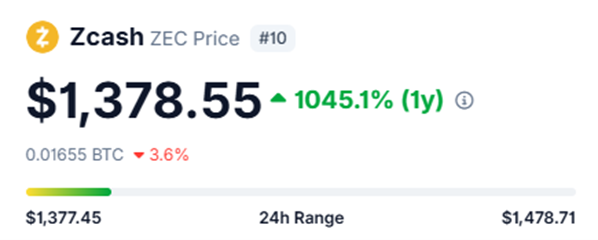
Zcash (ZEC) is the privacy coin. It’s soared over 1,000% in the past year.1
Why?
Because it makes privacy an option, not the default. Users can choose which transactions to obscure … and which should remain transparent and verifiable.
So far, that’s been the sweet spot for appealing to both institutional users and crypto purists.
But earlier this year, a single bug could have derailed the entire story.
And it’s an excellent reminder to all of us exactly why we should read the fine print when it comes to our crypto.
The Bug
The flaw sat in the math that proves those hidden transactions are legitimate.
It consists of just two lines of code that allow the shieled pool — called Orchard — to shield the details of each transaction while still verifying them.
In just those two lines hid an inflation. Simply put, the error meant that someone could in practice create counterfeit ZEC inside the pool. And because the pool is private, there would have been no public trace of it happening.
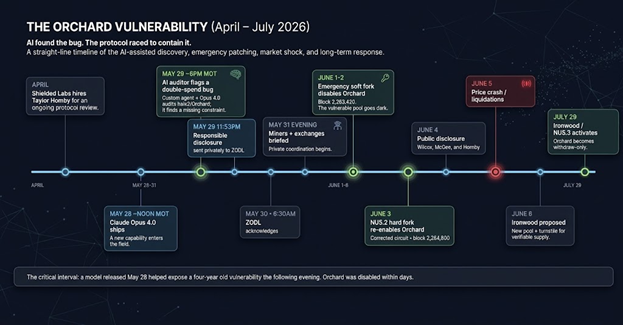
A white hat — that is, a hacker who finds vulnerabilities to help platforms, rather than hurt them — named Taylor Hornby was the one who realized what was hiding in the code.
He was hired by Shielded Labs,2 a ZCash development group, in April to hunt for exactly this. And he traced its origin back to May 31, 2022. Just over four years.
He had a working exploit the same day.
He reported it that evening. By June 1, the team shut Orchard down. Corrected code went live two days later.3
The Aftermath … And Recovery
Bitcoin's rules change when miners and node operators choose to run new code.
Zcash got an emergency update through in two days because a much smaller set of operators had to adopt it.
The cost is real. And even though the worst was avoided, the market named it.
ZEC fell about 38% in a day, from roughly $635 to $309. More than $100 million in bets got liquidated.4
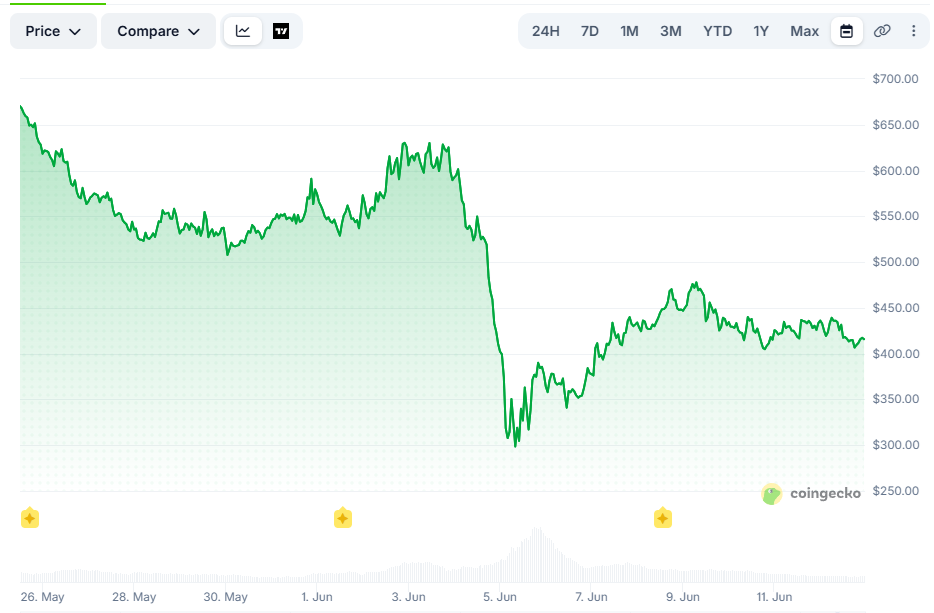
Why? Because no one could verify whether more ZEC was created in those four years.
The bug broke the guarantee that Orchard's internal notes matched what had entered. Math cannot prove no extra coins were created.
What the team could cap is what leaves. On July 28, they sealed the old pool behind a turnstile and opened a new pool called Ironwood.5
That old pool held about 3.66 million ZEC. The new pool opened empty.
The turnstile acted as a gate: it wouldn’t let more ZEC exit than legitimately went in. Which meant any counterfeit coins were effectively stranded.
Shielded Labs says exploitation is unlikely but cannot be ruled out.6 A later pass with a newer Anthropic model found no more critical bugs.
From the June 6 low — near $340 — ZEC is up about 323% into today’s price, near $1,438 at the time of writing.
The market first priced an unprovable printer. Then it priced the recovery — that ZEC can still move, the old pool is sealed and if any fake coins were made, they’re now exiled from the system.
Bottom Line
This isn’t meant to scare you away from ZEC.
In fact, my Weiss Crypto Portfolio members just banked a solid win of about 63% on their combined ZEC positions.
But those positions were all started after ZCash fixed its bug.
So, take this as a reminder to be mindful before you buy. Specifically, by checking two things …
First, a date. Find the project's security page. See when the last review happened, and whether anyone is still being paid to look.
An "audit" with no date attached is just marketing.
Second, watch what a project does after bad news. A crash is not the last word. How the team and community respond and rebuild is.
Best,
Juan Villaverde
1https://www.coingecko.com/en/coins/zcash?chart=type%3Dprice%26mode%3Dline%26timeframe%3Dd365
2https://shieldedlabs.net/the-orchard-counterfeiting-vulnerability/
3https://github.com/ZcashFoundation/zebra/security/advisories/GHSA-ww9q-8r59-xv46
4https://decrypt.co/370105/zec-crashes-38-as-zcash-discloses-critical-counterfeiting-vulnerability
6https://shieldedlabs.net/four-questions-about-the-orchard-vulnerability/