10 Times Companies Rehired the CEO & What Happened Next

|
Key Takeaways
|
 |
| By Gavin Magor Reviewed by: Jim Nelson |
This morning, Nvidia (NVDA, “B-”) reinstated Jensen Huang as CEO, 11 days after accepting his resignation.
Bringing back the boss has a long history … and a mixed record.
Here are 10 times it made headlines and how each one turned out.
10 Times They Rehired the CEO
1. Apple (AAPL, “B”): Steve Jobs, the comeback everyone remembers. Apple lost about $1 billion in the year Jobs returned.
One year later, Apple earned $309 million.
Two weeks before he resigned in 2011, it became the world's most valuable company.
2. Alphabet (GOOGL, “B-”): Larry Page takes back the wheel. Page stepped aside in 2001 on investors' terms and returned in 2011.
By 2019, revenue was more than five times the 2010 level.
3. Samsung Electronics (SSNLF, “D+”): Lee Kun-hee returns after a scandal. Lee resigned in 2008 after being indicted on charges including tax evasion.
The call to bring him back came from a committee of Samsung's company presidents.
Back in charge, he oversaw a record ₩36.8 trillion operating profit in 2013.
4. Pan Am: Juan Trippe outlasts a board revolt. Pushed aside in 1939, Trippe was back after about 10 months.
By the time he retired in 1968, Pan Am flew to 85 countries.
Along the way, he made Pan Am the launch customer for the Boeing 747.
5. OpenAI: Sam Altman's four-day exile. The board fired him in November 2023, and he was back within days.
Hundreds of employees had threatened to quit unless he returned.
OpenAI's valuation has grown nearly 10x since.
6. Twitter: Jack Dorsey, round two. Fired in 2008, Dorsey came back in 2015.
Revenue more than doubled on his watch, but Twitter still lost money in 2021.
In 2021, up to his exit, Twitter's stock was down 13%.
The S&P 500 rose 22.5% over the same stretch.
7. J.C. Penney: Mike Ullman's rescue mission. Ullman returned in April 2013 after Ron Johnson's turnaround strategy backfired.
In Johnson's one full year, sales had fallen 24.8%.
Penney filed for bankruptcy in May 2020.
8. Zynga: Mark Pincus tries again. The stock fell 18% on news of his 2015 return.
Zynga lost $117 million that year.
He stepped aside again 11 months later.
9. General Motors (GM, “B”): Billy Durant's second ride. Durant regained control of GM in 1916.
Within four years, the company was eight times larger.
Then he lost more than $90 million propping up GM's stock in 1920 and was forced out.
10. Automattic: Matt Mullenweg's three-day leave. The board put him on leave in September, and he was back in charge three days later.
Mullenweg then replaced the board that had tried to remove him.
It is too early to judge the outcome.
The Scorecard
Five comebacks worked, three failed, one was mixed and one is too new to call.
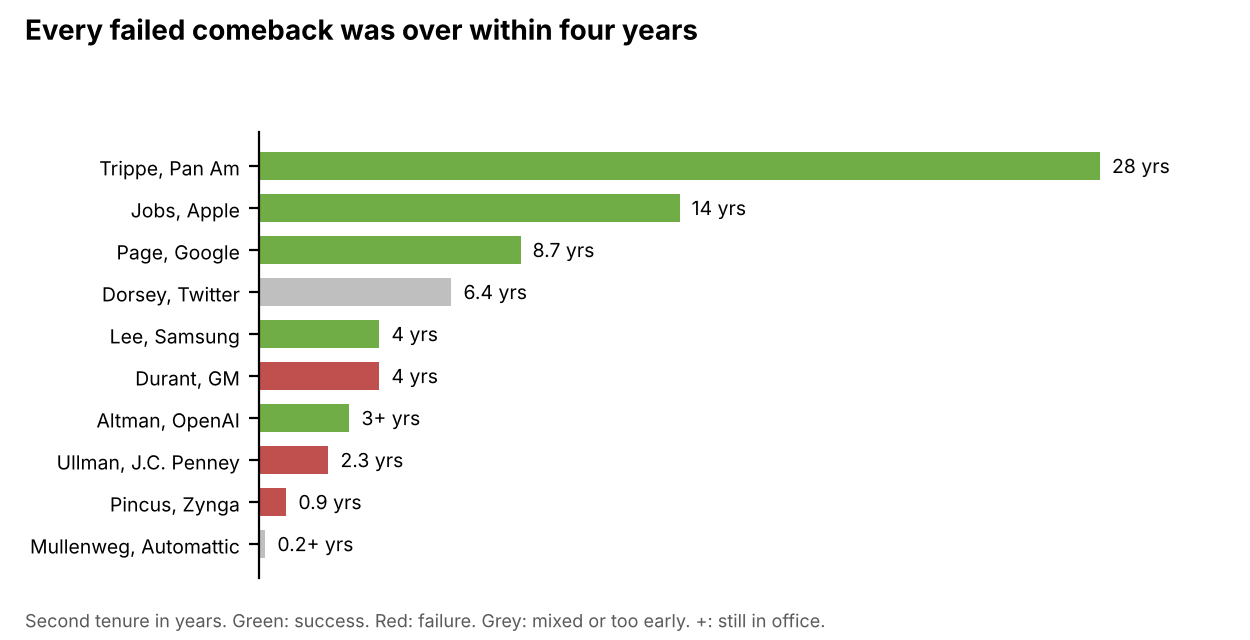
The winners stayed long enough to change the business.
Jobs, Page and Trippe each ran their companies for at least eight more years.
Every failure was over within about four years.
University of North Carolina researchers studied 167 returning CEOs at S&P 1500 companies.
Their companies' stocks trailed those run by first-time CEOs by 10.1% a year.
Founders made up 44% of those returning CEOs, and they did even worse.
Our 10 tilt toward success because they are the comebacks people remember.
Where Nvidia Fits
Huang was gone 11 days, not years.
The board said it was satisfied with his candor and his ability to lead.
That puts him with Altman and Mullenweg, whose returns undid a boardroom decision within days.
Nvidia carries a Weiss rating of “B-,” a BUY.
A leadership headline is a reason to recheck a stock, not a reason to sell it.
The Lesson of the 10
A comeback pays off when the returning CEO stays long enough to change the business.
Most comebacks make better stories than investments.
Cheers,
Gavin