2 Big Challenges for Nvidia — And What You Should Buy Instead

|
Key Takeaways
|
 |
| By Sean Brodrick Reviewed by: Jim Nelson |
I’m not here to praise Jensen Huang, but to bury him.
Okay, that's overstating things.
Nvidia (NVDA, “B”) remains one of the greatest success stories in technology. But two developments threaten the company's dominance of the artificial intelligence revolution.
And one of them could be a bonanza for investors in Nvidia's biggest rival.
First, I'm not going to spend much time on the alleged Singapore spy scandal or the alleged hanky-panky.
That's for Mr. Huang and his family to sort out on one hand, and the Justice Department to sort out on the other.
Instead, let's talk about the potential financial fallout.
As recently as last year, Singapore accounted for roughly 22% of Nvidia's reported revenue. Then Nvidia stopped disclosing how much revenue it got from Singapore.
The sales to Singapore likely continued, but Mr. Huang and/or Nvidia had reason to conceal them.
We can now expect further investigations into Nvidia’s Singapore sales by the U.S. Department of Commerce, the Department of Justice, the FBI and the Securities and Exchange Commission.
It seems likely that Nvidia’s sales to Singapore will be sharply curtailed, if not halted altogether, at least for a while.
We don't yet know how much damage Nvidia might suffer, but the uncertainty hangs over the stock like a thunderhead.
And that's only the first challenge.
The second could be even more dangerous because it strikes at the heart of Nvidia's competitive advantage.
The 3-Day Miracle That Could Shake Nvidia
On Tuesday, Nov. 10, artificial intelligence developer Anthropic launched its IPO roadshow, seeking to justify its shares being valued (under the ticker ANT) at $70 to $78 apiece.
Buried in its roughly 43-minute investor presentation was something astonishing.
Anthropic said its most advanced AI model, Claude Mythos, accomplished in three days something that previously required teams of highly trained engineers months to complete.
It got Anthropic's Claude software running on Advanced Micro Devices (AMD, “C”) AI chips. And it did so with almost no human intervention.
Specifically, Anthropic said Claude wrote or adapted nearly 100% of the specialized software instructions, called kernels, needed for the task.
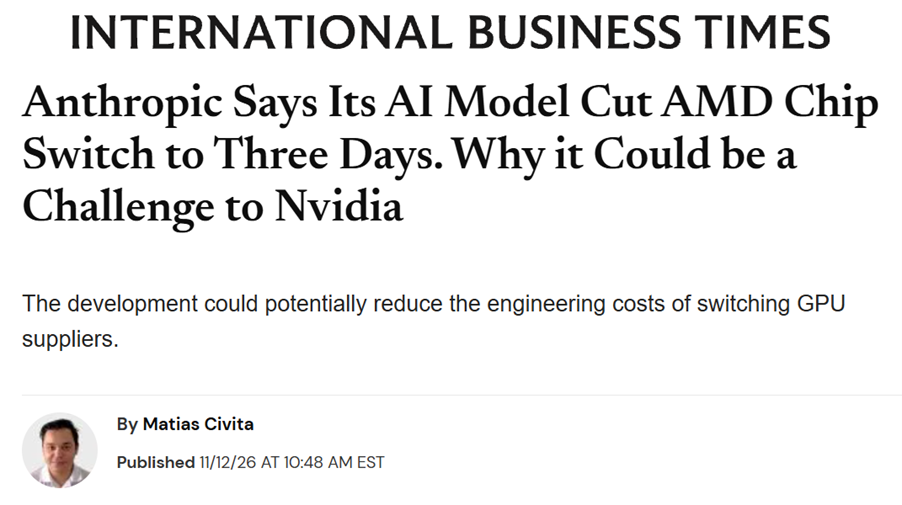
The demonstration involved prompt processing for one model on AMD’s MI355X chips, rather than migrating Anthropic’s entire computing operation.
Nevertheless, it suggests that AI itself could dramatically reduce the time and expense of switching between competing chipmakers.
Why is that such a big deal? Because Nvidia's greatest competitive advantage has never been just its chips.
It's the software that makes those chips work.
Nvidia's Secret Weapon: CUDA
Back in 2006, Nvidia introduced a software platform called CUDA, short for Compute Unified Device Architecture.
A traditional computer processor, or CPU, is like a small team of brilliant mathematicians. Each can solve complicated problems, but only a limited number at a time.
A graphics processing unit, or GPU, is more like a stadium filled with thousands of students, each performing relatively simple calculations.
Give them enough calculations to perform simultaneously, and that stadium can accomplish an enormous amount of work in very little time. That’s basically how AI computations work.
The problem was that programming GPUs for sophisticated scientific and AI applications used to be extraordinarily difficult.
CUDA changed that.
It gave programmers a relatively straightforward way to harness Nvidia's GPUs for massive computing jobs.
Nvidia also developed specialized mathematical libraries that made those chips faster and easier to use.
Over nearly two decades, researchers, universities and technology companies built their software around CUDA.
That gave Nvidia an enormous competitive advantage.
Think of CUDA as the operating system for an industrial machine.
Once you've trained your workers, written your procedures and built your factory around that system, switching to another manufacturer's equipment becomes expensive and disruptive.
That's why Nvidia could charge premium prices even when competitors offered comparable hardware.
AMD might build an excellent chip, but customers still faced months of software rewriting, testing and debugging to switch.
Until now …
AI Could Break Nvidia’s Software Monopoly
Anthropic's demonstration suggests that AI can increasingly perform the complicated programming work required to move applications from Nvidia chips to AMD chips.
Imagine a manufacturer discovering it could replace expensive machinery with less costly equipment — and that AI could rewrite the operating instructions in three days instead of six months.
Suddenly, switching suppliers becomes much more attractive.
That's potentially devastating to Nvidia's pricing power.
CUDA still offers enormous advantages in reliability, optimization and its extensive developer ecosystem.
One successful migration doesn't eliminate those advantages.
But if Anthropic's achievement can be repeated across other applications, Nvidia's customers will have substantially more bargaining power.
And the financial stakes are enormous.
The $100,000 Question
Market estimates put Nvidia’s B200 AI accelerators at around $35,000 to $42,000 apiece, compared with approximately $30,000 to $35,000 for AMD's MI355X.
Sure, sure, customers negotiate complex contracts, and fully configured systems cost considerably more. The point is that AMD can offer a meaningful discount.
For a customer purchasing thousands of accelerators, even a 10% price difference could translate into tens of millions of dollars in savings.
And hardware prices tell only part of the story.
AMD's MI355X offers 288 gigabytes of high-speed memory, compared with between 180 gigabytes and 192 gigabytes for Nvidia's B200. That's 50%–60% more memory per accelerator.
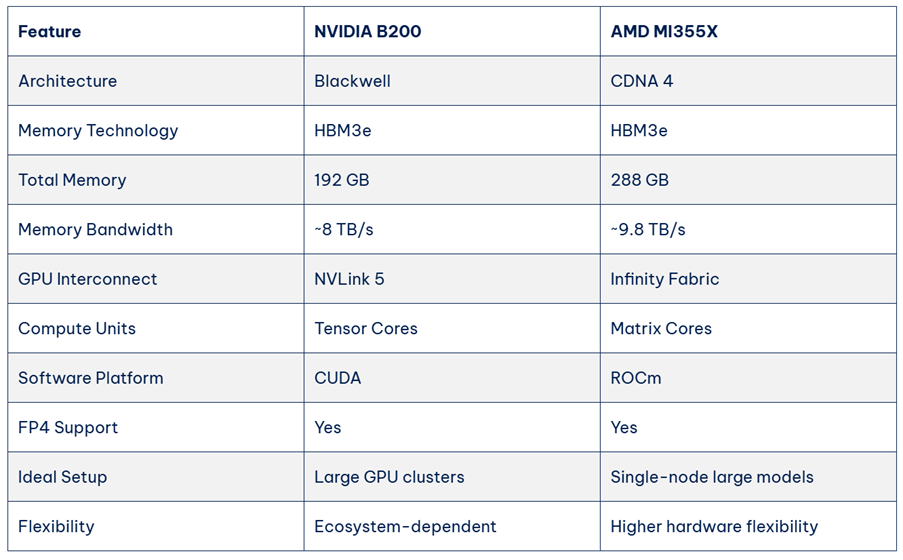
AI models require enormous amounts of memory to store and process information. More memory can let a company run certain large models on fewer chips.
In some memory-constrained applications, AMD could offer substantially lower costs per unit of useful computing capacity.
Now, more memory doesn't automatically mean faster or cheaper AI. Processing speed, power consumption, networking and software efficiency also matter.
The real breakthrough would come if customers could combine AMD's hardware advantages with much lower software-switching costs.
And THAT is what Anthropic's announcement suggests may be happening.
This means Nvidia may face a reckoning in its premium pricing.
What Should You Buy?
The obvious beneficiary is Advanced Micro Devices.
AMD was already making enormous strides in AI hardware before Anthropic's announcement.
Its latest quarterly results show just how quickly the business is expanding.
In the third quarter, AMD reported record revenue of $13.4 billion, up 45% year over year. Adjusted earnings jumped 74% to $2.09 per share.
Data-center revenue soared 97% to $8.5 billion, driven by demand for AMD's EPYC server processors and Instinct AI accelerators.
Management expects fourth-quarter revenue of approximately $17 billion — a whopping 66% increase from a year earlier.
AMD's next-generation MI450 accelerators and Helios rack-scale systems are already gaining traction with major AI customers, including Anthropic, Meta, Microsoft, OpenAI and Oracle.
Let’s look at a weekly chart …
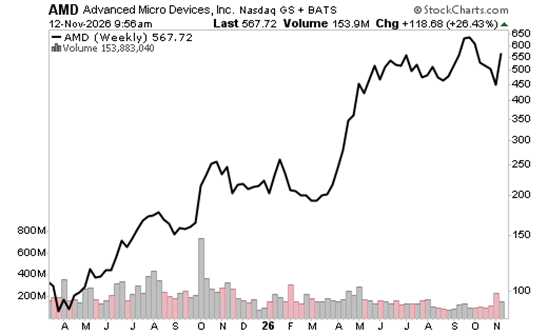
You can see that AMD was sold hard in the recent AI washout. But it’s bouncing back fast.
It’s already in an uptrend. It has the potential to go much higher.
AMD doesn't need to dethrone Nvidia to deliver spectacular growth.
It only needs to capture a larger share of the hundreds of billions of dollars being poured into AI infrastructure.
The bottom line is that Anthropic may have just demonstrated that one of Nvidia's strongest defenses is becoming easier to overcome. And AMD would be the beneficiary.
All the best,
Sean Brodrick