3 Ways to Profit as the Housing Market Freezes Up

 |
| By Sean Brodrick |
Something is breaking in the U.S. housing market.
Not in the spectacular fashion of 2008.
There’s no tidal wave of foreclosures, no banking crisis and no obvious mountain of toxic mortgages waiting to blow up.
Instead, we’re seeing something slower and potentially more persistent: Buyers are simply disappearing, even as more sellers crowd in.
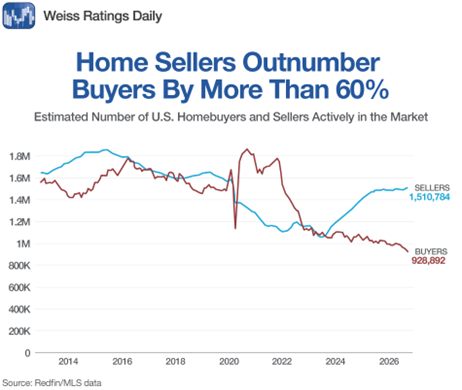
In September, there were an estimated 1.51 million home sellers in the U.S. market — but fewer than 929,000 buyers.
That means sellers outnumbered buyers by 62.6%, the widest gap since Redfin began keeping records in 2013.
Buyers fell to an all-time low for that data series, while sellers rose to their highest level since March 2020.
More Trouble on the Way
Meanwhile, pending home sales have fallen to their lowest level since 2014, excluding the brief pandemic shutdown in April 2020.
September pending sales dropped 4% in a single month — the biggest decline in more than three years.
And conditions have deteriorated since then.
The average 30-year mortgage rate has jumped from 6.66% in late August to 7.40% today.
At that rate, Redfin calculates the typical buyer's monthly housing payment at $2,777 — up 8.8% from a year ago and essentially the highest on record.
No wonder buyers are walking away.
The strain is showing up in canceled deals, too.
In September, 14.5% of home purchases that went under contract fell through.
Other than the pandemic panic of March and April 2020, that's the highest rate Redfin has ever recorded.
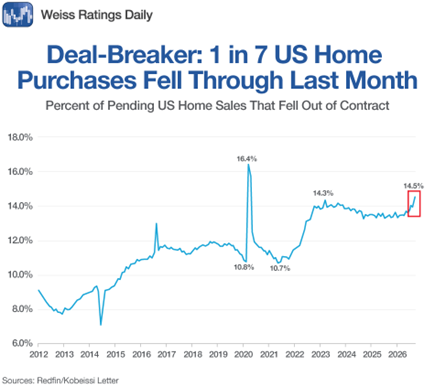
Before the pandemic, from 2017 through 2019, cancellations never even reached 12%.
Buyers Are Taking Control
When there are six sellers for every four buyers, sellers lose leverage.
As of Oct. 11, 22% of active listings had undergone a price cut — a record for Redfin's weekly data.
Median asking prices have actually slipped 0.3% year over year, their first decline since March.
The pain is especially severe in the Sun Belt.
Miami had 159% more sellers than buyers in September.
Austin had 131% more.
Atlanta had 110% more.
Tampa had 104% more.
In fact, 41 of America's 50 largest metropolitan areas are now buyer's markets.
Here are my three top ways an investor can position around this inventory backlog, transaction freeze and rate divergence:
Idea #1: Use Your Cash as Leverage
So, if you're looking to buy a home and can handle today's mortgage rates — or better yet, you're paying cash — the negotiating table has flipped.
You can bid below asking.
You can demand repairs.
You can ask sellers to pay closing costs.
And you can negotiate mortgage-rate buydowns or discount points rather than simply asking for a lower price.
Idea #2: Shorting Select Stocks
A frozen housing market doesn’t just hurt sellers.
It also puts pressure on companies that depend on homes changing hands.
Home builders like D.R. Horton (DHI) and Lennar (LEN) face affordability pressures, while title insurers and brokerages can suffer when transaction volumes decline.
That puts companies like First American Financial Corporation (FAF), Fidelity National Financial (FNF) and Compass (COMP) on my watchlist for potential downside.
Shorting stocks carries substantial risk, though, so this approach is best left to experienced investors.
Idea #3: Home Storage Stocks
At first glance, self-storage might seem like a terrible way to play a frozen housing market.
After all, moving is one of the biggest drivers of storage demand.
Fewer home sales should mean fewer people renting storage units.
Except there's another side to the story.
Someone trying to sell a house usually cleans it up, declutters it and stages it for buyers.
The sofa that overwhelms the living room, boxes stacked in the garage and half the junk in the kids' rooms have to go somewhere … like a storage unit.
And when a house that once sold in two weeks instead sits on the market for two or three months, that stuff stays in storage longer.
Call it the “housing limbo” trade.
Now, fewer moves can also mean fewer new storage customers.
But with homes taking longer to sell, existing customers may hold onto their units longer, helping offset some of that weakness.
Self-storage has another beautiful characteristic: Once people put their belongings into a storage unit, they hate taking them back out, even if rates go up.
Moving everything to another facility means renting a truck, recruiting friends and sacrificing time and effort to store the same stuff elsewhere.
Most people just pay the increase.
That gives storage companies some ability to raise rents on existing customers, even when they’re offering discounts to attract new ones.
My pick for this trade is Public Storage (PSA).
This $55 billion market cap company is the 800-pound gorilla of the industry.
It owns or operates 4,647 self-storage facilities in 41 states and Puerto Rico, totaling roughly 329 million rentable square feet.
It also owns facilities in Canada and a 35% stake in European storage operator Shurgard.
At the end of 2025, occupancy at its same-store properties was 0.5 percentage points higher than a year earlier — its first year-over-year occupancy improvement in more than four years.
Core funds from operations rose 1.8% for the full year.
Since then, Public Storage has completed its acquisition of National Storage Affiliates in July and Public Storage Canada in September, dramatically expanding its footprint.
Its next quarterly report is due Oct. 26.
The stock sports a nice dividend yield, too: Recently, it was 4.1%.
That’s more than 3.7 TIMES the dividend yield of the S&P 500.
That gives us an interesting setup. The chart looks good, too.
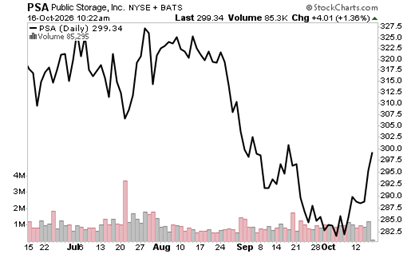
You can see that PSA tumbled after an earnings miss, but it has since bottomed and is now powering higher.
It should return to the highs it hit in August, and if it can break out, it could head higher from there.
The bottom line is that America has too many homes for sale, too few buyers and a growing backlog of houses sitting on the market.
That's terrible news for sellers.
But all the stuff those sellers cleared out of their homes?
It has to go somewhere.
And the longer those homes sit unsold, the longer that stuff may stay in storage.
That’s what makes Public Storage an interesting way to play the housing slowdown — with a healthy dividend to collect along the way.
All the best,
Sean