 |
| By Sean Brodrick |
One of the biggest surprises in the global economy right now is that while inflation is cooling in most major economies, the United States continues to run hotter than the pack.
The latest consumer inflation readings tell the story …
U.S. inflation is running at 4.2%, compared with 3.9% in Mexico, 3.2% in the European Union, 2.8% in Canada, 2.8% in the United Kingdom, 1.4% in Japan and just 1.2% in China.
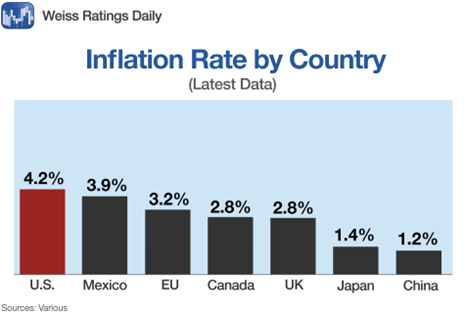
In other words, Americans are facing the highest inflation rate among the world's major developed economies.
That raises an obvious question: Why?
America’s Resilient Economy
The first reason is that the American economy remains surprisingly resilient.
While consumers in Europe, Canada and China have become increasingly cautious, U.S. consumers keep spending.
Strong employment, rising nominal wages and accumulated household wealth have kept demand stronger than many economists expected.
Reuters recently noted that persistent consumer spending remains one of the key reasons economists remain divided over whether the Federal Reserve should cut rates or keep policy tight.1
Gas Pump Pinch
The second factor is energy.
The conflict involving Iran and the disruptions around the Strait of Hormuz hit the United States harder than many expected.
Sure, America produces a lot of oil and natural gas. And American energy companies are happy to export that energy around the world to the highest bidder, driving up prices here at home.
U.S. energy inflation surged sharply this spring, with gasoline prices jumping more than 40% year over year and overall energy prices rising more than 23%.
Those increases fed directly into transportation, logistics and consumer costs across the economy.
The May CPI increase was the fastest in three years, driven largely by higher energy prices.2
Tariffs Hit Consumers
Third, the United States is seeing inflation pressures from President Trump’s tariffs.
Import prices rose 6.7% year over year in May.
Economists continue to point to President Trump’s tariffs as a significant inflationary force.
Stanford economists estimate the current tariff regime alone may add roughly one percentage point to inflation.
And researchers at the Peterson Institute say the combination of tariffs, larger fiscal deficits, tighter labor markets and more could keep U.S. inflation above 4% through the end of the year.
Why Global Prices Are Softening
Meanwhile, several major economies have factors working in the opposite direction.
China continues to struggle with weak consumer demand and excess industrial capacity, keeping inflation near 1%.
Japan has benefited from energy subsidies and relatively subdued domestic demand.
Europe and the United Kingdom have seen inflation moderate as food-price pressures ease and earlier interest-rate hikes continue to work through their economies.
The Road Ahead
The good news is that some of the forces pushing U.S. inflation higher may begin to fade.
Gasoline prices have retreated from their recent peaks as tensions in the Middle East ease.
The latest University of Michigan consumer survey shows consumer inflation expectations are edging lower.
The bad news is that the United States still faces several inflation tailwinds that many other countries do not.
Tariffs are pressuring import prices higher, and consumer demand is resilient.
Many economists now expect inflation to remain stubbornly above the Federal Reserve's 2% target well into next year.
For investors, the message is clear. Inflation may be cooling overseas, but the United States remains the inflation hotspot of the developed world.
That bodes well for the assets that have historically performed best during inflationary periods: energy, precious metals and critical minerals.
And also for companies with the pricing power to pass higher costs on to customers.
How You Can Play It
This morning, I gave you a ticker to play this hot inflation trend.
I have one more idea for you: The Schwab U.S. TIPS ETF (SCHP) is one of the most cost-effective ways to gain exposure to Treasury Inflation-Protected Securities (TIPS).
The fund charges an expense ratio of just 0.03%, making it one of the cheapest inflation-protected bond ETFs available.
And as of mid-June, SCHP's 30-day SEC yield was a whopping 13.35%.
This is thanks to unusually large inflation adjustments.
Let’s look at the chart …
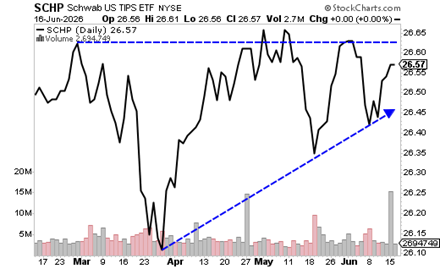
You can see that SCHP is hammering away at overhead resistance while making higher lows.
That’s a bullish set-up — for the SCHP and for investors looking for more inflation protection as America rides out stubbornly higher prices.
All the best,
Sean
2 https://www.reuters.com/world/us/us-consumer-prices-increase-expected-may-2026-06-10/