Best Consumer ETF for the 2026 Holiday Season: Why I’m Buying XLY

 |
| By Sean Brodrick Reviewed by: Jim Nelson |
Look out, Cindy Lou Who. The Tariff Grinch is coming to steal Christmas!
Well, not Christmas itself. But thanks to stubborn inflation, fueled by tariffs and war-driven energy costs, Americans are discovering that spreading holiday cheer is getting more expensive.
And if you're shopping for toys, the news is particularly grim.
The Bureau of Labor Statistics reports that consumer prices rose 0.4% in October, exceeding economists' expectations for a 0.3% increase.
That followed an even hotter 0.6% jump in September.
Bloomberg Economics estimates that inflation is running at approximately 3.9% annually — nearly twice the Federal Reserve's 2% target.
That's bad because inflation has a nasty habit of becoming self-perpetuating.
Once consumers expect prices to keep rising, businesses raise prices to cover their costs, workers demand higher wages and the cycle continues.
The good news is Americans aren't letting inflation stop them from shopping.
A Trillion-Dollar Christmas
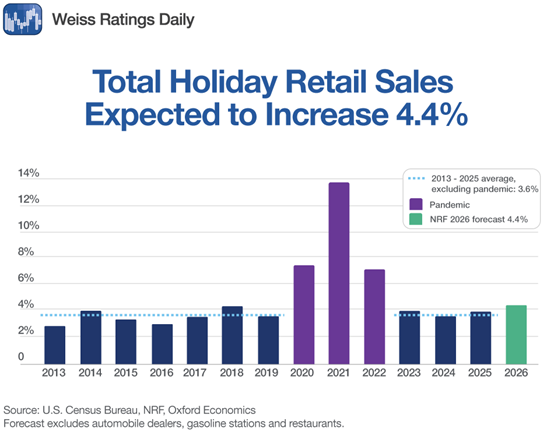
The National Retail Federation forecasts that holiday retail sales will rise 4.2% this year, reaching a record $1.013 trillion during November and December.
That would make this the first trillion-dollar Christmas shopping season in American history!
It's also an acceleration from 2025, when holiday spending rose 3.1% to $972 billion.
Here’s a chart showing how much Christmas spending has gone up (percentagewise) every year.
Pandemic spending was an outlier.
There's a catch, though.
With inflation running close to 4%, much of that additional spending simply reflects higher prices rather than more merchandise under the Christmas tree.
And the inflation monster is particularly hungry for toys.
According to the Bureau of Labor Statistics data, toy prices have surged approximately 9% since last Christmas — more than twice the estimated overall inflation rate.
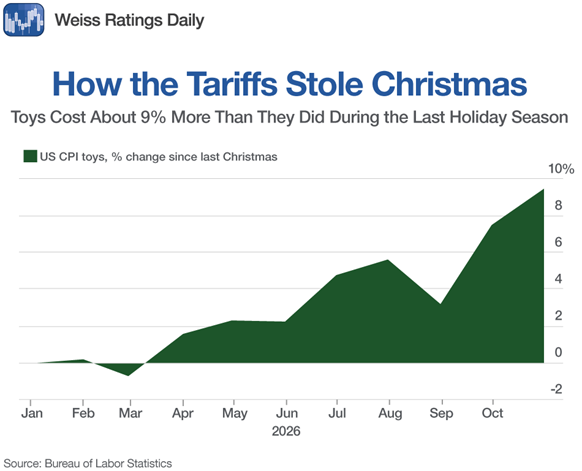
A major culprit is tariffs.
Since so many toys are manufactured overseas, particularly in China, import duties raise costs for American distributors and retailers.
Much of that expense ultimately gets passed along to consumers.
Unfortunately, the pain doesn't stop with presents.
Food prices were up 2.5% year over year in September. October brought another 0.5% monthly increase.
The war with Iran has sent energy and transportation costs soaring, making everything from shipping merchandise to stocking supermarket shelves more expensive.
Indeed, gasoline prices were up a whopping 34.2% year over year in September.
So, whether you're buying presents, driving to Grandma's house or preparing Christmas dinner, inflation is taking another bite out of your wallet.
The Online Shopping Boom
But there's one place where Americans are increasingly finding relief: the internet.
Adobe forecasts that U.S. online holiday sales will reach a record $275.1 billion this year, up 6.7% from 2025.
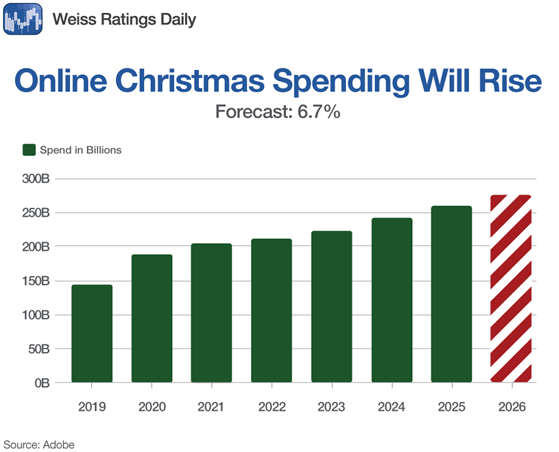
That's considerably faster growth than overall holiday retail spending.
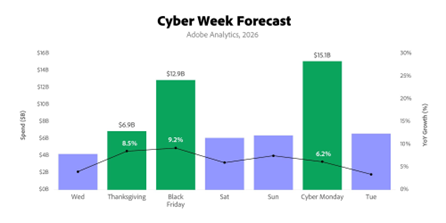
And Adobe expects Cyber Week alone — Thanksgiving through Cyber Monday — to generate $47.5 billion in online purchases.
Cyber Monday, Nov. 30, should be the biggest online shopping day of the year, with a staggering $15.1 billion in sales.
Better yet, bargain-hunters should find substantial discounts.
Adobe expects markdowns reaching 30% on electronics and 29% on toys during the holiday shopping season.
That's creating a tremendous opportunity for companies positioned to capture those purchases.
What You Should Buy
The Consumer Discretionary SPDR (XLY) makes my “nice” list this holiday season.
This ETF holds a basket of about 50 companies, including some of the biggest beneficiaries of holiday spending.
Its largest holding is Amazon (AMZN), representing approximately 22.6% of the fund. That's particularly attractive given the continuing migration toward online shopping.
Other major holdings include Home Depot (HD), at 5.7%, and TJX Companies (TJX), at 4%.
TJX, which operates T.J. Maxx, Marshalls and HomeGoods, is particularly interesting because bargain-hunting consumers are increasingly looking for discounts.
XLY also holds Lowe's (LOW), Starbucks (SBUX) and Booking Holdings (BKNG), giving investors exposure to home improvement, restaurants and travel.
The fund charges an exceptionally low annual expense ratio of just 0.08% — only $8 annually for every $10,000 invested.
Its distribution yield is a modest 0.79%. But we're buying this ETF for capital appreciation, not income.
Let’s look at the weekly chart …
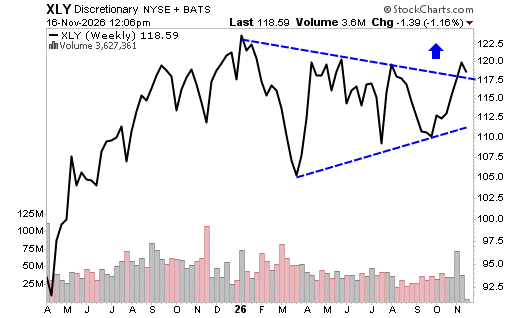
You can see the XLY has been coiling up and is trying to break out. That kind of breakout would give us a price target of $151.
XLY trades at about $118, so $151 is about 28% upside.
There are risks, of course.
XLY depends on more than Christmas shopping. Persistent inflation, weaker consumer spending or disappointing corporate earnings could hurt the fund.
Still, Americans have demonstrated remarkable resilience in the face of higher prices.
And as more holiday spending moves online, XLY offers an attractive way to participate in that trend.
The Grinch may steal some of Christmas's purchasing power. But he won't stop Americans from shopping.
Hang on, Cindy Lou Who. It’s the American consumer to the rescue!
All the best,
Sean
P.S. As noted, XLY’s 0.79% distribution yield won’t help you pay for your Christmas shopping.
Instead, you need to hear what Chief Income Analyst Nilus Mattive has to say about an income strategy that generated 22x more income than the average stock.