 |
| By Sean Brodrick |
American farmers are seeing a bumper crop of farm bankruptcies.
In 2025, farm Chapter 12 bankruptcy filings surged 46% to 315 cases.
That’s off the decade's peak. Still, this marks the highest level of agricultural insolvencies since 2020.
What’s more, 2025's 315 filings mark the second-consecutive year of increases, up 46% over 2024.
And 2024 was up 55% over 2023.
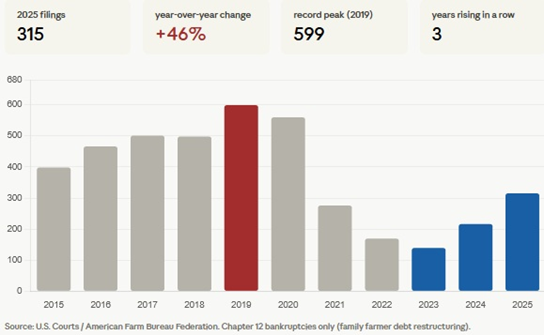
This is terrible for farmers, of course.
But big banks and investment funds are finding a real advantage.
As the saying goes, “If you can’t beat ‘em, join ‘em.” So, I’ll tell you how to potentially profit from this, too.
As bad as 2025 was for bankruptcies, it’s already looking worse this year — potentially much worse.
- Operating debt is rising.
- Incomes are expected to compress for the fourth year in a row.
- And through the first seven weeks of 2026, national bankruptcy filings across all chapters rose significantly.
For example, during the week ending Feb. 16, 2026, total filings were roughly 17.5% higher than the same week in 2025.
While these filings apply to all types, farmers can and do file Chapters 7, 11 and 12 bankruptcies.
Why the Drag on Ag?
The agricultural industry is currently trapped in a brutal margin squeeze.
Fertilizer prices are spiking with no relief in the short term.
Farmers are buckling under record debt — now exceeding $600 billion — while grappling with stubbornly high input costs and weakening crop prices.
For many, the era of "extend and pretend" with the bank has finally hit a wall in court.
Hip-Deep in Rising Fertilizer Prices
The primary culprits for this tightening noose are soaring fertilizer and fuel prices.
These two line items alone can account for 30% to 50% of total cash operating costs for row-crop producers.
When these inputs spike, thin margins vanish instantly.
Up to 30% of the world's global fertilizer trade passes through the Strait of Hormuz. With that waterway closed by the U.S. war with Iran, fertilizer prices are spiking.
Recent surveys suggest the situation is dire: Nearly 70% of farmers report they can no longer afford to purchase the full amount of fertilizer they need at current prices.
This isn't just a localized issue, though the stress is heaviest in the U.S. Midwest and Southeast.
For Farms of All Sizes, a Harder Row to Hoe
Beyond the bankruptcy courts, structural consolidation is hollowing out the industry.
The U.S. has lost nearly 150,000 farms and 21 million acres of farmland in just five years as small operations are absorbed by larger players or simply shuttered.
And it’s not just small farms, either.
In April, the Monette Group — one of the largest private farming operations in North America — filed for financial protection for its 440,000-acre operation.
That signals even massive, industrial-scale farms are reaching a breaking point.
How to Play the Consolidation
While this is a tragedy for the family farm, it creates a massive opening for institutional capital and well-capitalized REITs.
As marginal operators are forced to restructure or sell to settle debts, "motivated sellers" are creating a buyer's market for high-quality land.
Farmland Partners (FPI) is a REIT that should ride this trend.
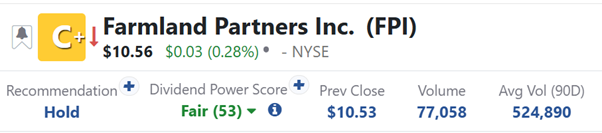
FPI owns or manages approximately 139,000 to 170,000 acres across 16 states, including the high-stress row-crop regions of Illinois, Iowa and Kansas.
It also has a recent yield of 2.31%, more than double the 1.1% yield of the S&P 500.
(Editor’s note: You’ll see that we give FPI a “Fair” Dividend Power Score. Only our Ratings Plus subscribers can see how dividend-payers rate on our proprietary scale. And that’s not all. The Ratings Plus can help you find your next great trade. Click here to see how.)
FPI’s model is straightforward: Buy the land and lease it back to operators. This allows it to collect cash rent while benefiting from long-term land appreciation.
While fertilizer prices are spiking now, the Strait of Hormuz will reopen, and global fertilizer supply chains will return to normal.
Then, we’ll see farmers who survived the bankruptcy wave want to expand.
And FPI will have the land to lease to them.
Don’t Bet the Farm; Bet on Them!
Historically, farmland has delivered steady gains with lower volatility and low correlation to traditional equities.
Let’s look at the daily chart …
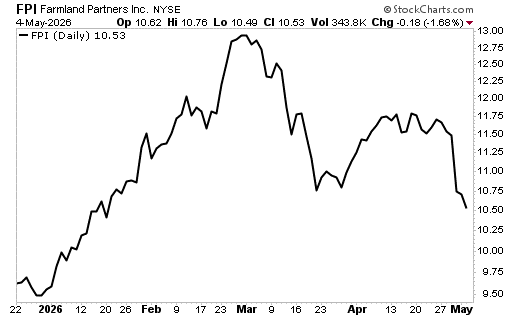
You can see that FPI hit a new high in February. Then it pulled back sharply, attempted a rally and pulled back again.
I believe it’s building energy for a new push higher. One that should take it back to its old highs and potentially much higher.
In a market where small farmers are getting fed into the debt harvester, FPIs’ ability to raise equity and debt gives it a significant opportunity to snap up the best acreage.
That and a nice dividend yield make FPI a solid addition to your portfolio.
All the best,
Sean Brodrick