 |
| By Sean Brodrick |
Gold is slumping again, and about 74% of S&P 500 stocks are trading under their 52-week moving averages.
Why?
Because bond yields are marching higher, and the odds of the Fed hiking rates in October and/or December — after already hiking in September — are increasing fast.
Yeah, it’s scary for a stock investor. But read on, and I’ll show you a safe harbor.
The odds of the Fed hiking in October were about 8% right before the September rate hike on Sept. 16.
But persistent inflation and rising yields across the bond market are reinforcing expectations that the Fed may have to raise rates again in October and AGAIN in December.
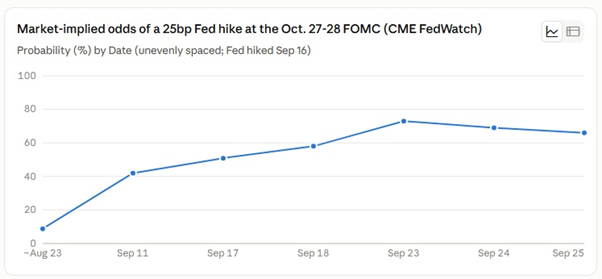
- Right after the hike: On Sept. 17, FedWatch showed roughly a coin flip, about 51% for a hike in October versus 49% for a hold. By the next morning, they were near 58%, up from 42% a week earlier, after Warsh's post-meeting comments.
- Wednesday, Sept. 23: The odds jumped to 73%, according to CNBC. That followed Governor Barr's remarks that he thinks policymakers still have more work to do, and an S&P Global report showing inflation at its highest in nearly four years. Another outlet reported “nearly 70%” the same day, which is normal intraday variation. Barr said further policy adjustments are likely.
- Friday, Sept. 25: October odds were near 66% and December near 93%. The 10-year Treasury yield hit its highest level since 2007 that week.
Markets now price a hike in October as more likely than not.
Odds of a December rate hike are also rising.
There’s an old saying on Wall Street that if the market is pricing in a 70% move by the Fed, the Fed has to follow through or there is a credibility problem.
This problem is exacerbated because Federal Reserve Chair Kevin Warsh has explicitly said he looks to market pricing and intends to let the bond market "tell its story," rather than having the Fed dictate or heavily manage long-term yields.
This is like the grocery store telling customers to come in and set their own prices.
That means customers will set prices to their advantage.
And in the bond market, that means bond traders will demand (and get) higher and higher yields.
What’s Driving Rates Higher?
Sticky Inflation. This is driven by tariffs, America’s ongoing war with Iran and Russia’s invasion of Ukraine.
The wars are pushing up oil prices, especially diesel, as refineries in Russia go KA-BOOM!
Higher diesel prices and higher gasoline prices feed through the system, raising all sorts of prices.
Hyperscaler Debt Issuance. AI companies are issuing debt for their physical buildouts, competing with Treasurys for investment funds.
Sure, it only affects bond yields on the margins now, but it’s going to get worse, and the market probably anticipates that.
Goldman Sachs expects hyperscalers to issue $420 billion next year, up 60% from 2026.
Ballooning Federal Deficits. Federal debt has moved above $40 trillion. The Treasury’s financing needs inflated to $739 billion in July-September, up $68 billion from the previous estimate in May. Wow!
And since Uncle Sam has to borrow more money at higher interest to pay the interest on existing debt, this debt cycle feeds on itself.
Higher yields → higher federal interest cost → larger deficit → more Treasury issuance → higher term premium.
Now for the Good News
Some equities can outperform even as the Fed raises rates.
In particular, you might look at cash-rich “fortress” megacaps.
Why?
Because their massive cash hoards mean they have zero near-term refinancing needs. That cash will also generate income in a higher-rate environment.
One ETF that holds many cash-rich megacaps is the iShares MSCI USA Quality Factor ETF (QUAL).
It has a “C+” from Weiss Ratings and an expense ratio of 0.15%.
It's packed with “financial fortresses,” including Microsoft (MSFT), Apple (AAPL) and Nvidia (NVDA).
Here’s a weekly chart of QUAL …
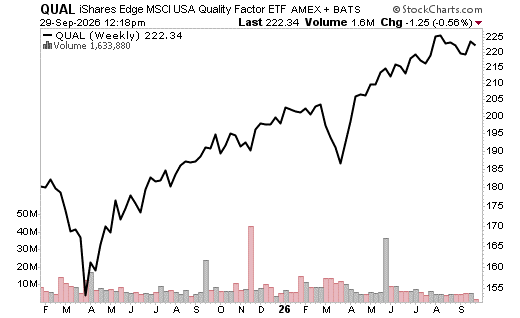
You can see that the current turmoil on Wall Street is barely bothering QUAL.
The stocks it holds are outperformers and will be safe harbors as financial storms roil Wall Street.
There are plenty of ways to deal with higher rates in stock portfolios.
And though gold is down in the short term, the longer-term forces powering it higher haven’t gone away.
That makes a pullback in metals and miners a buying opportunity.
I’ll be exploring these themes with subscribers to Wealth Megatrends and other publications.
If you’re doing this on your own, be careful. But don’t just sit on your hands.
All the best,
Sean