Boeing Just Enjoyed Three Good Headlines. Here's What Didn't Change.

 |
| By Gavin Magor |
A good headline can lift a stock for a day.
A balance sheet decides where it lands over the long run.
Boeing (BA) got two good headline days recently.
Last week, U.S. Trade Rep. Jamieson Greer said China is making progress on the 200-jet commitment it announced in May.
About 140 of those jets are in good shape, he said, and another 10 are being written up as orders.
This week, Boeing's 737 MAX 8 drew attention after a terror attack on a flight from Dubai to Tel Aviv.

The aircraft plummeted after the copilot attacked the pilot with a knife. Fortunately, the plane landed safely in Saudi Arabia with the help of a civilian passenger.
We’re thankful a bigger crisis was averted, and the Boeing 737 Max 8 was able to handle the rapid descent.
As for the stock, however, we don’t see a great deal of runway from here.

Boeing carries a Weiss rating of “D+,” which sits in the SELL range of our scale.
And for anyone investing for long-term financial security, that grade matters far more than any single day's move.
Here's why.
Big Revenue, Negative Operating Earnings
Boeing booked $94 billion in revenue over the trailing 12 months.
That's enormous scale.
But scale hasn't turned into operating profit.
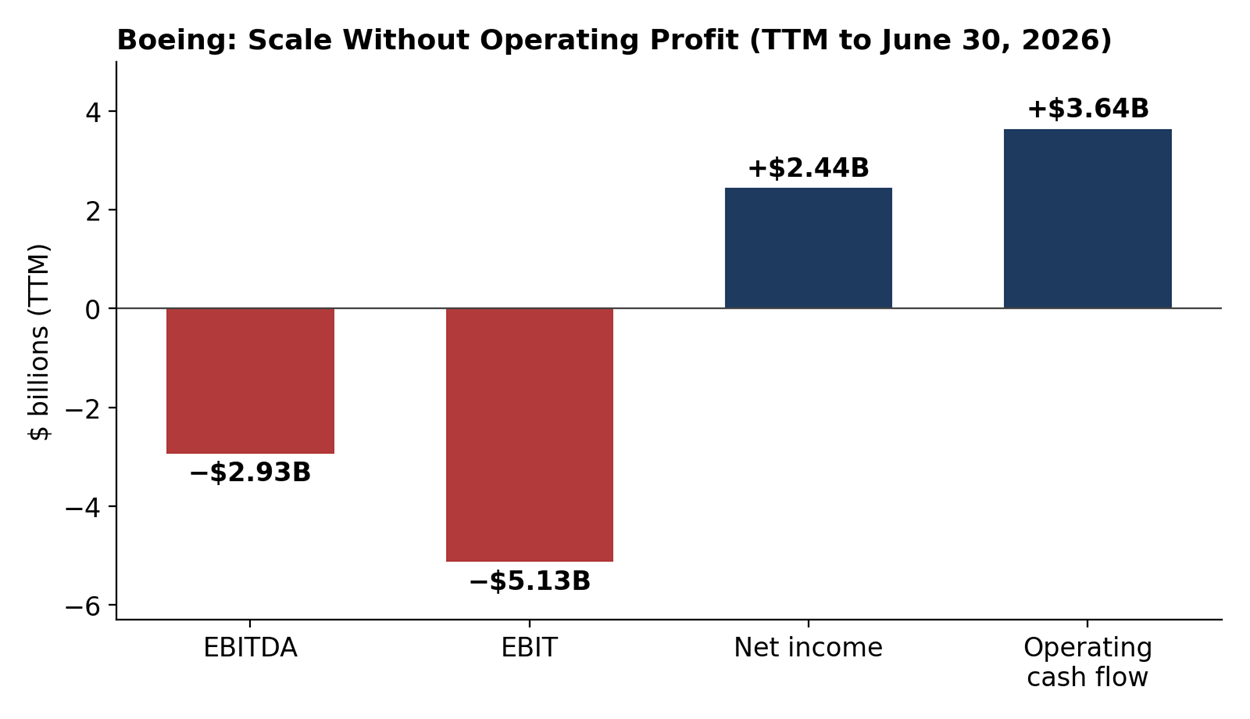
EBITDA came in at negative $2.93 billion, and EBIT at negative $5.13 billion.
Net income, by contrast, was a positive $2.44 billion.
That gap is the first thing we'd want explained.
Our summary doesn't show what closed it, so we're not prepared to call the positive bottom line a sustainable operating recovery.
Operating cash flow did improve, to a positive $3.64 billion.
Yet that's modest next to $48.36 billion of debt.
A Thin Cushion Under a Heavy Load
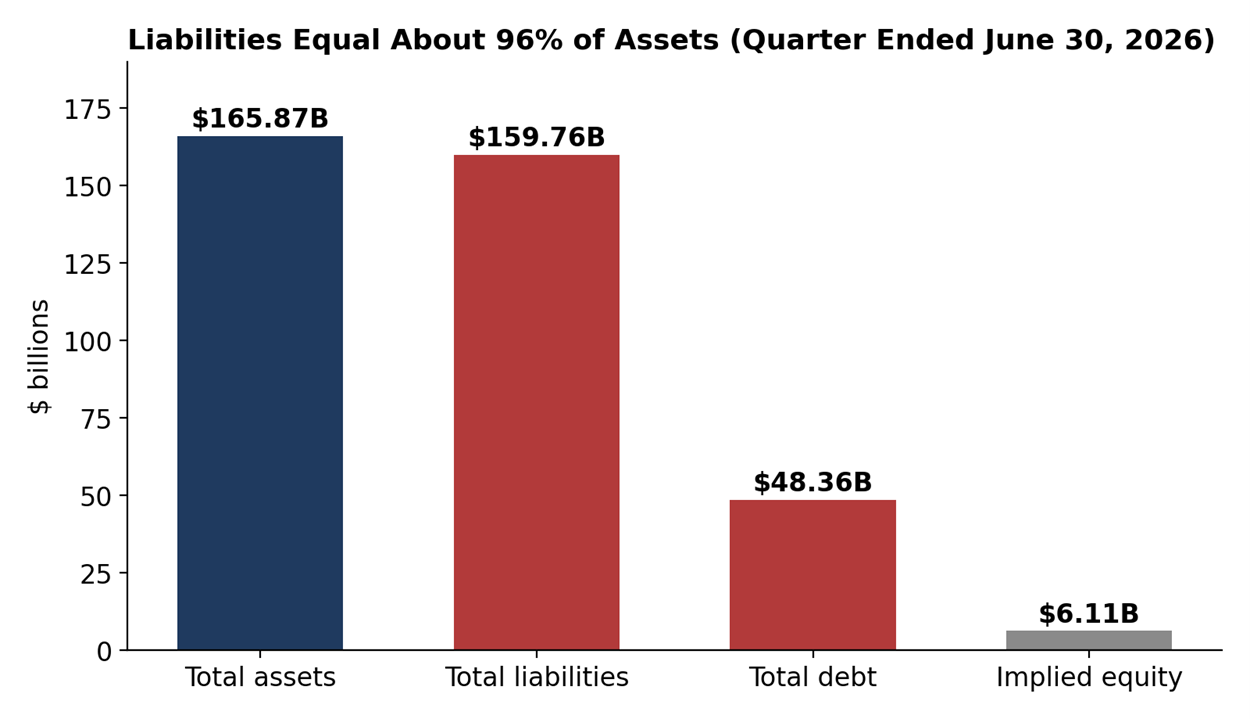
As of June 30, Boeing reported $165.87 billion in assets against $159.76 billion in liabilities.
That leaves implied book equity of roughly $6.11 billion.
Put another way, liabilities equal about 96% of assets.
For a company still working through production issues, that's very little room for error.
A Price That Assumes the Best
Boeing trades at 90.34 times trailing earnings.
That valuation assumes a substantial earnings recovery.
It's a lot of altitude for a company still sorting out its wings.
If the recovery arrives on schedule, fine.
If it slips, there's little in the price to absorb the disappointment.
What's Behind the Backdrop
On Sept. 16, CEO Kelly Ortberg told the Morgan Stanley Laguna Conference that 737 MAX production isn't yet stable at 47 jets a month.
Getting there is taking a little longer than he expected.
The constraint is wing production at Boeing's plant in Renton, Washington.
Fortunately for Boeing, it got another good headline Thursday.

The company just avoided a strike by engineers ahead of their Oct. 6 contract expiration. A strike would have effectively shut down the 777X certification program.
Whilst an order commitment from China would be welcome — along with workers to fulfill it — this doesn't build wings any faster.
Our Models vs. the Street
Wall Street is plainly more upbeat than we are.
Bank of America just reiterated its BUY rating and $270 price target.
The average analyst target stands at $274.85, according to Yahoo! Finance.
A price target is a forecast.
Our rating is built on what the numbers show now.
And right now — with Boeing’s negative operating earnings, heavy obligations and a thin equity cushion — the numbers tell us to sell, not buy.
What Patience Has Paid
Share returns tell the long-term investor's story.
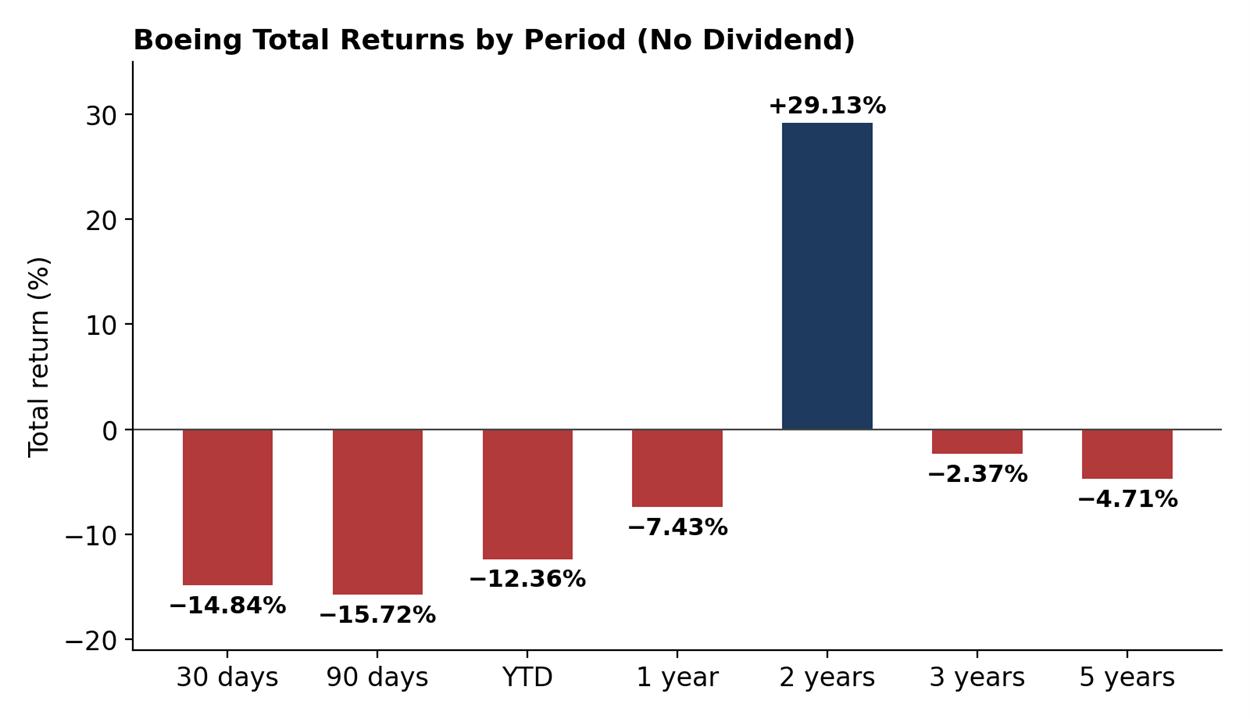
The stock is up 29.13% over two years, so investors have rewarded parts of the turnaround.
But it's down some 14% over 30 days and 12% year to date.
Stretch the window further and the picture doesn't improve: negative 2.37% over three years and negative 4.71% over five.
There's no dividend to reward the wait, either.
Over the three years through last Friday, the S&P 500 returned about 72%, according to Yahoo! Finance.
That's the real cost for a long-term investor.
Not just what a stock might lose, but what your money could have earned somewhere sturdier.
Key Items We're Watching
- Whether Boeing stabilizes 737 MAX output at 47 a month and clears the wing bottleneck in Renton.
- Any Chinese order news from the Trump-Xi meeting, and whether it brings firm orders or more commitments.
- Third-quarter results, expected in late October, specifically whether EBIT turns positive and cash flow starts reducing debt.
- MAX 10 certification, which Ortberg expects very soon.
Bottom Line
Boeing holds a valuable position in commercial aviation and defense.
Nothing in this report questions that.
But a great franchise and a great investment aren't the same thing.
For the “D+” Weiss stock rating to improve, we'd want to see positive operating earnings that persist, cash flow strong enough to reduce debt and more durable shareholder returns.
Until then, we'd leave the turnaround bet to those who can afford to be wrong about the timing.
The good news is that your long-term financial security doesn't depend on Boeing getting it right.
There's no shortage of companies that already earn a BUY rating from us.
Over the longer term, Boeing can certainly resume its upward climb, both when it comes to share price as well as its Weiss rating.
In the meantime, keep in mind that Boeing’s balance sheet will be what decides where it lands.
Cheers!
Gavin