Cal-Maine Lost Money on Eggs — Here's Why That's Not a Recession Signal

 |
| By Gavin Magor |
Eggs are the one item on your grocery list that doesn't care whether the economy is in a recession.
The company that sells more of them than anyone else answers to something else entirely: the hen.
This morning, Cal-Maine Foods (CALM) reported a net loss of $58.6 million, or $1.26 per share, for its fiscal first quarter ended Aug. 29.
The same quarter a year ago earned $199.3 million.
But it isn’t that “No one can eat 50 eggs,” like a prisoner said to Paul Newman in “Cool Hand Luke.”
Eggs Still Sell Like Hotcakes. Now They’re Just Priced to Move.
Cal-Maine’s net sales fell a whopping 41.5% to $539.6 million.
The loss was wider than the 77 cents per share that Wall Street expected.
The shares opened this morning at $63.50, a new 52-week low and 7.4% below yesterday's $68.55 close.
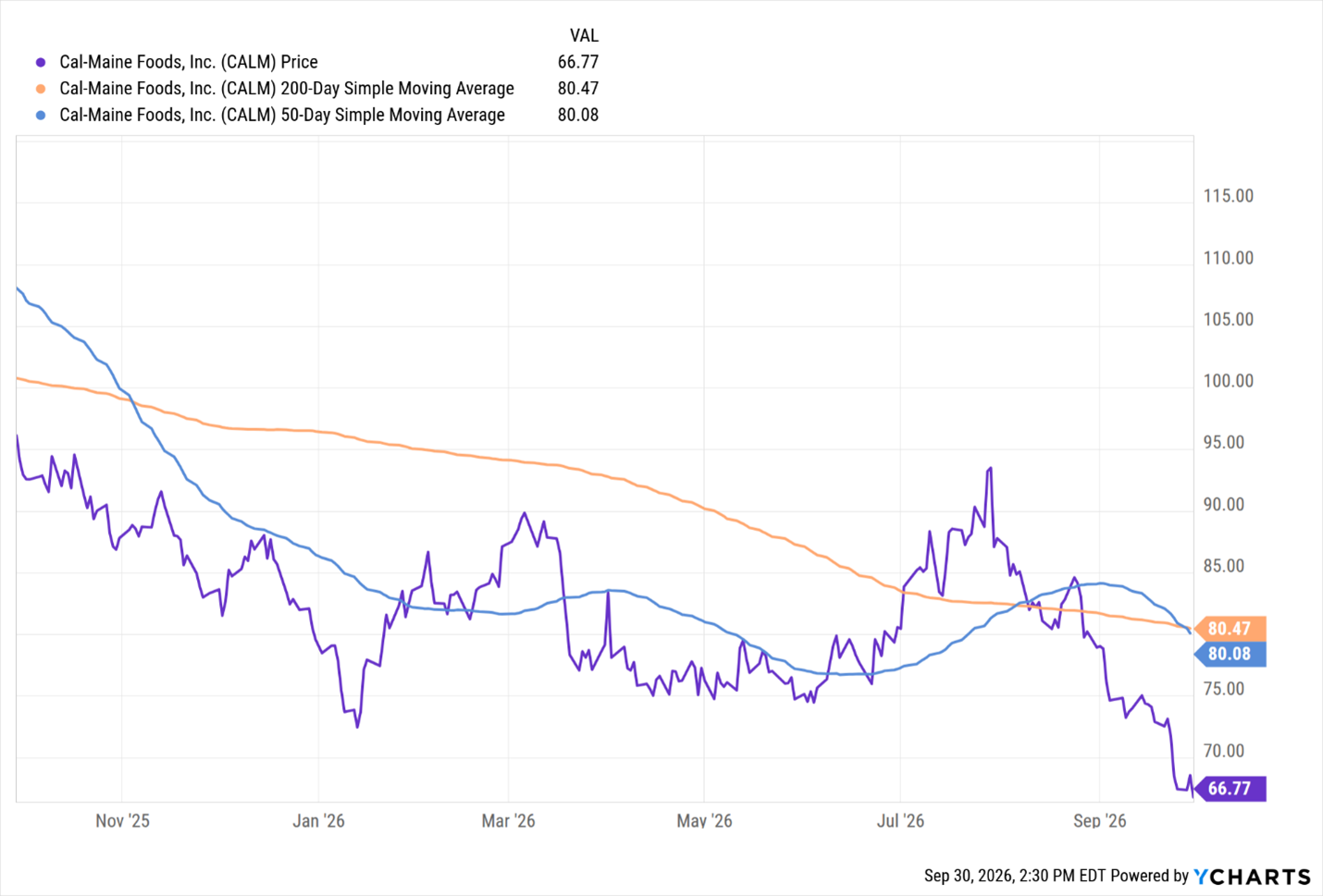
Nobody stopped buying eggs, though.
Volume barely moved, down just 0.7%. However, Cal-Maine's average conventional egg price fell 59.3% from a year ago.
The industry rebuilt its flocks after bird flu. Now, there are just too many eggs.
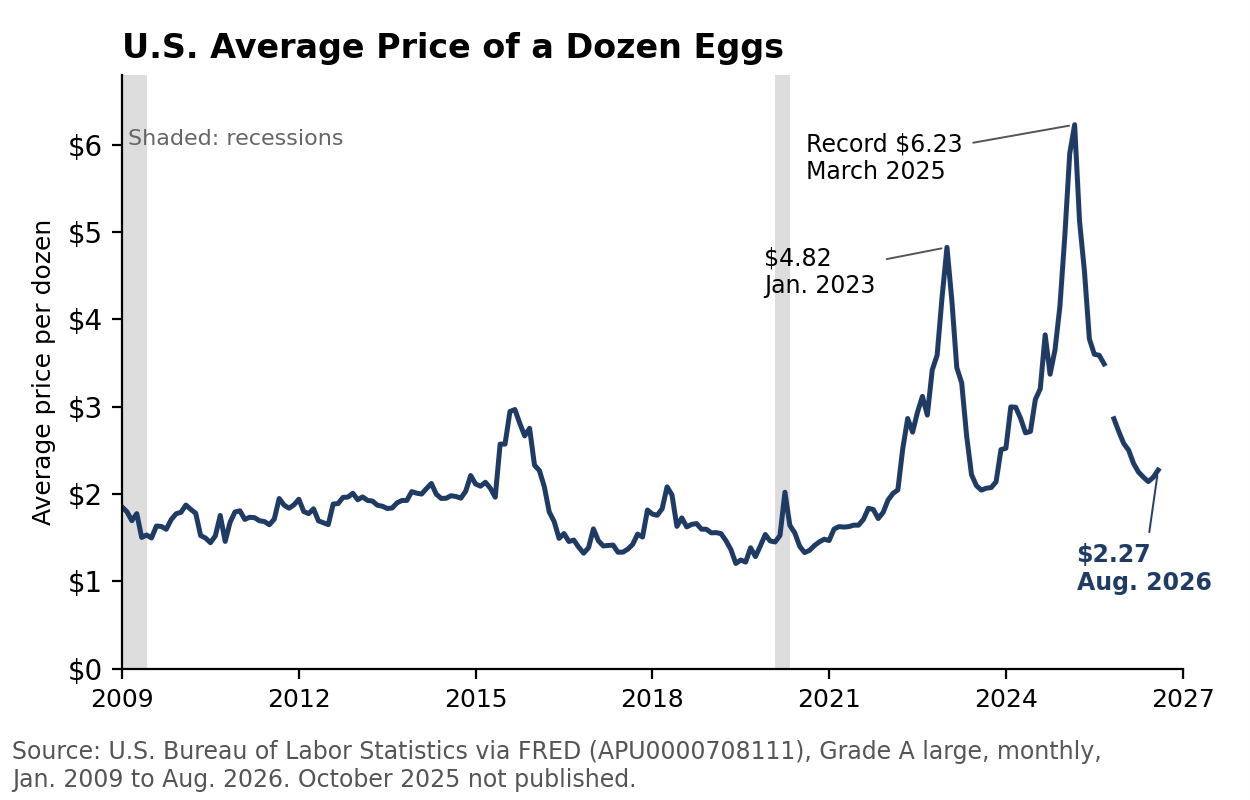
At the store, a dozen Grade A large eggs averaged $2.27 in August, according to the U.S. Bureau of Labor Statistics.
That is 64% below the record $6.23 price, set in March 2025.
The big spikes on the chart line up with bird flu outbreaks in 2015 and from 2022 through 2025. Not with recessions.
Who Buys All Those Eggs
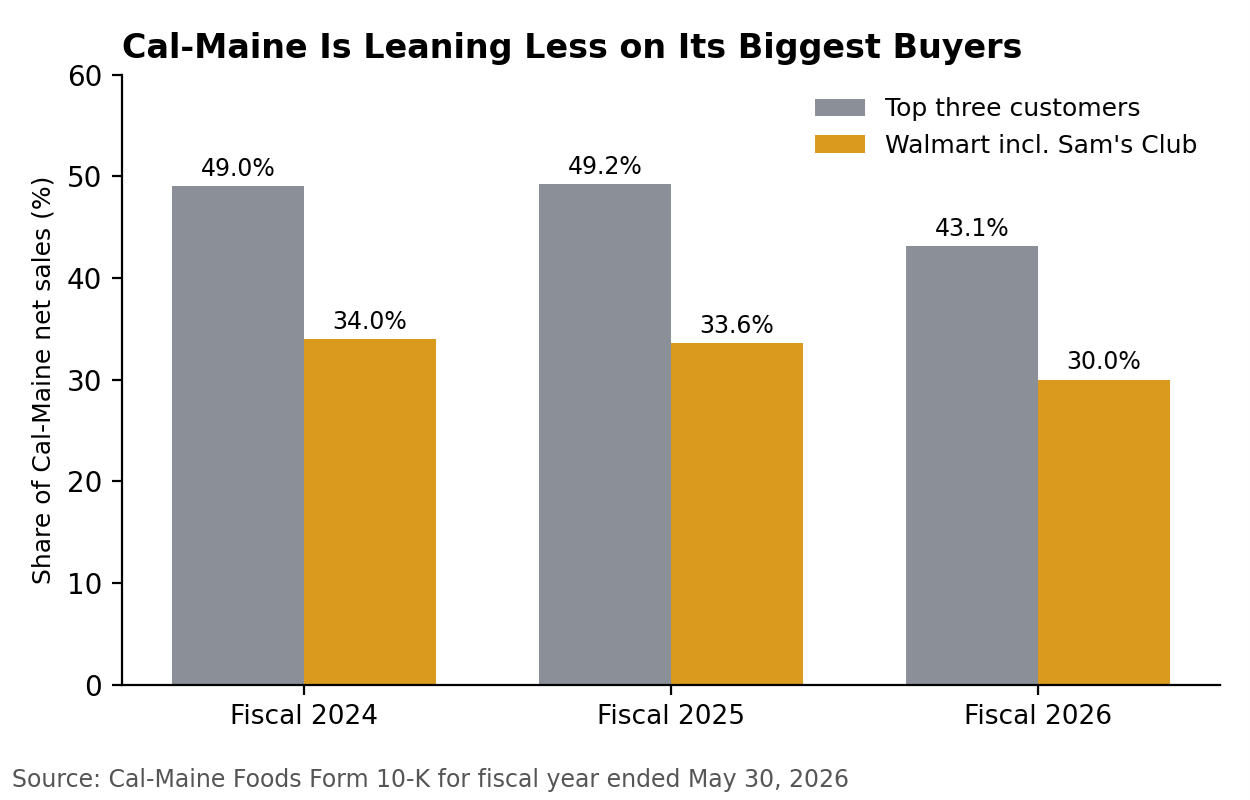
Walmart (WMT), including Sam's Club, accounted for 30% of Cal-Maine's sales in fiscal 2026.
That's down from 34% two years earlier, and the top three customers combined slipped from 49% to 43.1%.
Less dependence on a few giant buyers is a quiet positive.
The rest of the retail book runs through national and regional grocery chains, club stores and companies that supply independent supermarkets.
On the wholesale side, Cal-Maine sells to foodservice distributors and egg product makers.
Its Prepared Foods segment, anchored by the 2025 Echo Lake Foods deal, makes egg patties, omelets, pancakes and waffles. It delivered 11.7% of quarterly sales.
Cal-Maine also produces Eggland's Best eggs under license. Those sales, including affiliates, made up roughly 56% of that brand's eggs nationwide last year.
Most customers are free to buy elsewhere. And nearly all of Cal-Maine's conventional eggs are priced off wholesale market quotes or hybrid formulas tied partly to them.
So, when wholesale prices drop, Cal-Maine's revenue drops right along with them.
Some customers now buy under cost-plus or hybrid contracts, which cushioned part of this quarter's price drop.
Cal-Maine also bought more Eggland's Best franchise territory in the Northeast during the quarter, adding one of the country's largest, highest-income markets.
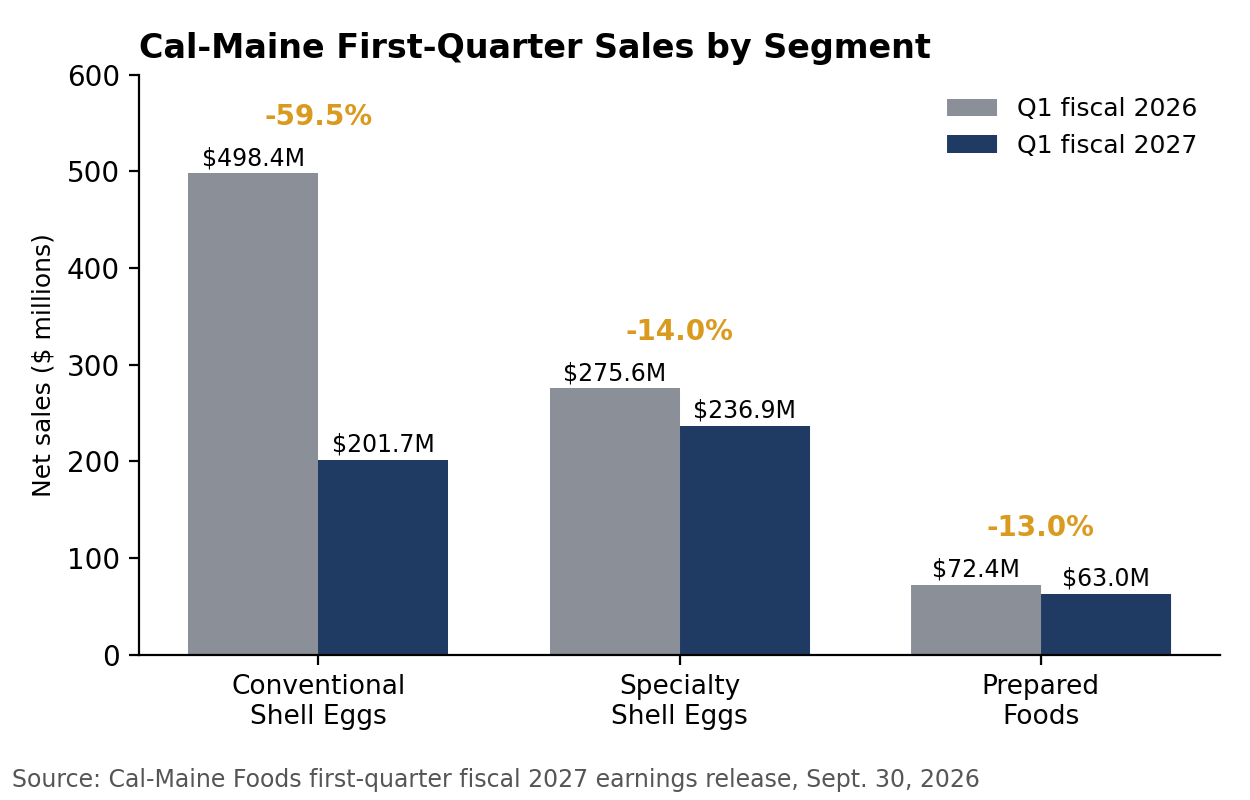
Specialty eggs and Prepared Foods held up far better, and together they now make up 54.1% of sales, up from 37.1% a year ago.
That's the shock absorber management has been building, and it's working, just not fast enough yet.
3 Recessions, 3 Different Stories
Whilst the S&P 500 lost more than a third of its value in 2008, Cal-Maine's stock returned 13.2%, dividends included.
In fiscal 2009, which covered the worst of the Great Recession, sales edged up 1.4% to $928.8 million and the company earned $79.5 million.
Profit did fall by nearly half from fiscal 2008's $151.9 million. But that was egg prices coming off record highs — not shoppers cutting back.
Back during the COVID-19 recession, the story flipped.
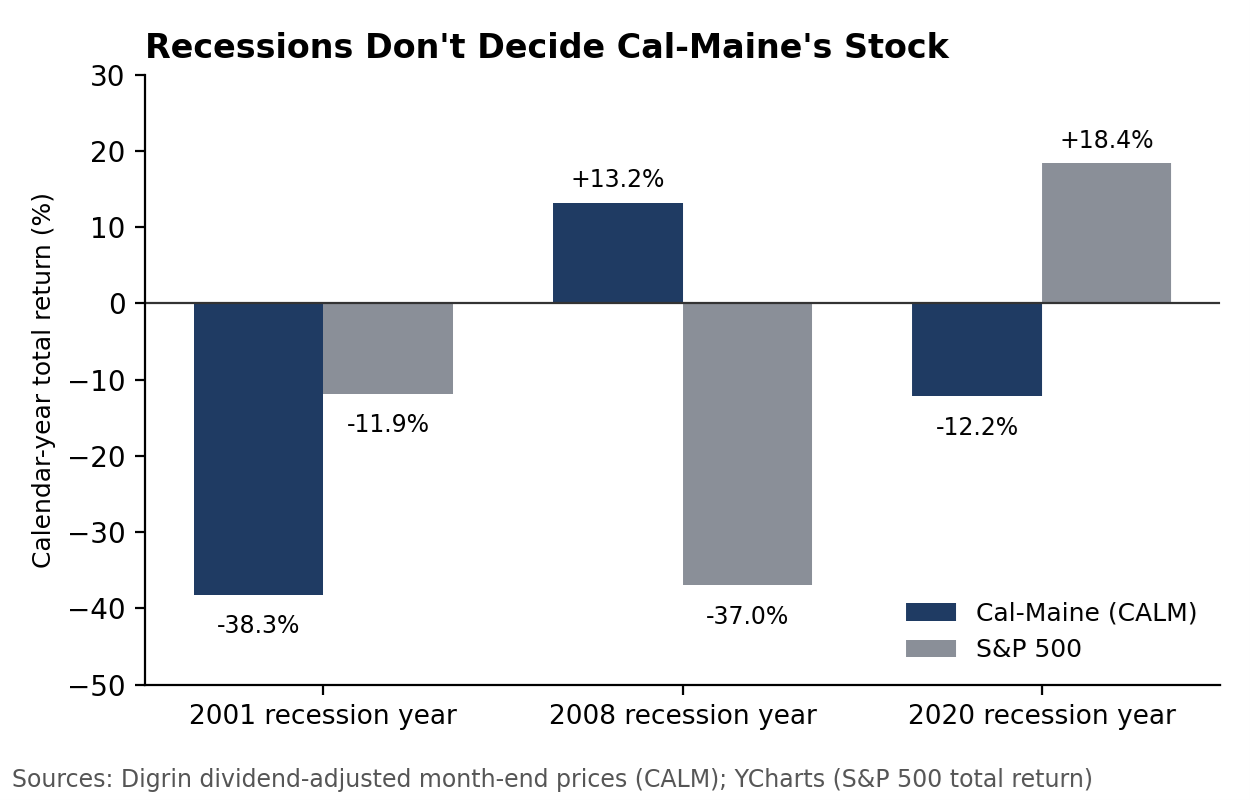
In the three months ended May 2020, sales jumped 61.6% to $453.3 million as families stocked their refrigerators. And Cal-Maine swung to a $60.5 million profit.
Yet the stock lost 12.2% in 2020, dividends included, whilst the S&P 500 returned 18.4%.
And in the 2001 recession, the stock lost about 38%, more than three times the market's 11.9% decline.
Recessions don't reliably move this stock in either direction.
The egg cycle does.
Cal-Maine's own annual report warns that weak economies push shoppers to trade down from specialty eggs to cheaper options.
That cuts both ways for Cal-Maine.
It sells both the premium carton and the cheap one … often to the same Walmart shopper.
Vital Farms: Same Aisle, Opposite Bet
Rose Acre Farms, long the No. 2 producer, is privately held.
So, the closest public comparison is Vital Farms (VITL), the pasture-raised brand.
Cal-Maine sells the whole value ladder, while Vital Farms sells only the top rung.
It reaches shoppers through grocers and natural-food distributors. Foodservice was just 3% of its 2025 revenue.
Cal-Maine's bigger wholesale and foodservice business spreads its risk more widely.
The oversupply has been rougher on premium player VITL.
Vital Farms' second-quarter revenue fell 10.1% to $166 million, its gross margin shrank to 6.6% from 38.9%, and it lost $31.1 million.
It also ended its buyback and lined up $185 million in new credit facilities.
Cal-Maine, by contrast:
- Held $767.6 million in cash and short-term investments at quarter-end.
- Listed no debt on its balance sheet.
- And it kept buying back stock, to the tune of another $14.9 million after the quarter closed.
In a recession, I'd expect trade-down to be a far bigger problem for Vital Farms than Cal-Maine.
Vital Farms' shares closed yesterday at $9.39, down roughly three-quarters from a year ago, and the stock carries a Weiss stock rating of D, a SELL.
An Axios report from Sept. 16 reported that the company is exploring going private.
The speculation briefly lifted the shares. But a rumor is not a reason to own a SELL-rated stock.
We'd avoid it.
Ten thousand dollars put into Cal-Maine at the end of 2008 was worth about $79,700 at yesterday's close, dividends included.
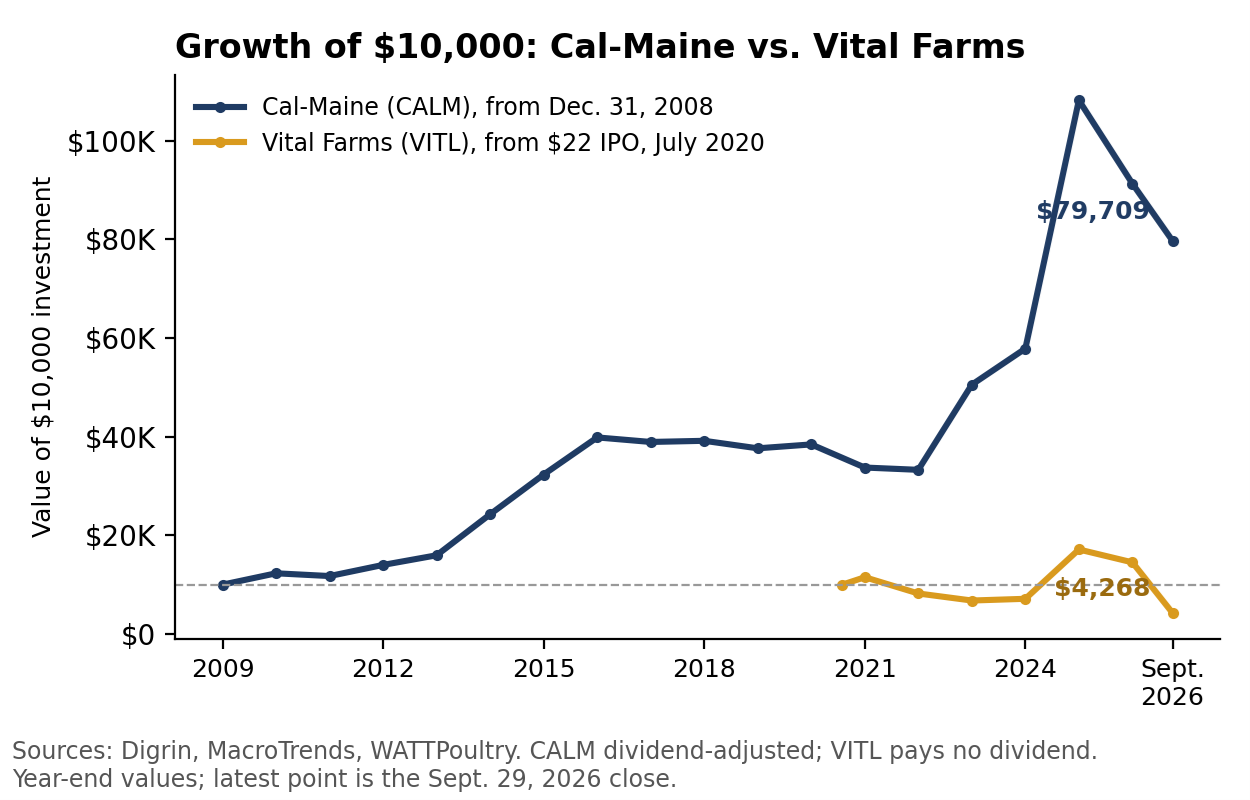
The same $10,000 put into Vital Farms at its $22 initial public offering (IPO) in July 2020 was worth about $4,270.
Over that same stretch since July 2020, Cal-Maine roughly doubled, dividends included.
Post Holdings: The Other Side of the Trade
You’ve no doubt seen Premier Protein drinks, Grape-Nuts cereal or Fruity Pebbles on the shelf, whether in a store or in your own home.
Those come from Post Holdings (POST). So do the egg and potato products that come from its Michael Foods subsidiary, which it sells to foodservice and food ingredient customers.
That makes Post a direct rival to Cal-Maine's Prepared Foods business. But with the opposite exposure to egg prices.
In other words, cheap eggs — like we have now — lower Post's costs.
In the quarter ended March 31, Foodservice segment profit jumped 79%, driven mainly by lower egg costs.
Still, Foodservice sales fell 6.5% to $652.9 million in the June quarter.
Segment profit fell 18.6% to $100.8 million, as a year-earlier bird flu pricing boost rolled off.
Post also carried $7.6 billion of long-term debt against $265.6 million of cash at the end of June.
Weiss rates it a D+ or SELL.
In a glut, Post is Cal-Maine's natural hedge.
But its heavy debt and its cereal and pet food businesses make it a different bet, not necessarily a better one.
What It Means for Your Portfolio
Cal-Maine carries a Weiss stock rating of C-, a HOLD.
If you own it, I'd follow the ratings’ lead and hold.
The balance sheet can ride out the glut. And stockholders' equity works out to roughly $55 per share. So, you've likely paid a modest premium to CALM’s book value.
If you don't own it, wait for the Weiss rating to reach B- or better before buying.
Income investors should know the dividend is paused.
Under its variable policy, Cal-Maine pays out one-third of quarterly profit. But it must first earn back a $94.5 million cumulative loss before paying again.
My forecast: Holiday demand into Thanksgiving and Christmas should narrow the losses over the next two quarters. But I don't expect to see the dividend return before spring, at the earliest.
Key Items We're Watching
- Wholesale egg prices into the holidays, when prices have historically run highest.
- Bird flu cases during fall migration, which would tighten supply and lift prices.
- Walmart's share of Cal-Maine's sales in future filings.
- Prepared Foods capacity, which management expects to rise more than 60% by the first half of fiscal 2028.
- Progress on the $94.5 million loss that stands between shareholders and the next dividend.
Bottom Line
Eggs don't care about recessions, and history says Cal-Maine's stock doesn't much care either.
It cares about how many hens are laying them.
Right now that's too many.
Which makes Cal-Maine a HOLD rather than a BUY … and SELL-rated Vital Farms and Post names to avoid.
When the flock math turns, Cal-Maine's cash pile means it will still be standing to collect.
Cheers!
Gavin