Central Banks Now Say AI Debt Is Out of Control

|
Key Takeaways
|
 |
| By Nilus Mattive Reviewed by: Jim Nelson |
Martin and I have been concerned about the growing specter of a new subprime crisis for a long time now, but about two months ago we took our warnings to a new level in this video that has since gone viral all around the world.
Now, even central bankers are starting to worry about what could happen next.
Take the European Central Bank. It just issued its latest Financial Stability Review, which included a special section devoted to financial risks associated with the AI buildout.
Here’s a choice excerpt from the report:
“As free cash flow has diminished, the AI infrastructure boom has come to rely on external sources of funding.
“For most hyperscalers, free cash flow has declined considerably since early 2025.
“It has turned negative in 2026 and is expected to remain so until 2028.
“The AI investment boom, which in its earlier stages was largely funded from internal profits, has therefore started to rely heavily on external sources of funding.
“This is reflected in large equity issuances by big tech firms, including seasoned equity offerings and record initial public offerings (IPOs) conducted or announced by AI-related companies.
“These large IPOs could be a sign of late-cycle market exuberance and run the risk of introducing additional volatility into equity markets.
“Big tech firms are also increasingly taking on debt (including euro-denominated debt) through private credit and public bond markets, with a notable rise in issuance.”
A little while later it also notes that …
“In recent weeks, concerns about the sustainability of this debt funding have risen, with credit default swap spreads for a number of big tech firms climbing to record levels.”
In simple terms, big tech companies were largely funding the AI buildout with their own money.
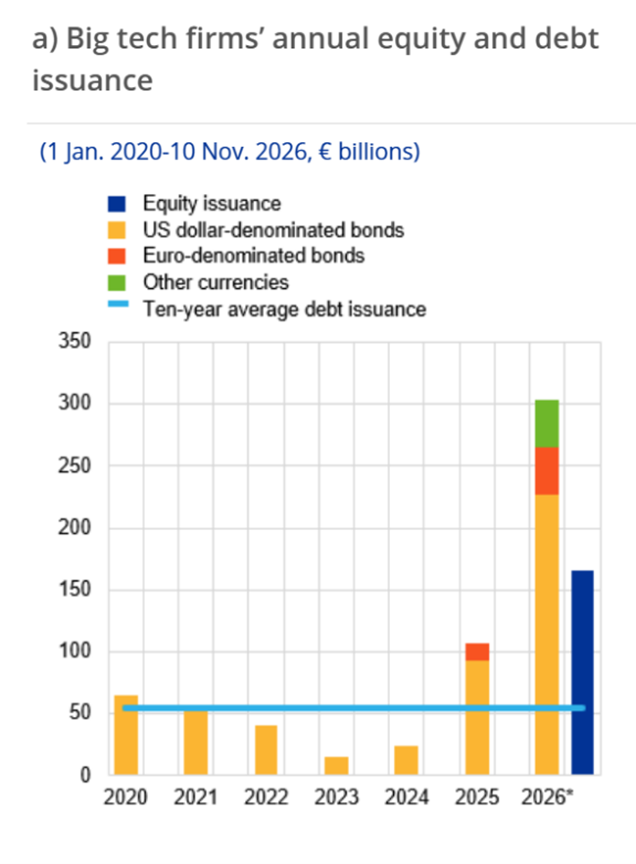 |
More recently, they have been using debt — including lots of opaque private loans — to keep pace with each other in what has essentially become a data center arms race.
We are talking TRILLIONS of dollars in loans here.
And now, many investors are paying huge premiums to buy insurance — in the form of credit default swaps — for protection if these loans ultimately blow up.
This is EXACTLY what we saw in the late stages of the housing-related Subprime Crisis.
Moreover, as the report notes, the other way these companies are getting funding right now is through massive IPOs.
Which is EXACTLY what we saw in the late stages of the Dot-Com Bubble.
I know because I was there for all of it.
I was starting my career on Wall Street just as the tech bubble grew and then popped …
I was at one of the “Big Three” credit ratings agencies as collateralized debt obligations became all the rage in the lead up to the subprime crisis …
And fortunately, I left all that behind to join forces with Martin just as he started to sound the alarm about what ultimately became the Great Financial Crisis.
It would be foolish to ignore our warnings about what’s happening this time around, which feels like a combination of the Dot-Com Bubble and the last Subprime Crisis.
We’ve been saying that for a long time now.
And this is precisely what the European Central Bank’s new report now says, too.
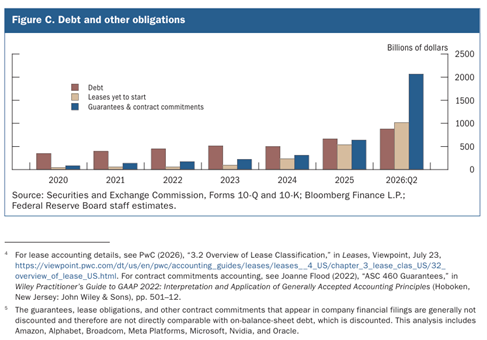
It notes just eight firms — Alphabet (GOOGL, “B”), Amazon (AMZN, “B”), Meta (META, “B-”), Microsoft (MSFT, “B-”), Nvidia (NVDA, “B”), Oracle (ORCL, “C”), Broadcom (AVGO, “B-”) and Anthropic (ANT, Not Yet Rated) — have “total off-balance-sheet commitments of more than $4 trillion as of the second quarter of 2026."
That’s IN ADDITION to what’s on their balance sheets.
The report’s conclusion about all of this?
"The rapid shift towards debt finance invokes historical parallels with the Dot-Com and Subprime bubbles.”
And it isn’t just European bankers. The Federal Reserve is now worried, too … as evidenced in the financial stability report that it released just a few days before the one from Europe.
Here are a few highlights that nicely summarize what I have been saying for more than a year now:
“Asset valuation pressures continued to be elevated. Measures of equity valuations have remained high, partly driven by market enthusiasm for super intelligence (SI).
“The ratio of equity prices to earnings for S&P 500 companies stayed well above its historical median, and an estimate of the equity premium — the compensation for risk in equity markets — remained low.”
And …
“Vulnerabilities associated with financial leverage remained notable. The banking sector remained sound and resilient overall.
“Banks continued to report regulatory capital levels near historically high levels, but fair value losses on fixed-rate assets remained sizable and sensitive to changes in long-term interest rates.
“Leverage at hedge funds reached the highest level since the data began in 2013 and was concentrated in a small number of large funds.”
And most importantly …
“Debt issuance to finance advanced computing infrastructure has grown rapidly over the past year.
“The composition of the debt being issued is also evolving from mostly corporate bonds to a combination of public and private debt, structured credit and project finance.
“In addition, large technology firms are rapidly increasing future lease commitments, backstop guarantees provided to other firms and other complex and contingent obligations.
“Advanced computing — related debt issuance rose to more than $680 billion by October 2026, about a fivefold increase from $130 billion in all of 2023.
“Investment-grade technology companies issued most of this debt, and advanced computing — related borrowing as a share of nonfinancial investment-grade corporate debt issuance increased from less than 6% in 2023 to about 31% in 2026.
“Outstanding public debt related to advanced computing is estimated at more than $1.1 trillion as of October 2026.
“Sizable transactions also occur in the private credit market, making the exact magnitude of advanced computing — related debt outstanding more difficult to measure.”
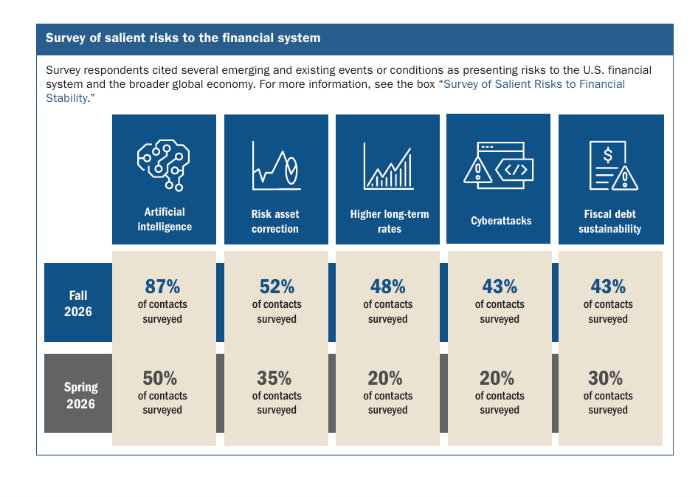
The report also included a very interesting survey result that showed 87% of respondents were worried about risks associated with AI … up from 50% back in the spring.
So basically, EVERYONE is worried about this now.
But in my opinion, the markets have not even begun to price these risks in yet.
Valuations are still very elevated.
Leverage is still high.
The underlying debt has skyrocketed.
It’s the same recipe we’ve seen before every other major crash.
Therefore, if you haven’t considered taking the protective steps Martin and I recommend at the end of our video warning, there’s still time to do so before it’s too late.
Best wishes,
Nilus Mattive
P.S. Want to keep earning solid income no matter what happens next? Then I also recommend you join me for tomorrow’s special briefing at 2 p.m. Eastern.
All you have to do is click here to reserve your seat and get a reminder before the event goes live.