 |
| By Sean Brodrick |
I think if we told people in 1970s America that one of the most promising places you could put your money was Vietnam, they’d call you nuts.
Fast forward over the decades, and I’m going to show you why Vietnam is an incredible opportunity.
And I’ll tell you an easy way to play it.
Right now, a massive wave of capital, factories and supply chains is quietly shifting into Vietnam.
The country put up roughly 8% real GDP growth in 2025, pushing the economy past $500 billion.
That’s a nice move for a “tiny” tiger.
And unlike many emerging markets, Vietnam isn’t fighting inflation or policy instability at the same time.
Inflation remains contained. Policy is pro-growth. And foreign capital is pouring in.
If exports stay strong and infrastructure spending ramps up as planned, upside scenarios point to much higher growth.
Vietnam Wins the ‘China +1’ Trade
President Trump stacked big tariffs on goods made in China. That will show them, eh?
Never mind that consumers pay the tariffs.
Factories in China took the hint anyway, and now they’re moving lock, stock and microchip to Vietnam.
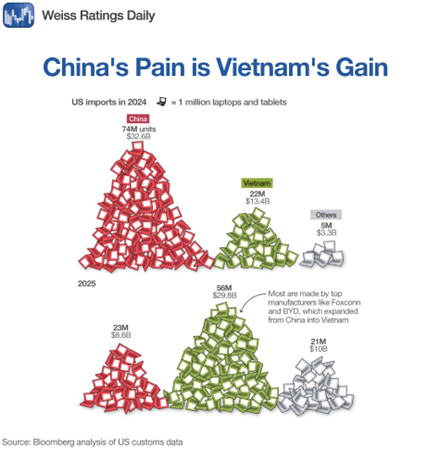
This chart shows how laptops and tablets imported to the U.S. have dramatically shifted their country of origin — from China to Vietnam.
And no wonder. Vietnam is literally right next door to China.
They share a long land border and sit in the same manufacturing neighborhood.
And it’s not just electronics. Many goods are cheaper to manufacture in Vietnam than in China and face lower tariffs when they enter the U.S. market as well.
Big names making the move include names like Samsung, Intel, Foxconn, Nike and Adidas.
Vietnam’s advantages are obvious:
- Labor costs are roughly 50% lower than in China.
- Geographic proximity keeps supply chains intact.
- Lower Trump tariffs on many products.
- Trade agreements with Europe and Asia open global markets.
Vietnam pulled in about $27 billion in foreign direct investment (FDI) in 2024, then ramped up to roughly $38 billion in 2025.
Manufacturing dominates that inflow — especially electronics, apparel and industrial production.
Exports tell the same story.
Total merchandise exports jumped to around $475 billion in 2025, up about 17% year over year.
Electronics alone are exploding higher, with exports nearing $165 billion.
Demographics Still Work in Its Favor
Vietnam is in the late stages of what economists call a “golden population” window.
The median age sits in the low 30s.
The workforce is still expanding.
And the population is projected to keep growing for decades.
A young, expanding workforce fuels consumption, productivity and long-term economic growth.
It’s one of the key ingredients behind every major emerging market success story — from South Korea to China.
Oil Risk, But Also Potential
Sure, Vietnam is exposed to rising oil prices caused by the war with Iran. Vietnam imports roughly 103 million barrels per year.
But that’s not a lot — about a third of what Thailand and Indonesia, two other Southeast Asian factory nations, import annually.
Vietnam used to be an oil exporter. Its legacy fields matured, which flipped it into a net importer.
But at higher oil prices — think $90 and above — new development becomes very attractive again.
And there’s a potential game-changer on the horizon.
A major offshore discovery — Hai Su Vang in the Cuu Long Basin — is being described as one of the largest finds in Southeast Asia in decades, with estimated recoverable resources north of 400 million barrels of oil equivalent.
That isn’t scheduled to come online until the end of the decade. There are ways to speed it up, but I would bet on Vietnam squeezing more oil from its old fields first.
The Investment Case Comes Together
Put it all together:
- Strong, sustained GDP growth.
- Massive investment inflows.
- Lower tariffs generally.
- Supply chain realignment in its favor.
- Favorable demographics.
- Manageable macro backdrop.
That’s the kind of setup you usually see before a major re-rating.
How to Play It: VNM
The cleanest way to access this trend is through the VanEck Vietnam ETF (VNM).
It holds about 50 companies across key sectors like:
- Financials (banks, brokers).
- Real estate and property developers.
- Consumer-facing businesses.
The valuation is what really stands out.
- The current P/E of the broad Vietnamese market is around 15x to 16x.
- Price/book around 2.1x.
- Forward earnings growth projected at around 13% to 14%.
That gives you a PEG ratio well below 1 on the broad market. And the VNM is the best of that market.
Translation: you’re paying a modest multiple for above-average growth.
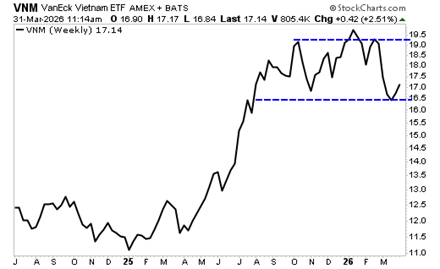
VNM has been rangebound since late last year.
It hasn’t yet reflected the improving fundamentals underneath.
That’s exactly the kind of disconnect you want.
Because once global investors start reallocating toward emerging markets — and toward supply chain winners like Vietnam — I expect the VNM to break out of that range and head for higher prices.
The bottom line is Vietnam is a real economy, growing fast, attracting capital and taking more share of global manufacturing.
The balance of forces is overwhelmingly positive. And the market hasn’t fully priced it in.
That’s your opportunity.
All the best,
Sean
P.S. Did you see yesterday’s huge announcement? My colleague, Michael Robinson, revealed the secret behind his 16 triple-digit winners over the past two years. Watch the replay here.