Consumers Are Stretched, Yet a $299 Skeleton Keeps Selling Out

 |
| By Sean Brodrick |
Times are tough. Inflation is eating away at purchasing power. Credit-card delinquencies are climbing. Millions of Americans live paycheck to paycheck.
Naturally, this means Americans are buying 12-foot-tall plastic skeletons. LOTS of them.
Heck, there might be one in your neighborhood right now.
I keep seeing them while I bike around central Florida.
They’re even more impressive in the nighttime.
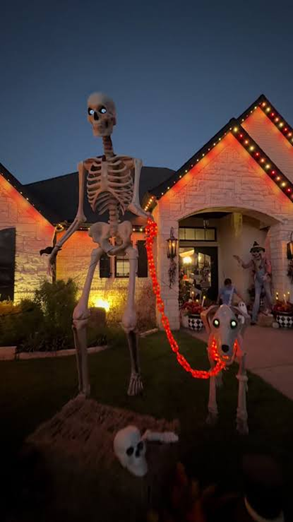
One near my mom’s house in Sarasota never comes down. It goes from spooky Halloween to pilgrim-decorated for Thanksgiving to dressed like Santa for Christmas. Ho-ho-ho!
The Monster’s Origin Story
The giant skeleton's origin story starts at Home Depot. Its $299 12-foot skeleton is affectionately known as "Skelly."
Some homeowners associations may have a bone to pick with Skelly. But he’s a monster hit.
Home Depot introduced him in 2020 after a merchandising executive noticed giant skeletons at haunted attractions and wondered why consumers couldn’t buy one themselves.
Apparently, a giant-skeleton-shaped hole in the American economy was waiting to be filled.
Home Depot (HD) recently said it has sold four times as many Skellies as in the product’s first year.
The company has repeatedly sold out, spawned a resale market and created an entire cottage industry of replacement bones, costumes and accessories.
Because if you’re going to spend $300 on a 12-foot skeleton, you certainly don’t want him standing around naked.
That would be tacky!
And Home Depot’s success sparked a giant skeleton gold rush.
Target (TGT) rolled out an 8-foot skeleton named Bruce, along with its 8-foot Lewis the Pumpkin Ghoul.
Lowe’s (LOW) sells 12-foot scarecrows and 10-foot reapers.
Refusing to let dust gather on its bones, Home Depot expanded the Skelly Cinematic Universe with a 7-foot skeleton dog, a 12-foot Grim Reaper, a 7-foot Frankenstein and interchangeable eyeballs.
This raises an obvious question: Aren’t consumers supposed to be broke?
Welcome to the K-Shaped Economy
Yes, many Americans are struggling, as years of compounded inflation have pushed up the cost of groceries, insurance, utilities, housing and other necessities.
Pandemic savings have largely disappeared for lower- and middle-income households.
Credit-card and auto-loan delinquencies have climbed.
But higher-income homeowners have benefited enormously from rising stock prices and home values.
Many refinanced or bought homes when mortgage rates were near historic lows and are sitting comfortably on 3% mortgages.
These people have money. And nothing says “I have substantial home equity” quite like an enormous skeleton staring down at your neighbors.
That’s the giant-skeleton economy.
And it illustrates something important about the economy as a whole: It’s split, with the top and bottom moving in opposite directions.
At the bottom of the "K," lower-income consumers are cutting back, trading down and scrambling to cover necessities.
At the top, affluent consumers spend big on travel, entertainment and discretionary goods, like the odd giant skeleton.
That’s why the economy can produce headlines about financially stressed consumers and neighborhoods that look like someone emptied a dinosaur graveyard onto the front lawns at the same time.
The Lipstick Effect Gets Really, Really Big
This also might be the “lipstick effect” at work.
The theory is that when people get nervous about the economy, they sometimes skip big purchases but keep indulging in smaller luxuries.
Maybe you postpone the $50,000 kitchen renovation. But $300 for a gigantic skeleton?
Well, now you’re just being financially responsible.
And compared with many other forms of entertainment, Skelly offers a surprisingly compelling value proposition.
You buy him once and haul him out every October for years.
And if — like that home in Sarasota — you can dress your skeleton for Christmas, St. Patrick’s Day, July Fourth and other holidays, it’s not just a Halloween extravagance.
Heck, it’s downright thrifty.
There’s also the entertainment value.
Kids love it. People photograph it. Owners post pictures and videos online.
One TikTok video shows shoppers lining up at 6 a.m. to snag two of the last Skellies at a local Home Depot. It got more than 2 million likes.
In a way, you’re not just buying molded plastic. You’re buying social currency.
And that is just the sort of discretionary spending that can survive even when consumers are becoming more selective elsewhere.
Halloween Becomes Big Business
The broader trend is impossible to miss. Americans have been spending more on Halloween decorations, shopping earlier and leaving their displays up longer.
The National Retail Federation forecasts that spending on Halloween decorations will hit $4.3 billion this year, up 65% from 2019.
So what does this bizarre trend tell us as investors? Bet on the retailers that can sell to both sides of the K.
3 Ways to Play the Giant Skeleton Economy
My first pick is Walmart (WMT).
Walmart is perhaps the ultimate trade-down winner.
It attracts lower-income consumers because they have to stretch every dollar.
But increasingly, it also attracts households earning $100,000 or more that have discovered there’s no prize for paying $7 for something Walmart sells for $5.
That makes Walmart unusually well positioned in an economy where nearly everybody wants value — even people who can afford not to worry about it.
Next is Costco Wholesale (COST).
Costco may be an even purer expression of the strange economy we’re living in.
Its shoppers skew affluent, yet those shoppers happily buy toilet paper by the pallet because they want a deal.
Costco combines two of the most powerful forces in retail: affluent consumers who still have money to spend and value-conscious consumers determined to make that money go farther.
Then there’s Home Depot, the company that created the giant skeleton boom.
Skelly has helped the company set Halloween sales records every year since his 2020 debut, and Home Depot says it now sells four times as many as it did in that first year.
More importantly, Skelly shows how Home Depot can make money even when consumers aren’t tackling $75,000 kitchen renovations.
That makes Home Depot a particularly appropriate pick.
If the giant-skeleton economy keeps booming, HD is selling the picks, shovels — and enormous plastic femurs. Such a deal!
Let’s look at a three-month performance chart of these three stocks.
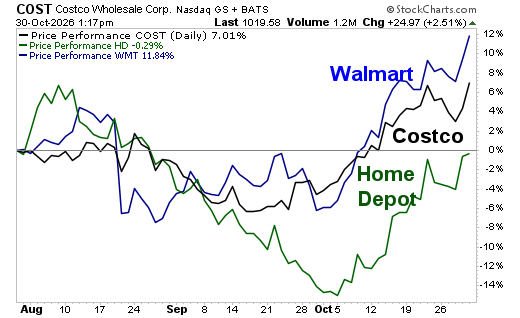
Walmart and Costco are leading the way higher, and Home Depot is playing catch-up … fast!
Put these three retailers together, and you have a pretty good snapshot of where American retail is headed.
Consumers are under pressure.
They’re becoming more selective.
They’re trading down where they can so they can continue splurging where they want.
Sometimes that means shopping at Walmart or Target.
And sometimes it means deciding the “thrifty” thing to do is to decorate your home with a 12-foot skeleton and a seven-foot skeleton dog.
The American consumer may be stretched. But apparently, there’s always room in the budget for Skelly.
Happy Halloween!
Sean