Data Centers Lost on the Ballot. Here's Why You Should Buy Today

 |
| By Sean Brodrick Reviewed by: Jim Nelson |
We may be looking at the contrarian play of the century.
AI data centers were roundly rejected in Tuesday's midterm elections. They're about as popular as diarrhea lettuce.
And Wall Street has responded by dumping stocks associated with the AI data center boom.
But among the rubble are companies with strong revenue, cash flow and earnings. Companies that stand to benefit from the biggest technology buildout in generations.
In other words, you may be able to scoop up some of these stocks at bargain-basement prices.
First, let's look at what went wrong.
Voters Tell AI Data Centers to Get Lost
Americans have fallen out of love with data centers because these enormous facilities consume staggering amounts of electricity.
They require water for cooling, strain local infrastructure and can drive up utility costs for ordinary homeowners.
Meanwhile, the companies building them have often demanded generous tax breaks.
What a deal! The world's richest technology companies get the benefits, while local communities get stuck with the bills.
Finally, Americans got to vote on the topic, and they said “ENOUGH!”
According to a post-election tally, communities in 13 states placed roughly 50 data center-related questions on local ballots during 2026.
Of 47 decided measures, 46 reportedly resulted in restrictions, bans, or moratoriums. That's a stunning 98% rejection rate.
In Ohio, one town after another approved restrictions on large data centers.
Illinois communities overwhelmingly rejected proposed facilities.
Kansas voters backed restrictions on particularly water-hungry operations.
And the backlash wasn't confined to local elections.
Democratic gubernatorial victories in Texas, Georgia and Iowa have raised the possibility of much tougher permitting requirements in states expected to host enormous new data center developments.
The implications for the AI boom are potentially enormous.
The Real Danger Is Coming in 2028
According to Michael Cembalest at JPMorgan Asset Management, 75% to 80% of the AI data centers scheduled for delivery in 2027 are already under construction.
Those facilities are likely to be completed regardless of the political backlash. But 2028 is another story.
Cembalest estimates that roughly 37 gigawatts of planned 2028 capacity could face outright pauses, while another 12 gigawatts could face onerous conditions.
That's an enormous amount of computing power.
For perspective, one gigawatt is 1 billion watts — roughly enough electricity to power hundreds of thousands of homes, depending on consumption.
Research firm SemiAnalysis reaches a similar conclusion.
Its analysts project 62.2 gigawatts of net U.S. data center additions in 2028, much of which hasn't started construction.
In a worst-case scenario involving permitting freezes, they estimate that 30.3 gigawatts of planned capacity could be at risk.
Take a look at this map from SemiAnalysis.
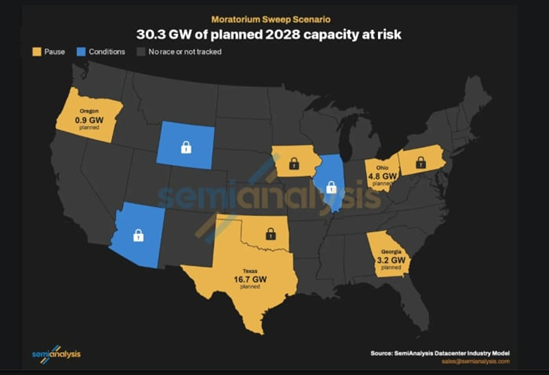
Texas alone accounts for 16.7 gigawatts of potentially threatened capacity in that scenario.
And data center builders face more than permitting delays.
They may have to pay for their own grid upgrades, accept water-use restrictions, comply with new labor requirements and give up lucrative tax incentives.
What? These trillion-dollar companies might actually have to pay their own way? Shocking!
Now for the twist …
The AI Boom Isn't Going Away
The demand for artificial intelligence isn't disappearing because voters don't want a data center in their backyard.
Companies still need computing power. AI models still need training. Businesses are still integrating AI into everything from manufacturing to medicine.
The companies providing that computing power will find ways to meet demand.
They'll adjust their plans, negotiate with communities, pay more in infrastructure costs and move projects to more welcoming locations.
I wouldn't be surprised to see Florida become a bigger player in the AI infrastructure boom.
The state's newly elected Republican governor, Byron Donalds, campaigned on respecting local government decision-making regarding data centers.
But that leaves plenty of room for development in communities that actually want these facilities.
It could also leave room for state-supported projects, including development on state-owned land.
The larger point is that the technology giants have been arrogant about where and how they build.
Now they're going to have to be smarter. They’re smart dudes. They’ll figure it out.
Goldman Sachs Sees a Silver Lining
Rich Privorotsky of Goldman Sachs believes investors are excessively pessimistic about the AI trade. He argues …
- First, AI-related stocks have already experienced substantial selling. Much of the bad news may be reflected in their prices.
- Second, the election has removed some uncertainty. Investors now have a clearer picture of the political obstacles facing new construction.
- Third, hyperscalers could actually accelerate spending.
Why? Because companies such as Amazon (AMZN), Microsoft (MSFT) and Alphabet (GOOGL) may want to get projects underway before tougher permitting rules take effect.
That could pull some future investment forward into 2027.
If new capacity becomes scarce, existing computing infrastructure becomes more valuable. And there’s plenty of evidence that the underlying AI investment cycle remains strong.
Advanced Micro Devices (AMD) recently reported excellent third-quarter results and issued robust fourth-quarter guidance, demonstrating that demand for AI hardware hasn't simply evaporated.
Sure, some projects will be delayed or canceled.
Companies that borrowed heavily to build speculative facilities could find themselves in serious trouble.
And higher construction and electricity costs could squeeze profits.
But it’s still worth spreading bets across the companies that own and operate the infrastructure powering the AI revolution.
My Pick to Profit
Consider the Global X Data Center & Digital Infrastructure ETF (DTCR).This fund holds a basket of stocks with exposure to AI infrastructure.
Its holdings include major data center real estate investment trusts such as Digital Realty Trust (DLR) and Equinix (EQIX), along with digital infrastructure businesses such as American Tower (AMT).
It also provides exposure to hardware and infrastructure companies that build and equip data centers.
And DTCR carries an expense ratio of 0.5% annually.
Here’s a weekly chart …
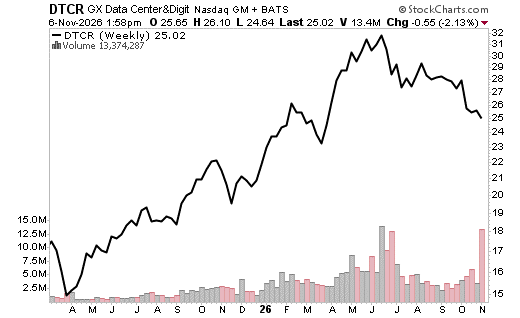
You can see DTCR rallied hard into June and has been correcting since then as it digested those gains. Its next leg should be higher.
I like its exposure to established operators with valuable existing infrastructure.
If permitting restrictions make new data centers harder to build, operating facilities with secured power supplies could become even more valuable.
And if the construction boom resumes, the fund can participate in that growth, too.
DTCR isn't immune to higher interest rates, construction delays or another AI sell-off. But diversification reduces the danger of betting on one highly leveraged developer.
Wall Street is treating the political backlash against data centers as though it could bring the AI revolution to a screeching halt.
I think that's a mistake. The next phase of the AI boom may be more expensive, more heavily regulated and more geographically selective.
But the computing power still has to come from somewhere.
A sudden end to the AI data center boom, well, it just does not compute.
If you’re a contrarian, DTCR is the way to go.
All the best,
Sean
P.S. Of course, you should also consider the risks of leveraging back into the AI trade. Watching this presentation by Dr. Martin Weiss should be your first action before buying OR selling anything.