Eli Lilly Clears a Higher Bar as Equal Weight Beats the S&P 500

|
Key Takeaways
|
 |
| By Gavin Magor Reviewed by: Leo Tavolaro |
You didn't take charge of your own portfolio to earn what an index fund pays.
You did it to beat one.
Thursday showed that instinct is sound.
It also showed the bar for success is set to stay high.
A tougher hurdle, a lopsided index and one stock clearing both.
Four in Five Stocks Won. The Index Still Lost.
On Thursday, 406 stocks in the S&P 500 rose.
That's about four of every five.
Yet the index itself closed down 0.3%.
The equal-weight version, where every stock counts the same, rose 1.2%.
The gap came from a handful of giants.
Alphabet (GOOGL) alone fell almost 13% after reporting negative free cash flow.
That means its spending on property and equipment took more cash than its businesses brought in.
Investors sold on worries about mounting AI costs.
Don't read that drop as a verdict on the company.
Alphabet carries a Weiss rating of B, a BUY.
Google Cloud revenue more than doubled in the quarter.
The market sold the spending, not the business.
It closed Thursday at $283.82.
That pullback hands you a BUY-rated name at a lower price.
That matters to you because the S&P 500 is no longer a broad bet on American business.
The Magnificent Seven technology stocks make up about 35% of its value.
So when you measure yourself against the index, you are mostly measuring yourself against seven stocks.
This year, that's a contest a careful stock picker can win.
Your New Hurdle Is the 2-Year Treasury
The index isn't your only opponent.
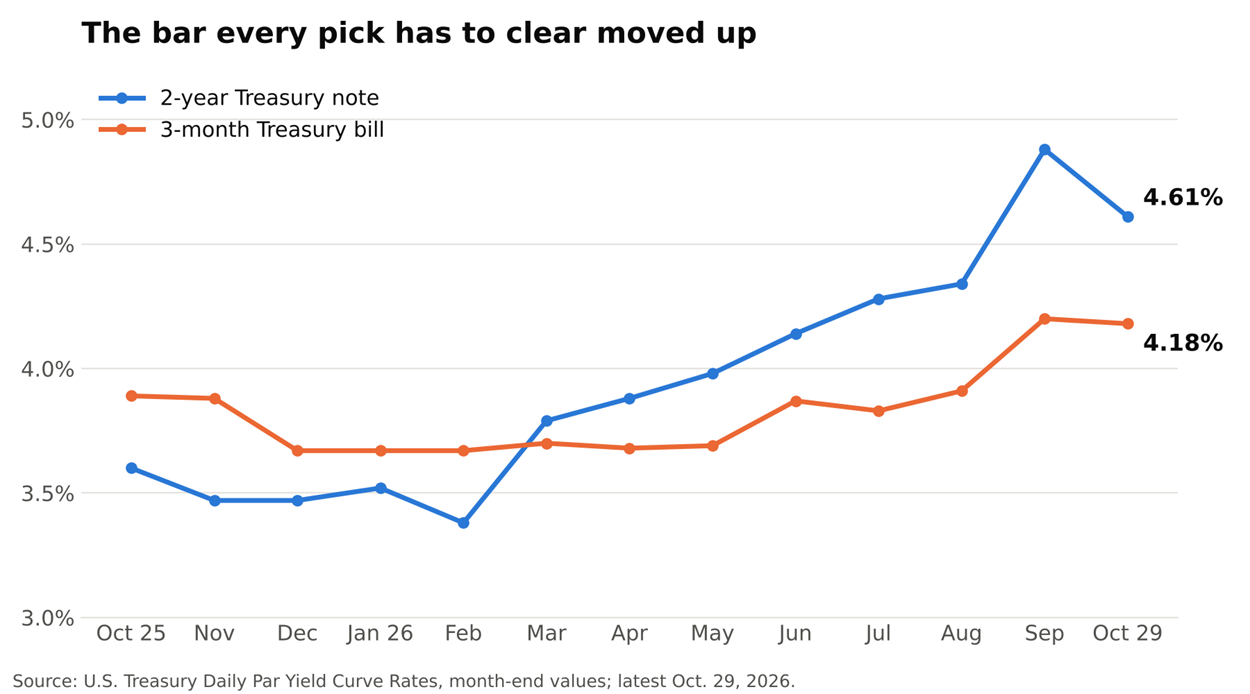
Every stock you buy also competes with a risk-free alternative: the 2-year Treasury note.
It closed Thursday yielding 4.61%.
A year earlier, it yielded 3.59%.
So a stock now has to beat a guaranteed two-year return before its risk is worth taking.
And Thursday's data says that bar isn't coming down soon.
Growth Is Hot and Prices Are Sticky
Gross domestic product (GDP) grew at a 3.4% annual rate in the third quarter, the Bureau of Economic Analysis (BEA) reported.
The core personal consumption expenditures (PCE) price index, which excludes food and energy, rose 3.1% in the year to September.
That's well above the Federal Reserve's (Fed) 2% target.
On Friday, the Employment Cost Index (ECI) showed compensation costs for civilian workers up 3.4% over the past year.
The Fed held rates steady on Wednesday, but two policymakers voted for a hike.
Futures traders put the odds of a December hike near 80%.
I expect short-term rates to stay high well into 2027, longer than many investors assume.
For a stock picker, that changes which companies deserve your money.
High rates make investors impatient with companies whose spending runs ahead of their cash.
They reward companies already turning sales into cash.
The Scoreboard Says Picking Pays
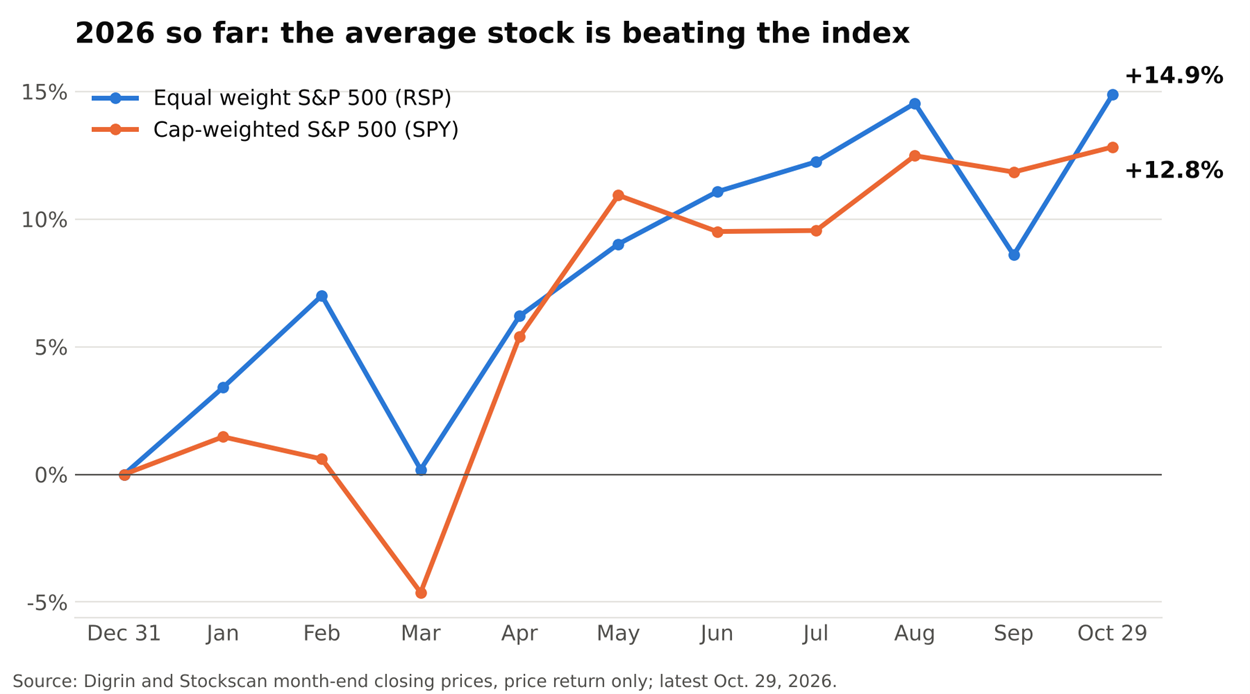
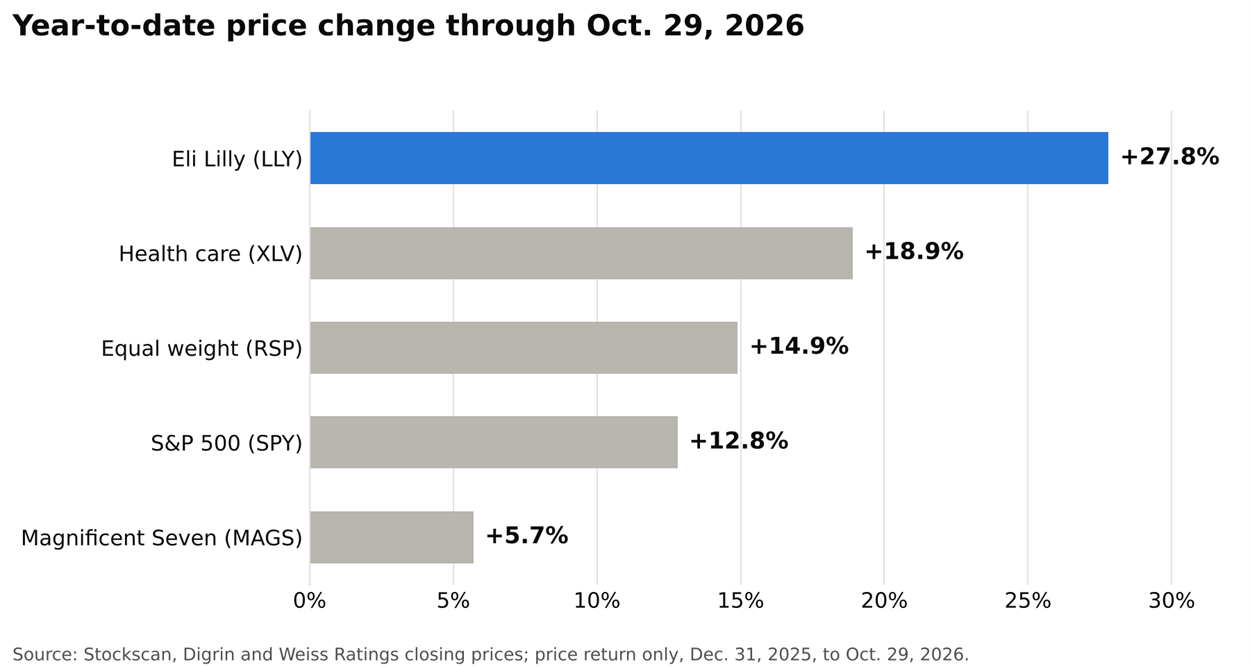
Through Thursday, the S&P 500 was up 12.8% this year.
An exchange-traded fund (ETF) holding every stock in equal measure, the Invesco S&P 500 Equal Weight ETF (RSP), was up 14.9%.
As recently as Oct. 7, it trailed the index by about four points.
October flipped that.
The Magnificent Seven, as a group, gained just 5.7%.
Health care did far better.
The State Street Health Care Select Sector SPDR ETF (XLV) was up 18.9% for the year through Thursday.
The sector set a record high on Thursday.
Our ratings show the better index still isn't the best you can do.
The equal-weight fund carries a Weiss rating of C+, a HOLD.
The health care fund also earns a C+, a HOLD.
Both beat the S&P 500 this year, but neither is a fund we'd rush to buy.
The returns that clear the hurdle with room to spare come from individual stocks with strong ratings.
That's how we run the Weiss Ultimate Portfolio, which I edit: every position gets the same weight, and every stock has to earn its place.
The Medicine Cabinet Has More Than One Remedy
Three large drugmakers reported in October, and our ratings separate them clearly.
Johnson & Johnson (JNJ) carries a Weiss rating of B-, a BUY.
Its third-quarter sales rose 5.9%.
It also raised its full-year guidance, the kind of steady progress that clears a 4.61% bar.
AbbVie (ABBV) earns a Weiss rating of B, a BUY.
On Friday, it reported third-quarter revenue up 10.3%.
It raised its adjusted earnings guidance at the same time.
That gives you a second strongly rated way to own the health care rally.
Merck (MRK) also raised its earnings guidance on Thursday.
But its Weiss rating is C, a HOLD.
If you own it, our rating says keep it, not add to it.
Know When a Stock’s Rating Changes
With Weiss Ratings Plus, you get an instant alert when a stock you follow is upgraded or downgraded.
You can screen with our Risk, Reward, Growth and Solvency indexes, among others.
You can compare any stock with its sector and the broad market.
And you can build a watchlist of the names in this report.
Click here to see everything Weiss Ratings Plus includes.
The Stock That Made Thursday's Index Look Wrong
Remember those 406 stocks that rose while the index fell?
Eli Lilly (LLY) was one of the standouts, and it carries a Weiss rating of B, a BUY.
Shares closed Thursday at $1,373.70.
That was a gain of 6.6% on the day.
Sales That Turn Into Cash
Third-quarter revenue reached $24.4 billion.
That's 39% more than a year earlier.
Mounjaro, its diabetes drug, brought in $10.7 billion on its own.
Zepbound, its weight-loss drug, added another $5.4 billion.
Sales of Foundayo, its new weight-loss pill, nearly doubled from the second quarter.
Lilly raised its full-year revenue forecast for the third time this year.
The new range is $91 billion to $92 billion.
The old range topped out at $87 billion.
This is exactly the kind of company high rates reward.
It is turning sales into cash now, not promising it later.
Through Thursday, the shares were up 27.8% this year, more than double the S&P 500's gain.
That's a stock clearing both hurdles at once.
What I'm Watching
- Tuesday's midterm elections, which could stir short-term swings in the megacaps that dominate the index.
- Amgen (AMGN) reports after the close on Tuesday. With a Weiss rating of B+, a BUY, it's the next test of the health care rally.
- The BEA's second estimate of third-quarter GDP on Nov. 25.
- The Fed's December meeting, which ends Dec. 9. A hike would lift the hurdle again.
Bottom Line
You didn't take charge of your own portfolio to earn what an index fund pays.
Thursday proved you don't have to.
Four in five stocks beat the index that day.
Use the 2-year Treasury note's yield as your hurdle for every new buy.
Then put that test to work with Eli Lilly, a B, a BUY, at market.
After Thursday's pullback, Alphabet, also a B, a BUY, is worth buying at market too.
Cheers!
Gavin