Editor’s note: In Part 2, Dallas Brown showed how America’s founders fought a war to own their money and owe no one. In Part 3 of this four-part series, he follows Washington’s $40 trillion debt from the Capitol to the gas pump, and shows what history says comes next.
 |
| By Dallas Brown |
Here’s where we are.
As of Oct. 5, the federal government owed more than $40.25 trillion. That’s $2.39 trillion more than one year ago.
That’s some $6.5 billion of new debt every 24 hours. Split it up, and every household in America owes about $298,606.
This doesn’t even include your mortgage. Or car loan. Only money Washington has borrowed in your name.
In August, the annual interest bill on all that debt topped $1 trillion for the first time. That’s more than $2.7 billion every day just to pay rent on money that’s already been spent.
It gets worse.
Washington overspent by nearly $2 trillion in the fiscal year that ended Sept. 30, the most in five years. And the Congressional Budget Office expects that to hit $3.1 trillion a year by 2036.
By then, the debt the public holds will equal 120% of our entire economy — blowing past the record set right after World War II.
When a government owes that much, it has two choices. Make real cuts. Or quietly print money and let inflation shrink the debt.
Guess which one Washington picks.
That’s the double tax. You’re taxed once when you earn a dollar. Then you’re taxed again as that dollar quietly loses value in your savings account.
That second tax is about to get a lot heavier …
You Can See It in Months, Not Years
This isn’t a warning about 2036. It’s on your receipts right now.
In September alone, prices jumped 0.6%, seasonally adjusted. Over the past year, they’re up 3.7%.
Now look at what you actually buy.
- Gasoline: up 9.1% in one month. Up 34.2% in a year.
- Heating oil: up 74.2% in a year.
- Energy overall: up 20.4% in a year.
- Plane tickets: up 22.4% in a year.
Zoom out, and it hurts even more. By the government’s own price index, what cost $100 in January 2020 cost about $131 by September 2026.
A dollar you saved before the pandemic now buys about 77 cents’ worth of goods and services.
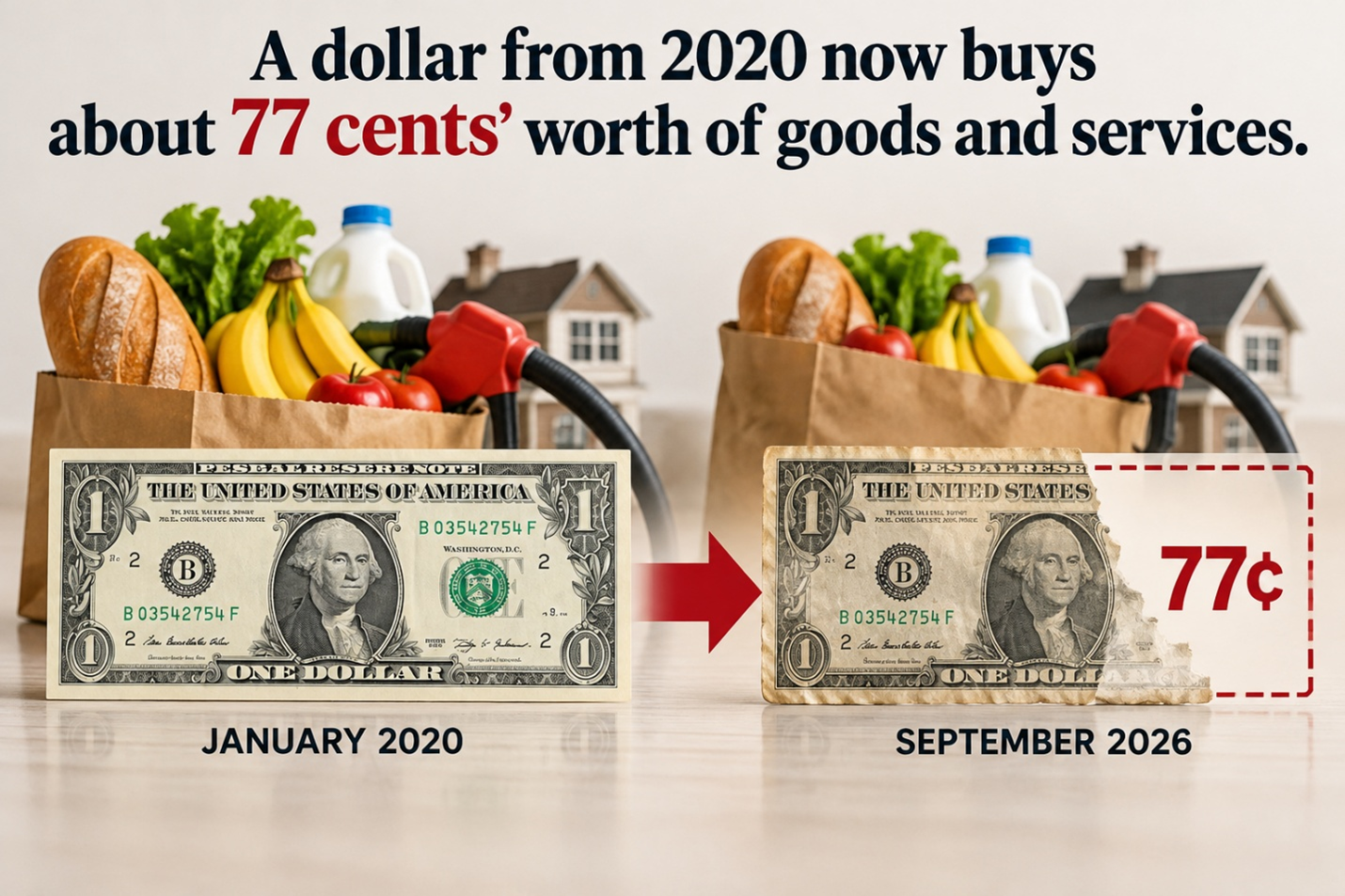
Seventy-seven cents. You worked for a full dollar.
Even the Federal Reserve has run out of excuses.
On Sept. 16, it raised interest rates for the first time since 2023. Its new chairman, Kevin Warsh, admitted inflation has been “too high ... for too long.”
On Oct. 28, the Fed held rates steady. But two officials voted to raise them again.
Still, long-term interest rates sit at their highest level in 24 years.
That’s how it starts.
First gas.
Then everything that rides on a truck.
Then everything else.
The Empire Clock
Ray Dalio has studied 500 years of great empires and their money. The Dutch. The British. The Americans. The Chinese dynasties.
He found the same story every time. A country rises. It works hard, builds, invents, saves. Its money becomes the money the whole world trusts.
Then it peaks. It borrows. It prints. It gets comfortable.
Meanwhile, a new power starts to emerge. Indeed, this is likely taking place right now as a rising China challenges an over-extended America.
The great empires Dalio studied lasted roughly 250 years. And America just turned 250.
On top of that, the transition between empires is almost never peaceful, but fraught with conflict and violence.
The old power doesn’t give up its place quietly. It fights. With tariffs. With sanctions. With money wars. Sometimes with real wars.
In March, Dalio said the years ahead will look more like the chaotic era before 1945 than anything most of us have lived through.
He also explained what lenders do when they start to fear they’ll be paid back in cheap money, or not at all.
They sell bonds and buy gold.
When he wrote that, gold had jumped 70% in a single year.
That was the whole world voting on whether it still trusts Washington’s promises.
The world is voting. Now it’s your turn. And you don’t have to wait for Election Day.
You can’t stop Washington from borrowing. Not by yourself. But you can refuse to stay silent while the bill lands on your receipts.
Click here to sign the Declaration of Dollar Independence.
In the final installment, I’ll tell you how one family already won this fight once, and the steps you can take right now to protect what’s yours.
Own our money. Owe no one our freedom.
Dallas Brown