Google's $4.3B Nuclear Deal Proves AI's Power Hunger. Here's Who Gets Paid First.

 |
| By Al Qureiyeh |
If you've been waiting for proof that AI really needs all the power Wall Street keeps talking about, you just got it.
Alphabet (GOOGL) has agreed to buy the extra electricity from a $4.3 billion upgrade of Constellation Energy (CEG) nuclear plants for 20 years, to run Google's AI data centers.

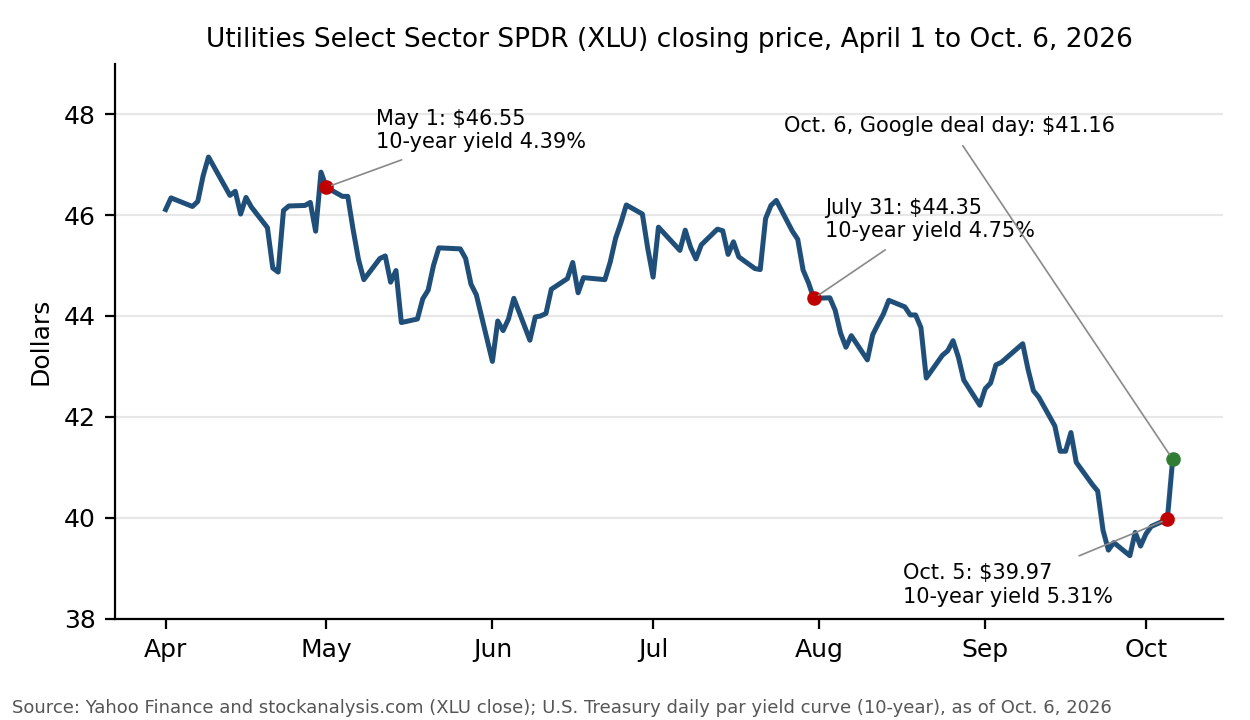
But if you've tried to profit from that demand through utility stocks, you've probably lost money. Over the past month, the Nasdaq-100 is up nearly 6%, while the biggest utility fund is down more than 4%.
There's a reason for that gap. And there's a better way to own the build-out: the companies selling the equipment every new power plant and data center needs.
What Happened
The exception is Constellation, which jumped about 12% on Tuesday.
Constellation will add nuclear capacity by upgrading its existing reactors, and Google will buy that power for the life of the deal.
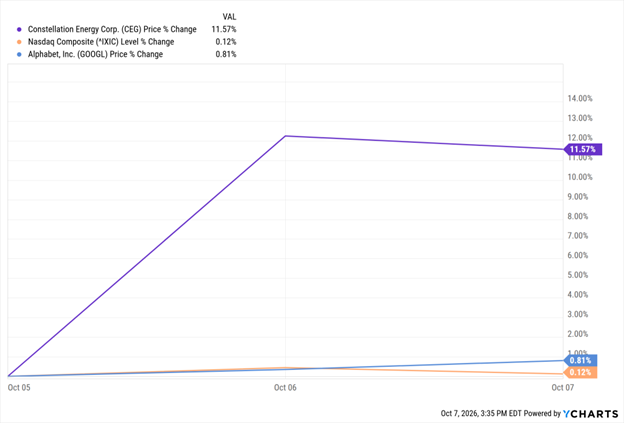
The first upgrade is due in 2028, and the price was not disclosed.
The power producers that sell into the open market led the rally: Talen Energy (TLN) and Vistra (VST) rose sharply on Tuesday alongside Constellation.
The regulated utilities, whose prices are set by state commissions, rose far less, with Duke Energy (DUK) and NextEra Energy (NEE) up only modestly.
Same for the Utilities SPDR (XLU), which holds Constellation, Vistra, Duke and NextEra.
Markets took the news of Alphabet’s fifth nuclear deal at face value. The 10-year Treasury yield, the rate on a 10-year government loan, barely moved. So, the jump did not come from rates.
Why the Skeptics Are Only Half Right
Most commentary on the deal was upbeat, with two worries.
First, the payoff from Tuesday's deal is years away, because the first upgrade does not arrive until 2028.
Second, some people worry that data centers will push up household power bills.
That concern is real, but it’s also easing.
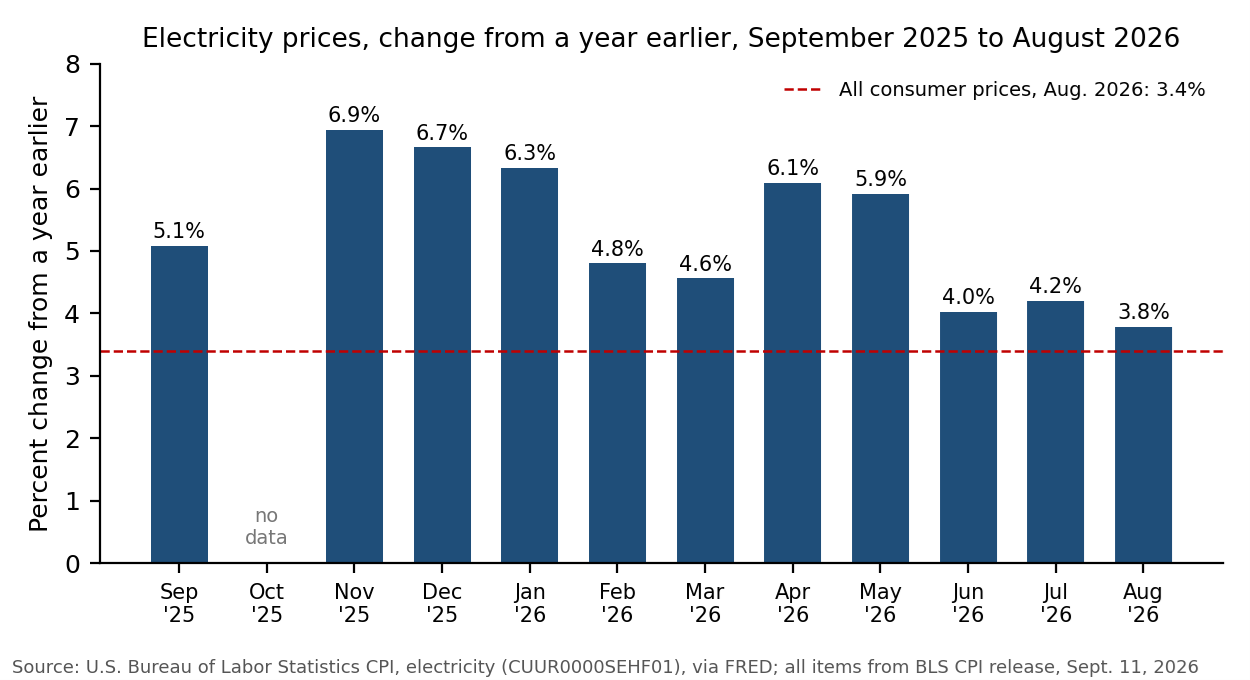
The average summer power bill came to about $11 a month more than last summer, according to the Energy Information Administration's September outlook.
Electricity prices are still rising, but more slowly than they did last winter.
The Rally Leaders Aren't Our Top-Rated Names
We combed the utility fund's holdings, and the names leading the rally are not the ones Weiss rates highest.
The XLU’s biggest holdings are the regulated utilities, and Weiss rates them a BUY: Duke, Southern Company (SO), American Electric Power (AEP) and Dominion Energy (D) all earn a "B," and NextEra earns a "B-."
The equipment makers also earn a BUY: GE Vernova (GEV) is "B" and Eaton (ETN) is "B-."
The rally leaders rate lower: Constellation and Vistra are each "C," a HOLD, Talen is "D+," a SELL, and the XLU itself is "C," a HOLD.
Then there’s Oklo (OKLO) and NuScale Power (SMR). In addition to their "D-," or SELL, ratings, neither has a reactor producing power for sale.
And Tuesday's deal backs large reactors that already run.
Utilities Are Now Trading Like Bonds
Since August, utility stocks have behaved less like growth companies and more like bonds. When Treasury yields rise, utilities fall.
Over the past month, the 10-year yield rose on 15 trading days, and the utility fund fell on 10 of them.
That makes sense. Many investors own utilities for steady income. With Treasurys now paying more than 5%, they can get that income from government bonds instead.
The demand did not go away, and it shows up as orders for the turbines, transformers and switchgear that new power plants and data centers need.
The equipment makers receive those orders, and their shares have risen with the AI stocks rather than slumping with the utilities.
This Buy-Rated ‘Utes’ May Be Worth Buying Here
With Treasurys on fire, and select utilities trading like bonds, our top pick among the XLU components is Eaton.

Eaton makes the gear that moves power inside data centers, and orders for its electrical business in the Americas rose 41% over the past year, according to its July report.
Eaton beat the S&P 500, an index of 500 large U.S. companies, in most of the recent periods when rates jumped this fast.
Wednesday’s closing price of $431.33 is about $50 below the average target on Wall Street of around $480. That’s about an 11% potential gain, but for a utility, that’s not a small move.
Plus, Eaton pays you to wait, with a quarterly dividend of about $1.10 a share, good for a current 1% annual dividend yield.
Our time frame is within a year, with the first checks at GE Vernova's report on Oct. 28 and Eaton's own in early November.
The Story Behind Another Ute ‘Buy’
GE Vernova builds the gas turbines and grid equipment new power plants need, and its unfilled orders stood at $176 billion in July.

Its shares trailed the S&P 500 from May to July, the last such rate jump, so a further climb in yields is its main risk.
GEV stock closed Wednesday at $997 after sliding all week. So, this is a rare chance to grab the stock while there’s no comma in the price tag.
The Takeaway
Both Eaton and GE Verona would lose if data-center spending were cut, so they share that risk.
Because of that risk, they didn’t quite make the cut for my AI Profit Accelerator portfolio.
That strategy is driven by fundamentals and short-term algorithms, while this is a longer-term theme … and a speculative one at that.
Demand for power is growing, but utility stocks have been trading like bonds, so we would own the companies taking the orders for the equipment.
Eaton and GE Vernova earn solid Weiss “Buy” ratings … and their prospects support the stocks’ potential to stay at current levels and rise from here in the coming months.
What We're Watching
First, earnings.
GE Vernova reports on Oct. 28, and if its backlog of unfilled gas turbine orders and reservations shrinks from 116 gigawatts, the build-out case is wrong and we will say so.
Eaton is expected to report in early November, and we want its data-center orders still growing.
Second, winter power bills.
The Energy Information Administration's Oct. 6 outlook expects households that heat with electricity to pay slightly more than last winter, while natural gas bills fall.
That assumes a winter like last year's, so a colder one would push bills higher and draw more political pressure on utilities.
Third, geopolitics.
The war in the Middle East keeps oil near $100 a barrel, and a wider conflict would raise every power producer's fuel costs.
The Nov. 3 midterm elections will decide who sets the rules for data-center power and who pays for it.
Fourth, select other XLU components.
We would buy Duke, Southern and American Electric Power, each rated "B," a BUY, once the 10-year yield stops climbing.
We would buy Constellation and Vistra, each rated "C," a HOLD, if Weiss upgrades them to a BUY.
Take care,
AL Qureiyeh