How to Get Paid No Matter What Friday's Jobs Report Says

 |
| By Gavin Magor |
Market moves can feel irrational in the moment, which is exactly why we lean on data instead of headlines.
Right now, the data says two things are slipping: job openings and consumer confidence.
Here's what that means for your portfolio — and for the income you actually live on.
Jolted Confidence
Yesterday, two reports took its temperature at the same time.
Neither reading signaled a crisis. But together, they told a story worth acting on before this coming Friday's jobs report.
The Bureau of Labor Statistics (BLS) said in its Job Openings and Labor Turnover Survey (JOLTS) that job openings fell to 7.08 million at the end of August.
That's down 256,000 from July's upwardly revised 7.34 million, and below the 7.23 million economists expected.
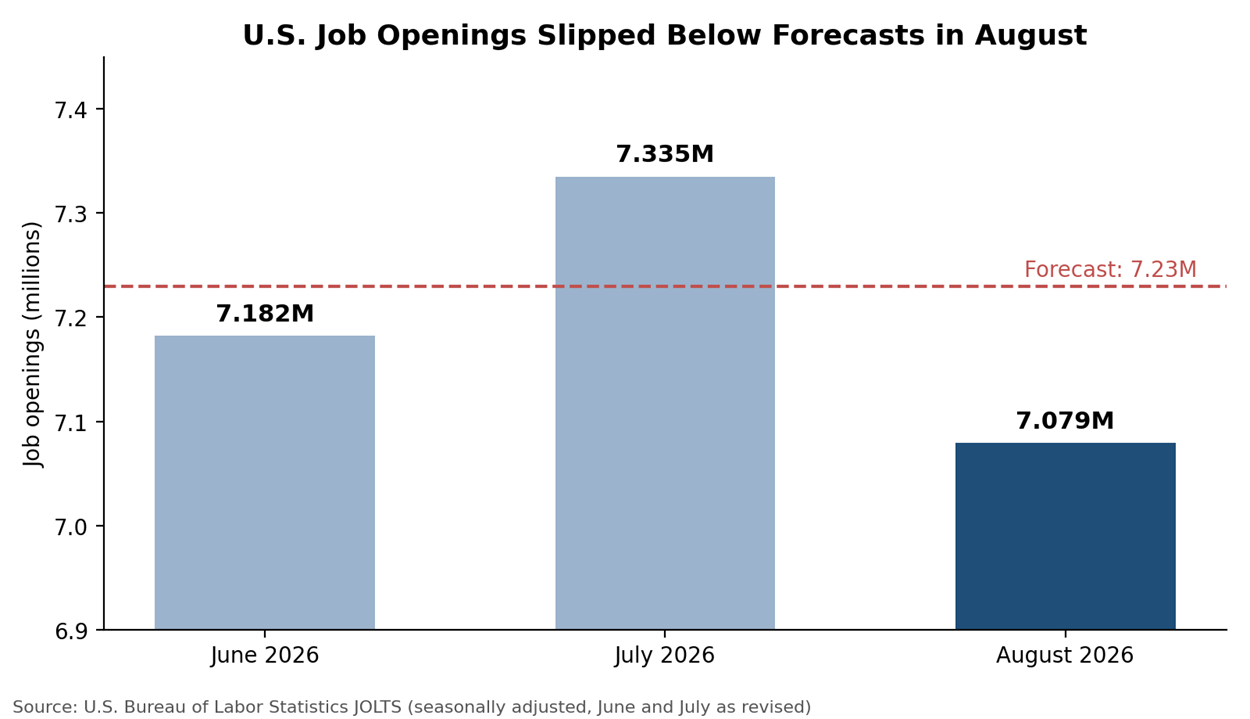
That’s the lowest reading in five months.
The biggest declines came in professional and business services and in healthcare and social assistance.
Confidence Just Hit Its Lowest Level Since 2014
At the same time, The Conference Board's Consumer Confidence Index fell 6.7 points to 81.9, well below what forecasters expected.
That's its lowest level since 2014.
The Expectations Index, which tracks how people see the next six months, dropped to 63.6.
The Conference Board has long treated readings below 80 as a recession warning.
Meanwhile …
Just 1.7 Points Separate ‘Plentiful’ Jobs From ‘Hard to Get’
Buried in the confidence survey is a simple labor gauge.
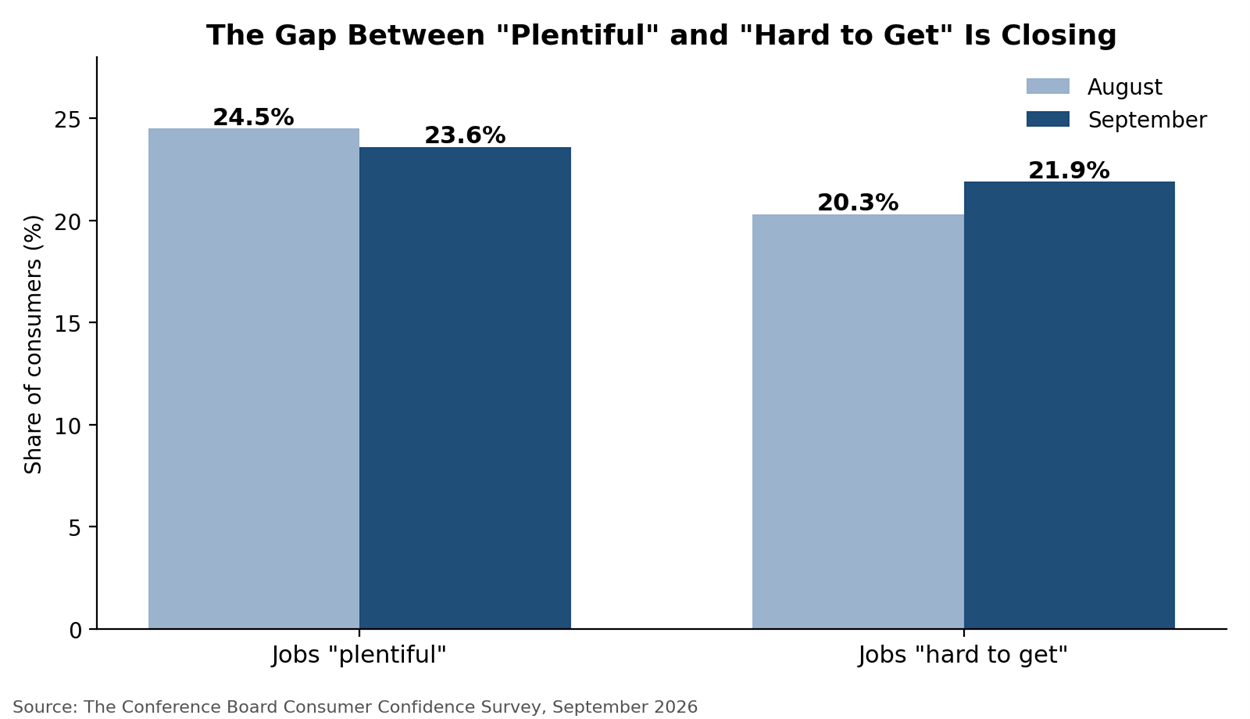
In September, 23.6% of consumers said jobs were "plentiful," down from 24.5% in August.
Meanwhile, 21.9% said jobs were "hard to get," up from 20.3%.
That leaves a gap of just 1.7 percentage points.
Looking ahead, 28.4% expect fewer jobs six months from now.
That's roughly twice the 14% who expect more.
Nobody's Getting Fired. Nobody's Getting Hired, Either.
Hires changed little in August, at 5.2 million.
Layoffs and discharges were essentially unchanged at 1.6 million.
Quits held at 3.1 million.
So, employers aren't firing. They just aren't replacing workers or adding new roles.
It's a low hire, low fire job market.
For people who have a job they want to keep, that can be reassuring.
For anyone still earning a paycheck and hoping to negotiate a raise, it's an employer's market again. For everyone else, it's one more reason to keep cash close.
That's awkward timing, since consumers' average 12-month inflation expectations rose to 6.1% in the same survey.
Fewer openings mean less leverage to win a raise that keeps pace.
How to Keep Getting Paid No Matter What
First, shore up your cash reserve.
Your first line of defense isn't in your brokerage account.
It's an emergency fund you can reach without selling anything.
If your income is even remotely dependent on a slowing hiring environment — clients, contracts, or a business that leans on staffing — now is a sensible time to top up that reserve.
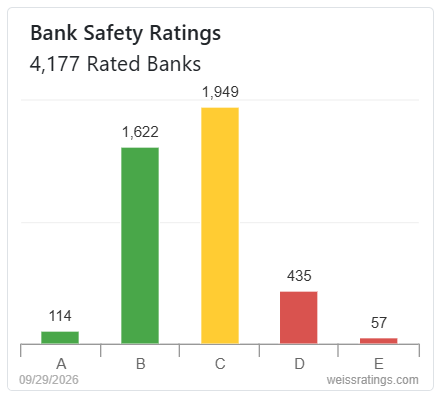
Keep that cash at a bank, credit union or other financial institution with a strong Weiss Safety Rating, so your liquid safety net is safe.
Second, don't trade the mood.
Confidence surveys measure how people feel. And feelings move faster than paychecks.
The hard data on hires and layoffs barely budged.
Selling stocks because a survey soured is how investors lock in a bad week.
Consumers in the same survey still expect stock prices to rise over the next year, just with less conviction than before.
Third, watch the canary.
Staffing firms feel a hiring freeze before almost anyone else.
Robert Half (RHI) is a good example.

Its 6.42% dividend yield looks tempting.
But a yield that high on a cyclical business is the market asking a question, not handing out a gift.
Also tempting: Shares are trading at a discount.
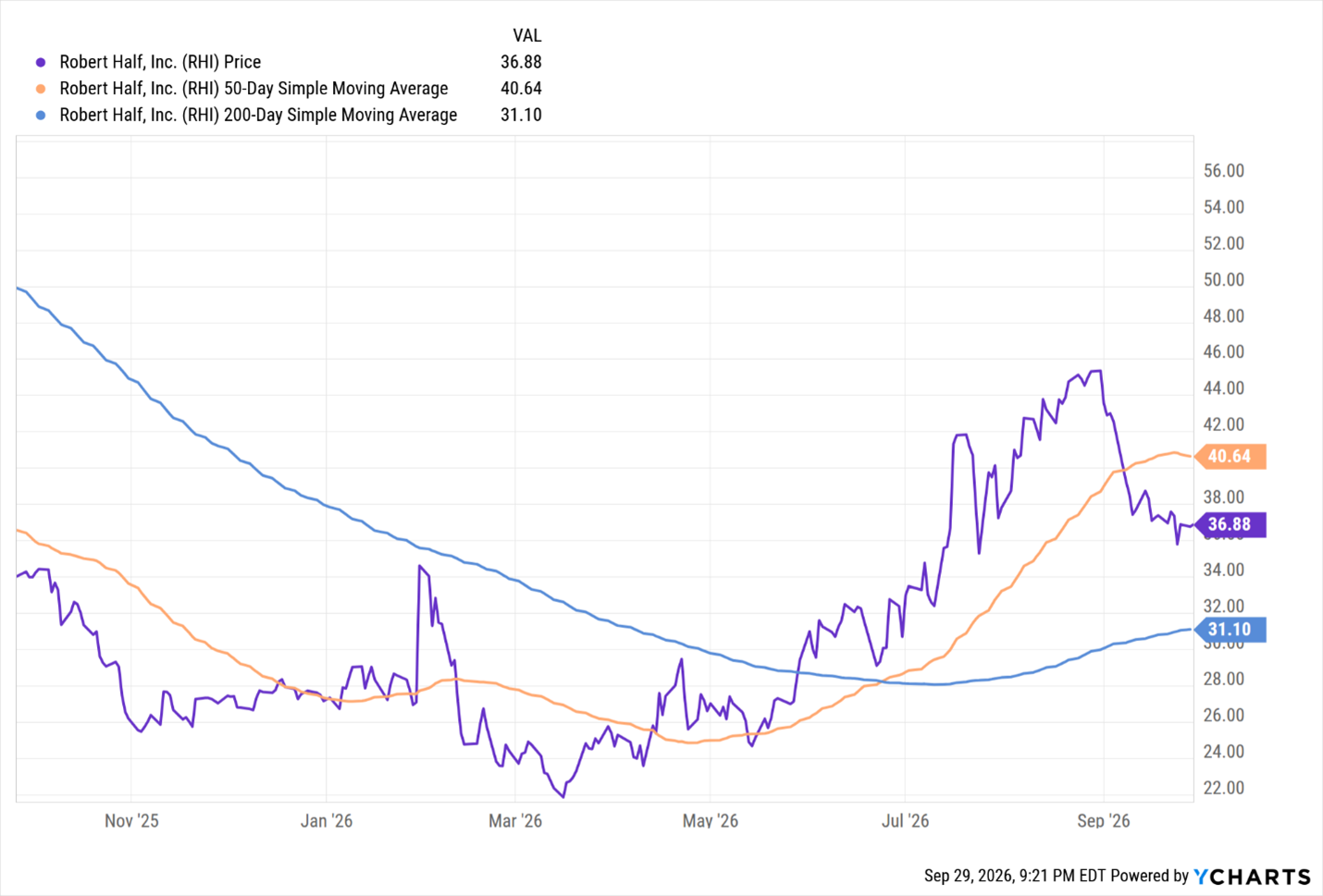
RHI closed yesterday at $36.88. That’s well below their 52-week high of $46.70.
However, the stock carries a “C” Weiss rating, a HOLD, after our system upgraded it on Sept. 24.
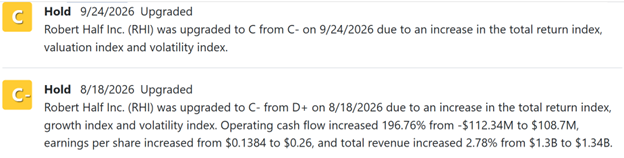
So, for my part, I'll be watching Robert Half —the company, not the stock — as an early signal of when hiring starts to thaw.
Fourth, lean on what people buy anyway.
The survey showed consumers planning to spend less on hotels, airfare and movies.
Beyond their top categories, they leaned toward necessities and inexpensive treats.
That's a world where a can of soda still sells.
Coca-Cola (KO) carries an “A-” Weiss rating, which puts it firmly in BUY territory.
Companies that sell everyday essentials tend to hold up well when households get choosier.
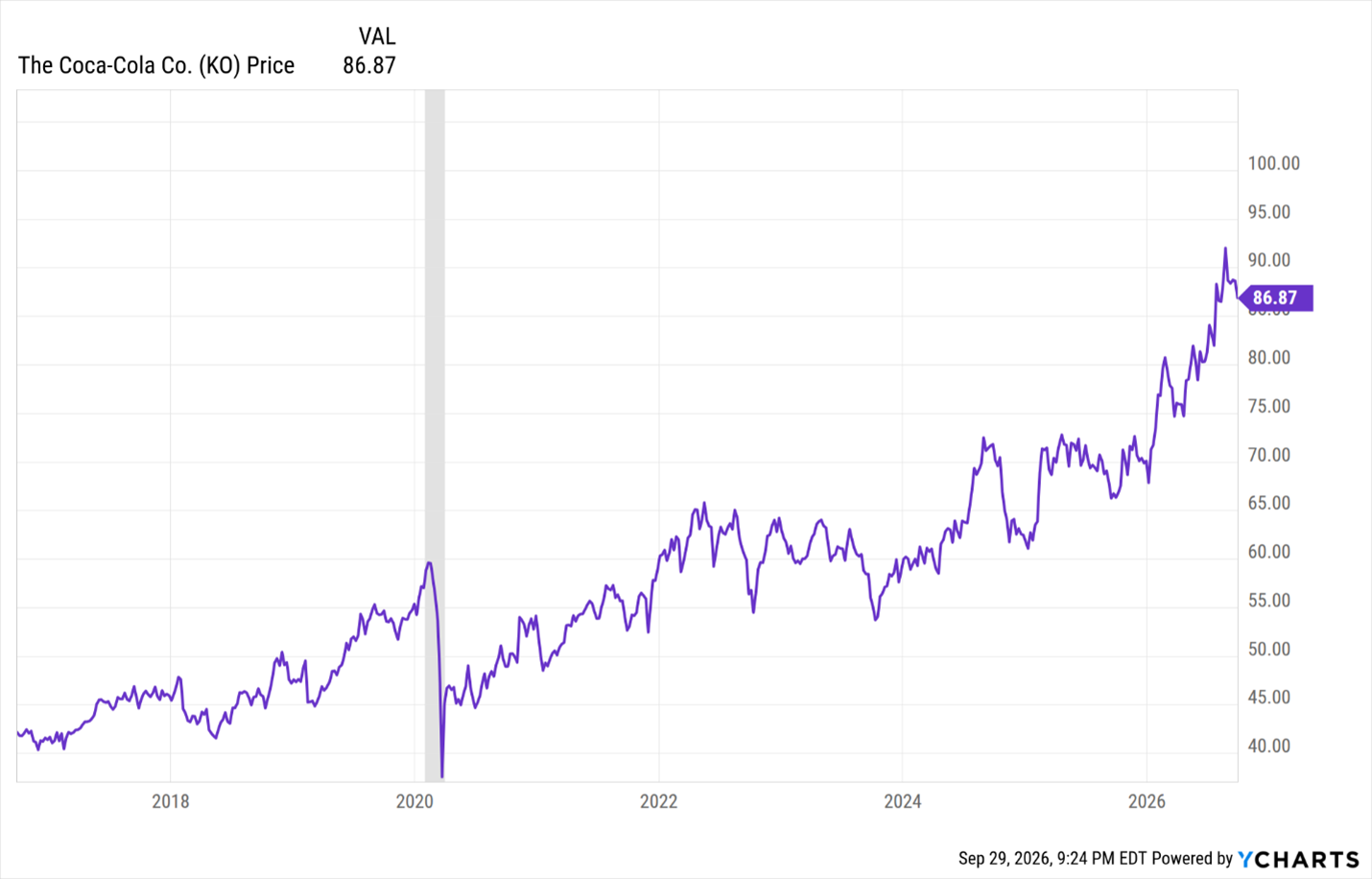
This 10-year chart of KO includes the pandemic-era recession. As you can see, the dip was a buying opportunity.
Now, that’s not to say that a recession is coming.
The data still sits above levels that have historically sparked concern.
Jobs and confidence are just two of the things I’m keeping a close eye on.
What I'm Watching Next
- Friday's September jobs report, after the unemployment rate held at 4.1% in August.
- The Personal Consumption Expenditures (PCE) inflation report due later this week.
- Whether hires start to slip in the next openings report on Nov. 3, which would turn a freeze into something colder.
- Interest rate expectations: 68.4% of consumers now expect higher interest rates over the next 12 months, following this month's Federal Open Market Committee rate hike.
Bottom Line
Whilst Wall Street spent the morning debating what these reports mean for the Fed, I'd spend it thinking about what they mean for your household.
The job market isn't breaking.
It's getting quieter.
And in a quieter market, the first thing to protect is the one asset that doesn't trade on any exchange … your cash.
Cheers!
Gavin
P.S. Currently, RHI is a “Hold.” KO is a “Buy.” But they’re just two of the thousands of stocks our system rates every day.
With Weiss Ratings Plus, you can screen the entire Weiss universe to find highly rated stocks that match what you’re looking for — including dividend payers built to keep putting cash in your pocket.