 |
| By Chris Graebe |
If you want to understand how our Weiss IPO Score system works, don't look at a spreadsheet.
Instead, look at the last two decades of IPO history. It tells a story that our system was built to decode …
A story about which companies rewarded early investors handsomely, which ones quietly destroyed wealth, and how you could have told the difference on day one if you had the right framework.
Let me walk you through two instructive examples. These two are cybersecurity plays, and I’ll get to why that sector is important a bit later.
Palo Alto Networks: The One That Did Everything Right
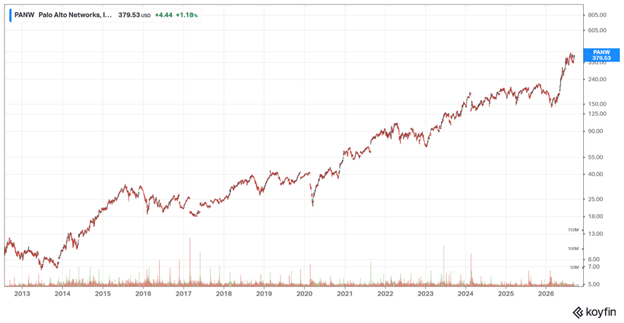
On July 20th, 2012 Palo Alto Networks (PANW) priced its IPO at $42 a share and closed its first day of trading at $53. That 26% pop got Wall Street's attention.
But there’s something that makes PANW genuinely remarkable as an IPO case study.
The initial pop was just the beginning. PANW went on to climb more than 70% from its IPO price within six weeks of its debut.
And for investors who bought on day two, stayed disciplined, and held through our key measurement dates, the stock delivered multiples that dramatically outperformed the broader market.
Since its IPO, the stock has returned almost 4,000%.
When we backtested PANW's IPO characteristics through the Weiss IPO Score system, the screener would have given us an “Investable” rating.
The system flags exactly what patient investors were rewarded for seeing, which is a company with real technology, steady revenue growth, and a defensible position in a market that was only going to get more important.
CrowdStrike: The Model Loved It
On June 12th, 2019. CrowdStrike (CRWD) IPO’d.
The company had reported a net loss of $140 million in its last fiscal year on $250 million in revenue. On paper, that looks like a red flag.
But the Weiss IPO Score system doesn't just look at current profitability. Rather, it looks at the full picture, the quality of growth, the size and defensibility of the market opportunity, the competitive positioning, and the management team's track record.
And on all of those dimensions, CrowdStrike scored exceptionally well.
The model loved it and rated it, “Investable.”
The stock’s performance validated that verdict decisively …
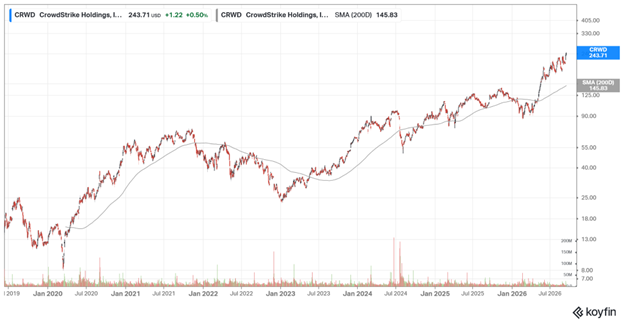
CRWD delivered a 3-year total return of 141% to investors who bought on day two and held.
This is particularly impressive as three years after the IPO, the tech sector entered a bear market.
So anyone that held into its November 2021 peak before the bear market would have reaped a return of 362%.
As of today, CRWD has returned over 1,400% since Day 2.
What These Two IPO Stories Tell You
There’s a pattern that emerges when you look at PANW and CRWD side by side.
The pop on day one tells you almost nothing useful.
The Weiss IPO Score doesn’t care much about day-one excitement.
What it does value is the underlying characteristics that have historically separated the IPOs worth owning from the ones worth avoiding … Regardless of how loud the opening day fanfare gets.
Below is a recent screenshot of the screener.
Notice how the tool rates IPOs by “Investable,” “Investable — Added Caution” and “Not Investable.”
These scores are further classified as “Preliminary,” for companies that haven’t yet IPO’d and “Final” for those that have.
Related story: How to Spot an IPO Flop
Why This Matters Right Now
Cybersecurity is back in the spotlight in a major way.
Q-Day, the moment when quantum computers become powerful enough to crack today's encryption standards, has moved from theoretical to imminent.
The NSA has already mandated quantum-safe acquisitions for national security systems by January 2027.
And the NIST has set a full phase-out deadline for quantum-vulnerable algorithms by 2035.
These mandates are worth trillions of dollars in eventual spending.
That means the next wave of cybersecurity IPOs is coming …
And with the Weiss IPO Score screener, available exclusively to Weiss Ratings Plus members, you'll be able to run every new debut through the same framework that would have identified PANW and CRWD as strong buys from the very first day of trading.
The history of IPOs has given us a clear and repeatable playbook.
The only question is whether you have the right tool to read it.
Happy hunting!
Chris Graebe