I Bonds Offer 5x More Income Than Stocks Right Now

|
Key Takeaways
|
 |
| By Nilus Mattive Reviewed by: Jim Nelson |
A lot of investors are shell shocked after the Big Tech selloff last week.
Of course, they can’t say I didn’t warn them.
And frankly, I think it can get a lot worse from here, even with yesterday’s moves.
But I’m not here to gloat.
I’d rather just present a couple of solutions that conservative investors, especially anyone focused on income, should consider right now.
Take I bonds.
I previously recommended them to my Safe Money readers several years ago when they were paying a guaranteed annualized return of 9.62%.
I also bought tens of thousands of dollars of them for my own family.
And while they aren’t paying quite that much anymore, they can still hand you a guaranteed 5.51% right now … which is better than you’ll get from just about any other fixed-income investment with the same level of safety.
But that’s still just the beginning of the story.
Let’s start with the basics.
The U.S. Treasury started offering I bonds back in 1998.
These directly-issued U.S. government bonds are backed by “the full faith and credit” of Uncle Sam.
And they are similar to classic Series EE savings bonds in the sense that their value doesn’t fluctuate and they don’t trade on any secondary exchange.
That means unless the government defaults on its debts, the money you invest is totally safe and cannot lose principal.
As with Series EE bonds, I bonds can also be held for up to 30 years before they mature. They also must be held for at least one year before they can be redeemed.
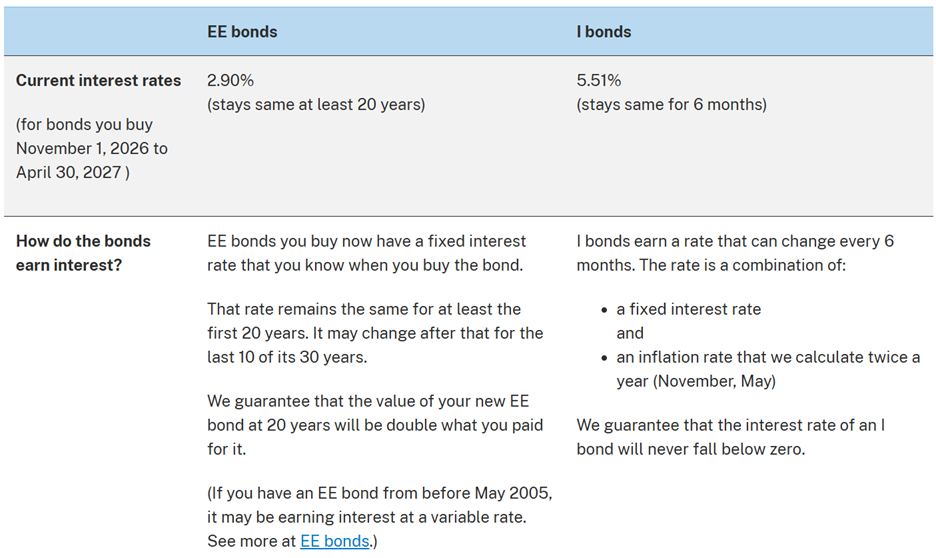
The difference is that I bonds pay two different types of interest.
The first interest rate — the fixed baseline interest rate — is determined when you buy your I bonds.
After many years sitting at zero, that number is now 1.4% a year. And you’ll get that as long as you hold the bonds.
The second component is designed to keep pace with changing rates of inflation as measured by the “Consumer Price Index for All Urban Consumers,” or CPI-U, and it is adjusted every six months.
New rates are announced on May 1 and Nov. 1. And this part is critical …
As long as you purchase the bonds by the last day of the preceding month, you start earning the current rate for the next six months.
Current I-bond holders receive the new rate every time it changes as well.
Now, this causes a lot of confusion for people. So let me try to clarify it a little bit more …
As long as you buy your I bonds within that given six-month window, you will receive that period’s interest rate for the next six months of your ownership.
In other words, it happens on a rolling basis: If you buy your bonds in June, you’ll get the rate that was announced on the preceding May 1 for the next six months. Then, in December, you’ll start getting the rate that was announced in November.
Here’s another thing that lots of people miss: The Treasury doesn’t distinguish between bonds purchased on the first day of the month or the last day of the month.
This means you really only have to own your bonds for five months and one day to earn the first full six months of interest.
It also means you should redeem I bonds at the beginning of the month whenever possible. Otherwise, you’re holding them for a longer period of time without earning additional interest.
And since you receive a new rate every six months, the interest on these bonds is compounding semiannually — earning holders more interest on the interest they’ve already collected.
Which brings us to the really exciting part …
The new composite rate that became effective as of Nov. 1 is 2.04%. When you add in the 1.4% fixed rate, the overall interest rate becomes 5.51% on an annualized basis.
And again, if you happen to buy them later in the month — like sometime over the next week — you’re hacking the system by lowering the overall amount of time you actually have to hold the bonds to receive the full interest.
Of course, you don’t have to act on this right away.
You can actually wait until the very end of the current six-month period.
That gives you an additional advantage: You can start to get an idea of what the NEXT six-month rate is going to be.
Since you must hold I bonds for at least one year, this is great.
Reason: It’s possible to estimate the full amount of interest you’ll earn in that required holding time before you commit your money.
You simply need to see how CPI numbers have been coming in.
Or you can do a quick web search because several different websites keep a running tally and post their estimates of what the yield will be.
Either way, the point is that you can get a 5.51% return right now with absolutely no risk of loss whatsoever.
That’s about FIVE TIMES the yield on the S&P 500 right now.
And it’s better than any rate you’ll find on a savings account, money market or CD.
It’s even better than the yield on a 30-year Treasury.
Plus, because they are directly backed by the United States Treasury, you have even better protection than you’d get from an FDIC-insured bank account or CD.
On top of that, the interest you earn from I bonds remains tax deferred until you decide to cash them in.
And when that day comes, your interest is exempt from regular state and local taxes, too.
For a lot of people, that makes the after-tax yields even BETTER still.
Just consider someone like me, living in California where state income tax rates go all the way up to 13.3%!
Also, if you use the proceeds for qualified education expenses — including expenses incurred by your child — the gains could be free from federal taxation as well. Some income limitations and phase outs do apply.
Add it all up, and I bonds are a no-brainer for anyone looking to keep some money safe and growing at the fastest possible rate with absolute safety and extra tax benefits.
Now for the “bad” news …
You can only purchase a maximum of $10,000 worth of electronic I bonds per Social Security number in any given calendar year and you have to use the government’s clunky website, www.treasurydirect.gov.
If you get a tax refund, you can also purchase up to $5,000 of paper I bonds every calendar year when you file. The option is mentioned on the 1040 form.
Just note that there’s a $50 minimum and the cap applies to a tax return, not to each individual taxpayer.
Here are two additional points many people miss:
First, you can purchase up to $10,000 in additional I bonds for every EIN number you have.
This is an additional way for business owners or even self-employed people to invest even more money at today’s favorable rates.
Second, you can also buy I bonds as a gift for someone else … so consider buying them as holiday presents this year!
Other possible drawbacks?
As mentioned, you can’t cash them in for the first year of ownership.
Moreover, if you redeem your I bonds at any point in the first five years, you lose the latest three months of interest.
However, as I showed you a moment ago, buying I bonds toward the end of a given month quickly cuts your obligatory holding time down by almost 10%.
And given the huge yield advantage over other “cash like” investments, even forfeiting three months of interest after that first year would still be a better total outcome than you could get with anything else right now.
Best wishes,
Nilus Mattive
P.S. Of course, if you want to go for even more income … more often … using three different high-powered strategies … then I have something even better to consider. Just click here to get all the details.