 |
| By Nilus Mattive |
If you know anything about me, you know I’m concerned about the AI boom.
In fact, I recently put out an urgent video to warn Americans about just how bad things could get because of it.
But just to summarize …
I think most AI-related investments are too pricey and investors’ short-term expectations are way too high.
I also think most of our recent economic growth has been fueled by AI-related spending … and a greater proportion of that is now being funded by debt that could blow up in our faces.
Most importantly, I worry about AI’s larger impacts on society — from the near certainty of massive job losses to the possibility of some dystopian future dominated by a handful of technological overlords.
Nothing I’m seeing alleviates any of my worries at all.
For example, I talked about massive layoffs already happening because of AI here last month.
Well, just in the last week we heard about Nike cutting 1,400 jobs from its tech department …
Microsoft offering voluntary buyouts to workers for the first time in 15 years …
And Meta slashing its workforce by a full 10% to directly offset AI spending.
So yeah, there’s a lot of downside and some of it is already happening.
However, there is one big, obvious, already-starting-to-happen benefit from AI, too.
I’m talking about AI’s ability to help develop novel drugs and disease treatments at lightning speed.
See, there’s one thing that AI is especially good at right now — crunching large amounts of data in a hurry.
Nowhere is that ability more needed than in healthcare — particularly in the area of drug discovery and development.
Indeed, AI can make light work of tasks that were previously insurmountable for entire teams of human beings.
And the better news is that it isn’t replacing their roles, it’s simply freeing up more time for scientists and researchers to ask better questions and get faster answers.
Just consider what happened with the 2024 Nobel Prize in chemistry.
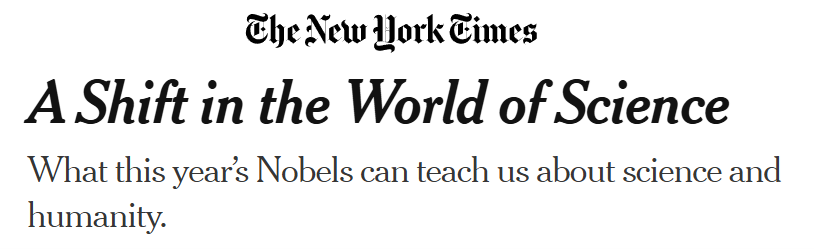
In an article titled “A Shift in the World of Science,” The New York Times summarized it this way:
“The Nobel Prize in Chemistry went to three researchers for using AI to invent new proteins and reveal the structure of existing ones — a problem that stumped biologists for decades, yet could be solved by AI in minutes …”
“To crack the protein structure problem, AlphaFold, the AI that led to this year’s Chemistry prize, was trained on a databank encapsulating the work of more than 30,000 biologists.”
This is an astounding achievement.
Additional Reading: AI (& This Drug Giant) Could Save Your Life
Some people spent their entire careers trying to solve a problem. Then an AI model came along and spit out the correct answer almost immediately!
Now take this accomplishment and think about how quickly it can start scaling across the pharmaceutical industry.
Rather than blindly stumbling through a maze of possibilities, hoping for a valid path, scientists can have AI models work out billions of permutations all in one shot.
This automates labor-intensive efforts and saves lots of money in the process. We’re talking months instead of years … worth billions of dollars.
They can load in reams of data they already have and make massive new discoveries.
AI can also look at existing drugs and find new applications for them — which is a HUGE boon for pharmaceutical companies and their bottom lines.
AI can help drug companies anticipate a compound’s properties — things like potency, solubility and toxicity — right from the start.
Plus, it can streamline the process of getting drugs through clinical trials. That saves even more time and money.
Your typical pharmaceutical business has been very much like a vintage muscle car — made of real metal and steadily increasing in value with every passing year.
As these companies integrate AI into their businesses, it’s like installing the mechanicals from a modern-day F1 car under that 1960s bodywork.
How Can You Play the Trend?
I have been recommending blue-chip pharmaceutical companies for as long as I’ve been a professional analyst because they are some of the most defensive — i.e., economically-insulated — investments in the world.
In fact, when we look at the data, healthcare is one of the three best-performing sectors during recessions. The other two are consumer staples companies and utilities.
It’s easy to understand why.
All these types of businesses provide items people need no matter what’s happening in the world or the economy.
That leads to relatively stable, predictable cash flows … money that usually comes back to shareholders as large and growing dividend streams.
Those payments help cushion portfolios during downturns. And ironically, the defensive nature of the businesses further attract more capital during market drops, too.
My Safe Money Report readers already own my favorites right now.
Meanwhile, I plan on talking about a small, undiscovered AI healthcare stock on stage at next week’s Weiss Investment Summit in Boca Raton.
So, if you’re going — and I hope you are! — then you can look forward to hearing more about that idea very shortly.
It doesn’t pay dividends. But it could easily go 2x, 3x or 4x from current levels. However, it’s simply too small to mention in a widely-circulated article like this.
Of course, you can also use our Weiss Ratings database to identify great pharmaceutical stocks on your own.
Or, if you want broad exposure to the sector, use an ETF like the iShares U.S. Pharmaceuticals ETF (IHE) or the SPDR S&P Pharmaceuticals ETF (XPH).
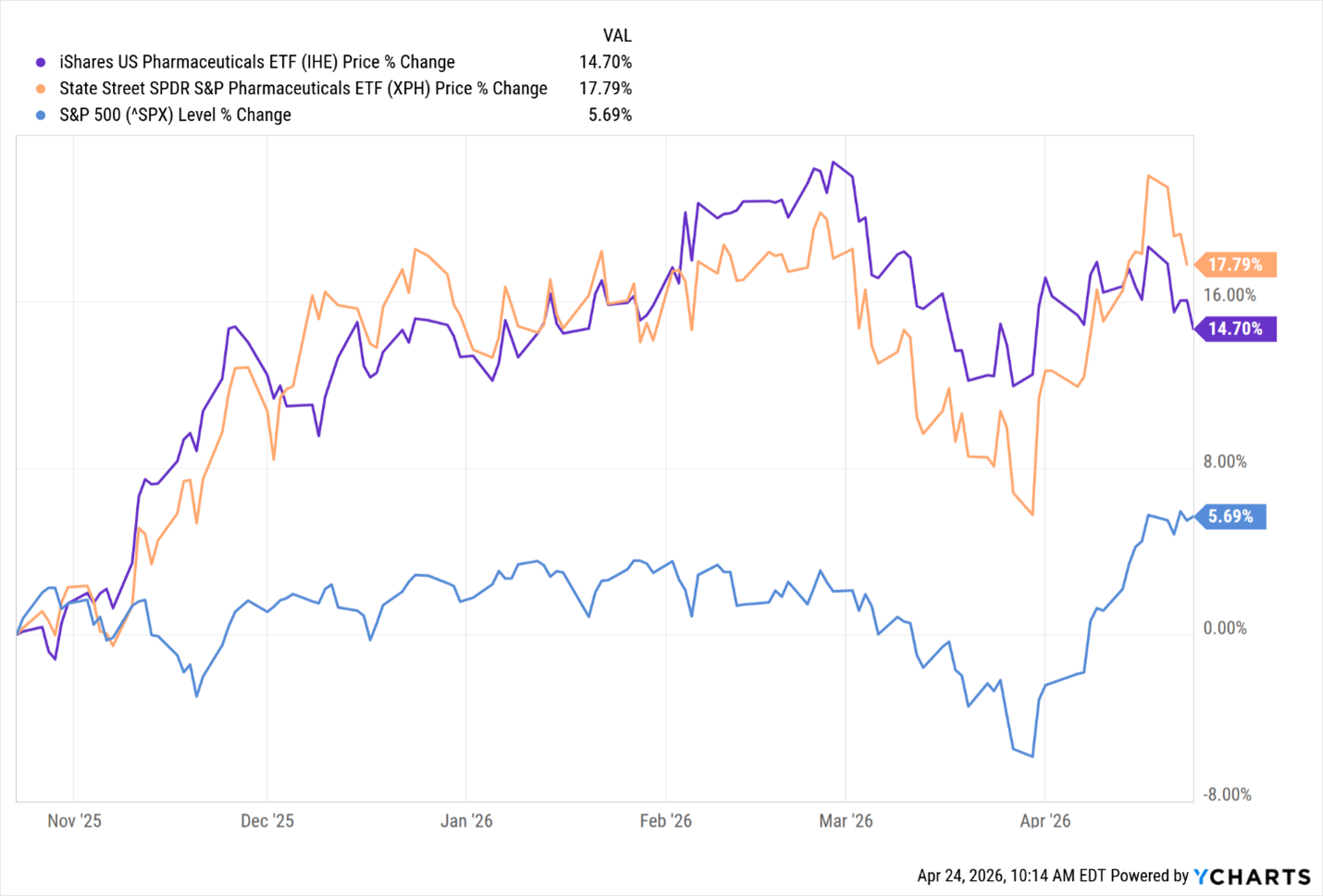
Whatever way you decide to go, the important takeaway is that despite all the big risks associated with AI … and as negative as I am about it overall right now … there is still some upside for both humanity and well-informed investors.
Best wishes,
Nilus Mattive
P.S. As noted, I recently put out an urgent warning about the AI Apocalypse I see unfolding.
In it, I share more ways to cushion your portfolio against it. You can watch it here.