Nvidia’s CEO Scandal: Why Our Ratings Still Say ‘Buy’

|
Key Takeaways
|
 |
| By Jim Nelson Reviewed by: Dawn Pennington |
Depending on how you count things, arguably one of the three most important men in the world just landed himself in hot water.
But the media circus doesn’t show the full picture.
Nvidia (NVDA) CEO Jensen Huang told employees on Sunday about his romantic involvement with a fellow tech chief …
One who’s been accused of sharing sensitive information with the Chinese government.
Nvidia’s board immediately launched an investigation into the matter.
That was followed by a series of investigations by the U.S. government through the Justice Department, FBI and Department of Commerce.
Meanwhile, the court of public opinion continues to weigh in on his company’s stock.
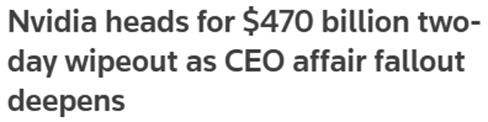
Huang has long held a line that the U.S. should keep the trade of Nvidia’s chips to China open, though with restrictions and caution.
To be clear, nothing has indicated that Huang did anything to compromise either company or national security secrets. Or that the affair was anything other than a personal one.
Then again …
Huang Is No Ordinary Chief Executive
Huang is arguably in charge of the most important company in the most important industry right now.
That’s why Nvidia is one of the world’s most actively traded stocks …
And why every decision he makes has an outsized effect on those shares.
No wonder why every corner of the political and financial press has raced to post stories about what the headlines could mean.
Not just for Nvidia, but also for the AI buildout … and even for the global economy.
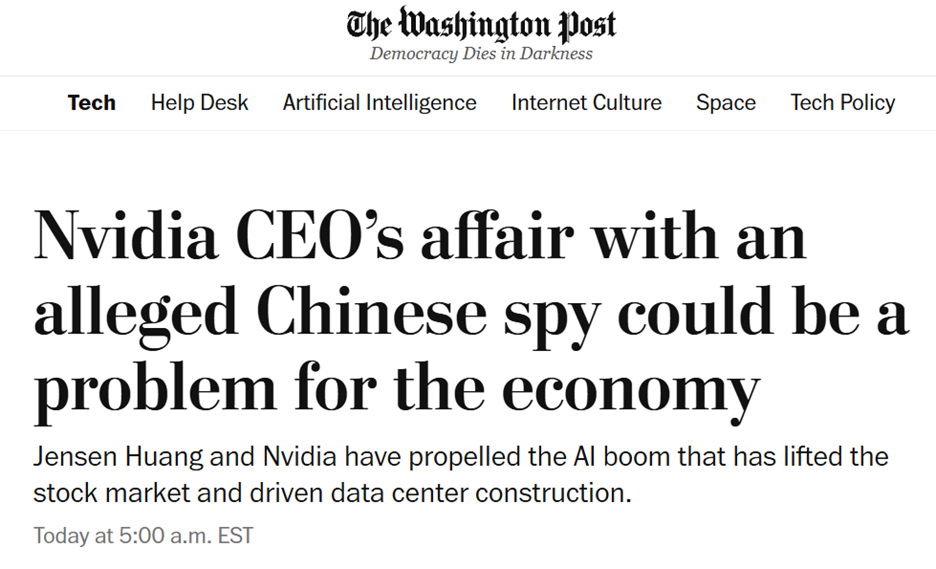
Those headlines drove the market action over the past couple days.
But in the AI stock universe, only Nvidia was seemingly punished:
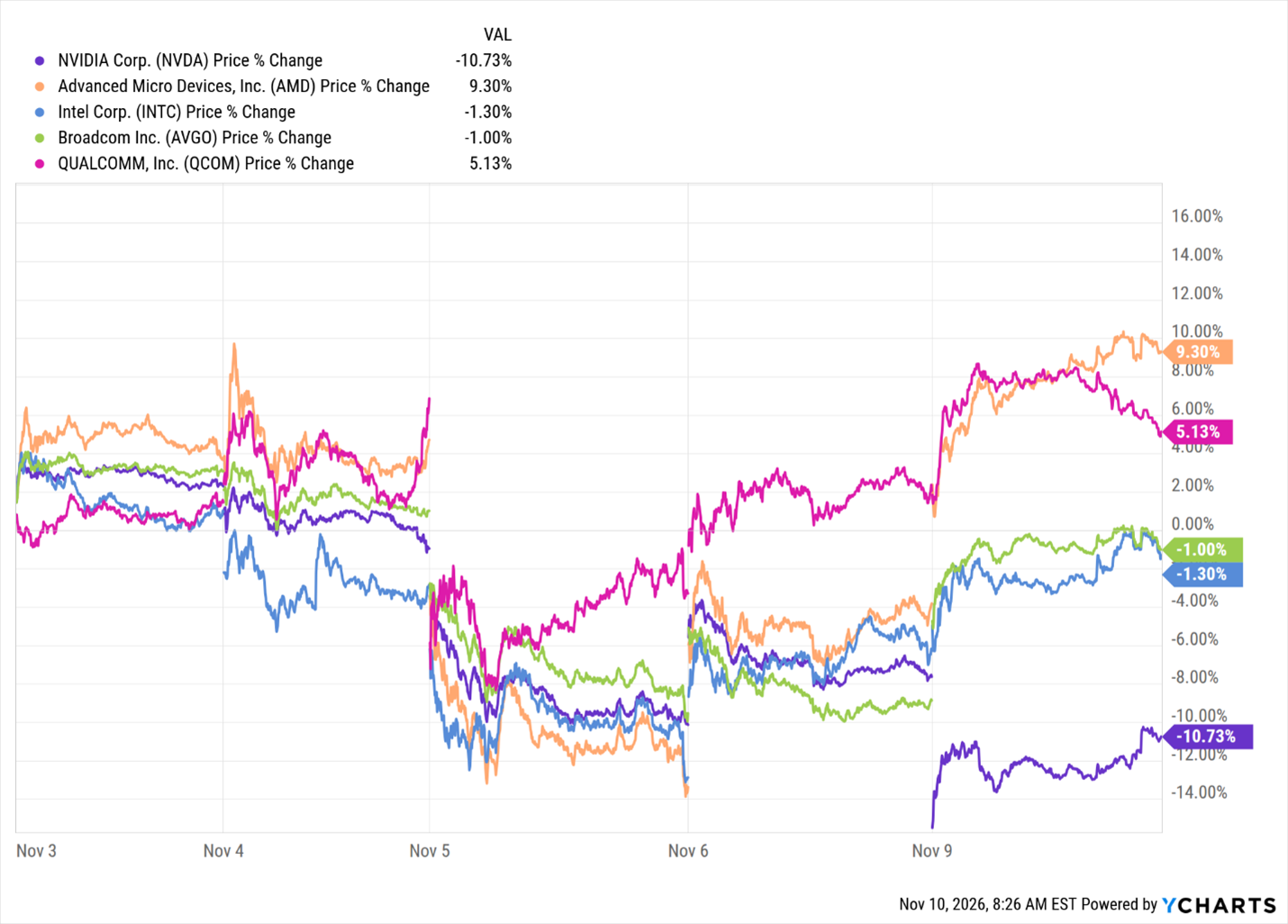
Nvidia fell hard, following a rough performance last week. Yet other chipmakers like Advanced Micro Devices (AMD) and Qualcomm (QCOM) surged.
Intel (INTC) and Broadcom (AVGO) jumped on the day but remain slightly down over the past five days.
This story is far from over. And the fallout is not immediately clear, despite journalists’ best guesses.
So, today, we are going to take the view that dates back to our founder, Dr. Martin Weiss … and look at the facts, the data and our proprietary and unbiased ratings.
What Huang Means to AI in Numbers
Many have tried to chronicle Nvidia from its birth as a small designer of GPUs for video games in the late 1990s to its current multitrillion-dollar market size.
Stephen Witt, author of “The Thinking Machine: Jensen Huang, Nvidia, and the World’s Most Coveted Microchip,” explains it as a company that made a radical bet — one he attributes mainly to Huang.
You see, Huang saw what few others did in the early 2000s — GPUs were powerful parallel processors that could do much more than push the boundaries of graphics in video games.
They could be used to process data at speeds to keep Moore’s Law alive.
Huang and his company developed CUDA, which stands for Compute Unified Device Architecture.
It is the platform that powers ChatGPT, Claude, Gemini and more.
It just took a decade or more before any of the companies behind those AI models believed Huang … or at least what he saw coming.
Once they did, well, we see what AI has become.
According to The New York Times, 76% of workers reported using AI in 2025 as part of their jobs. That’s up from 30% in 2023.
Just four companies are projected to spend about $700 billion on AI infrastructure this year.
And AI data centers already consume 1.5% of the world’s electricity.
None of this would be possible if Huang gave up when no one wanted CUDA back in 2006.
The question now is …
What Would Change Without Him?
Ben Buchanan, former AI adviser to President Joe Biden and current adviser to Anthropic, said:
“It’s no exaggeration to say Jensen is one of the most significant people in the world and one of the most significant people in the AI industry.”
Following the news about his private affair, another industry analyst, Dan Ives, said: “There’s no true succession plan. He’s kind of irreplaceable.”
That may be true. But we didn’t lose the formula for making steel when Andrew Carnegie sold his company to John Pierpont Morgan in 1901.
Cars didn’t disappear when Henry Ford was forced out of Ford (F). (That’s a story for another time.)
And Apple (AAPL) remains the world’s largest company by market cap despite losing Steve Jobs 15 years ago.
Since the late 1990s, Huang has been one of the most successful CEOs in the world. But he was also a founder.
Chris Graebe, our startup specialist, recently had this to say:
“Early-stage founders need to be comfortable with chaos. They need to sell the vision, stretch every dollar and make decisions quickly.
“Public company CEOs need to build systems, manage complex organizations, answer to shareholders and think about risk on an entirely different scale.
“One is trying to create something that doesn’t exist.
“The other is trying to grow and protect something that already does.
“And occasionally, you find a rare entrepreneur who can do both.
“Think about the founders who managed to evolve alongside their businesses rather than get left behind by them. That’s a special kind of leadership.
“But not every great founder has to become a great public company CEO for investors to win.
“Sometimes the smartest thing a founder can do is recognize when it’s time to bring in someone else to lead the next chapter.”
Up until now, Jensen Huang has proven to be one of those rare people who could do both. But that doesn’t mean he is the only thing holding Nvidia together.
Sometimes, a new person can actually do more for a company than the genius who founded it.
So, even if all these investigations somehow force Huang’s friends on the board to dump him, Nvidia isn’t going anywhere.
But longevity doesn’t mean it’s a good investment. For that, we turn to …
What Our Stock Ratings Tell Us About Nvidia
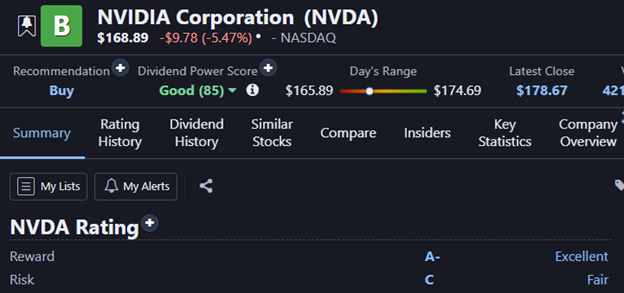
Weiss Ratings gives Nvidia a “B,” with a Reward Index rating of “A-” and a Risk Index rating of “C.”
That means there are still plenty of opportunities for shares to recover from this recent month-long rout.
However, investing in Nvidia right now still comes with some risks.
For starters, there’s policy risk from the incoming Congress that largely ran on limiting the data center buildout and on developing new regulations on AI.
There’s valuation risk, as measures like the Buffett Indicator sit at all-time highs.
There are the circular financing risks that Nilus Mattive has pointed out in these pages.
And there is, yes, leadership risk. Which both pre- and post-dates the current scandal.
Just because Nvidia may not need Huang forever, there is always the risk that his eventual replacement — whether soon or in decades — could be the wrong choice.
We recently downgraded Nvidia to a “B” from “B+.” That is still in “Buy” range.

But the real test comes a week from today.
We’ll get fresh data following Nvidia’s earnings announcement.

That’s where any changes to our NVDA rating would come from.
Others will be listening to what Huang has to say on the earnings call. We’ll be paying attention to the facts, data and our ratings.
Sincerely,
Jim Nelson
P.S. Dr. Martin Weiss founded this company on those principles — to follow the facts, data and ratings.
So, when he and Nilus teamed up on what was really happening with all the spending and debt propping up Nvidia and the rest of the AI boom, we knew something was happening.
The duo dropped these explosive results following their investigation. You’ll want to see them even if you don’t own Nvidia or the other AI elites.