Nvidia's Jensen Huang Is Back. Three Risks the AI Rally Didn't Fix.
|
Key Takeaways
|
 |
| By Dawn Pennington Reviewed by: Jim Nelson |
If you own Nvidia (NVDA, “B-”) — or any fund that does — last week probably felt like the AI bubble was finally popping.
I thought so, too, after the market slid into correction mode Friday. Even the biggest IPO on record, Anthropic (ANT, “Not Investable”), got caught in the AI stock sell-off.
Then, Monday morning, Nvidia’s board brought Jensen Huang back. Eleven days after he resigned. Six days after the board said it had no plans to bring him back.
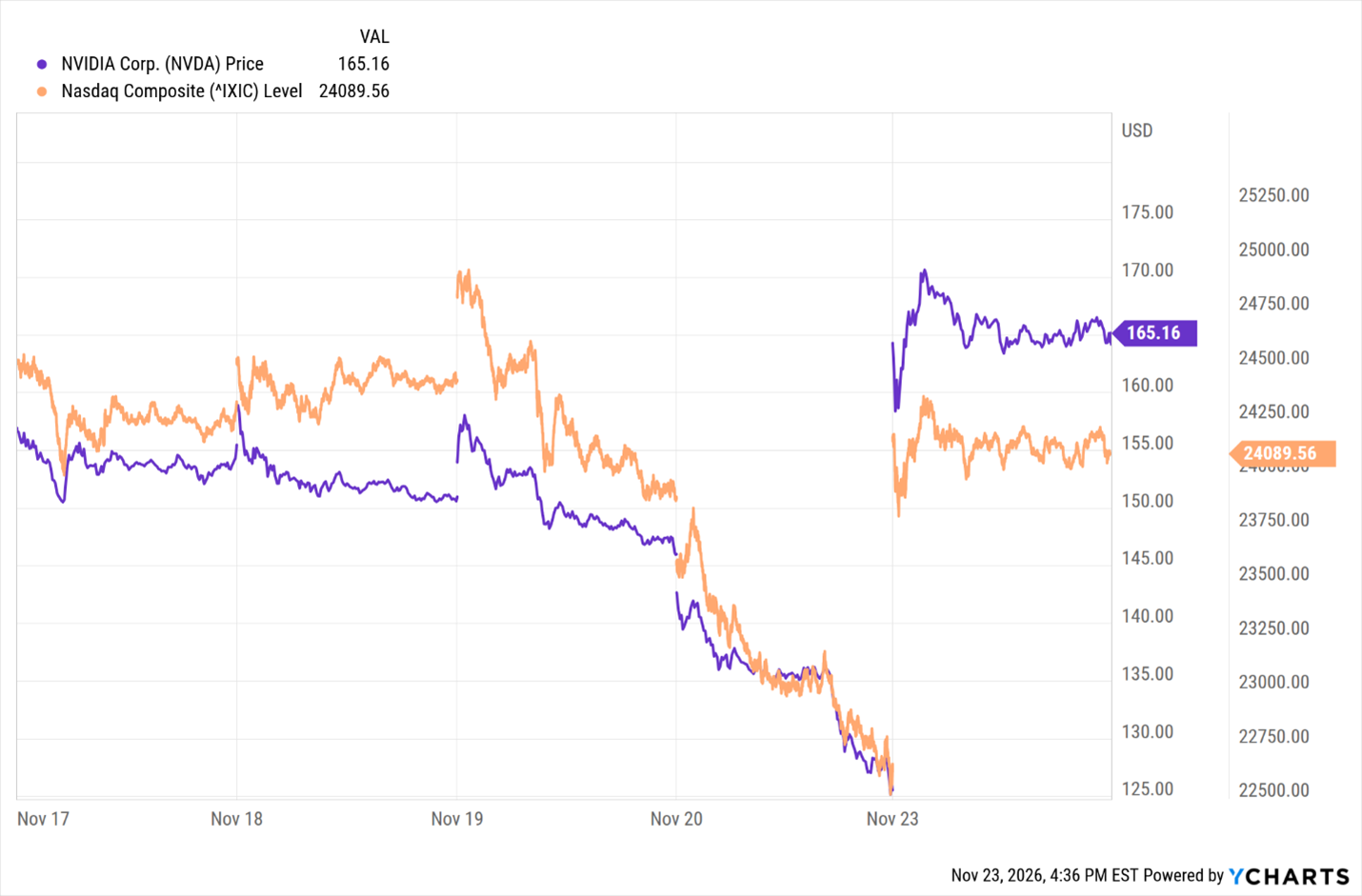
He left under pressure. He came back under pressure. And the market responded as if someone had released a pressure valve.
Six Days From ‘No’ to ‘Yes’
Huang stepped down Nov. 12 after reports of an affair with Alice Huang, a former executive at Singapore-based Megaspeed who is suspected of being a Chinese government agent. (The two aren’t related.)
Related story: Who Replaces Jensen Huang, and What It Means for AI Stocks
On last Tuesday’s earnings call, board chair Harvey Jones said flatly that the board did not intend to reinstate him.
Then the pressure built. Tech leaders signed a petition. President Trump told CNBC he spoke directly to the board.
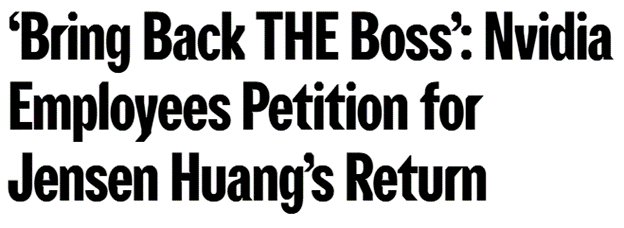
On Monday, the board voted unanimously to reinstate Huang.
It said it received input from senior levels of the U.S. government and is confident his return poses no national security risk.
Wall Street loved it.
The Nasdaq rallied about 6.5% on Monday.
Nvidia shares jumped about 33% by late morning, adding close to $1 trillion in market value.
Short-sellers were staring at roughly $12.2 billion in paper losses, their worst one-day hit since at least 2019.
‘I Made the Deal’
On Monday morning, President Trump told CNBC he spoke directly to Nvidia’s board and urged it to bring Huang back. “I made the deal,” he said.

He also said he was “basically … represented at the board,” and that the board asked his administration for assurance that Huang wasn’t a national security risk.
He also says Vice President JD Vance provided an assist.

Keep in mind that a board answers to shareholders.
The Nvidia board made its biggest decision of the year after a call from the White House.
And it did so while U.S. investigators are still trying to determine what, if anything, Alice Huang passed to Beijing.

Bloomberg reported that the board brought Huang back without consulting Nvidia’s senior management, who were told at the last minute.
Then There’s the Money
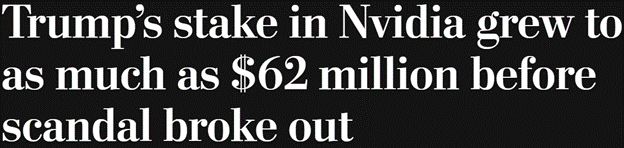
The Washington Post reported that the president’s own disclosures suggest he held between $13 million and $62 million in Nvidia stock at the end of August.
The president’s side is simple. He says Huang “did nothing wrong” and the board “acted really responsibly.”
And Monday’s rally says plenty of investors agree that Nvidia is worth more with Huang than without him.
When a president says he made the deal, Nvidia’s biggest risk isn’t just chips or China anymore. It’s politics.
As an investor, remember this …
If Washington can put a CEO back, Washington can also change its mind.
Why I Call It an AI Bubble Patch
Think about everything the market was pricing in last week.
It wasn’t just a missing CEO. It was a pile-up:
- Nov. 18: Moody’s cut its outlook on Nvidia’s debt to stable from positive, pointing to the lack of a formal succession plan.
- Nov. 20: The stock fell nearly 14% after Reuters reported the SEC is looking into Nvidia’s accounting.
- By Friday’s close: seven straight weekly losses, Nvidia’s longest losing streak since 2008.
Huang’s return fixes the first problem.
Nvidia has its leader back, and the succession question goes away.
It doesn’t touch the other two.
Our own Nilus Mattive put it bluntly on our editors’ call today. Nvidia has become “too big to fail,” the way the big banks were in 2008.
Sean Brodrick went one better. He called it “too big to punish.”
That's a distinction worth thinking about.
When a company becomes so important to the economy — and so deeply tied to Washington's priorities — the usual rules may not apply.
That can protect the stock for a while. But it can also leave investors exposed when the political winds shift.
And that's a risk Jensen Huang's return doesn't fix.
Six Questions for Capitol Hill
Huang heads to Capitol Hill next week.
- On Dec. 1, he sits for a closed-door interview with three House committees.
- On Dec. 3, the Senate Banking Committee questions him in public.
Lawmakers from both parties are already asking hard questions.
Sen. Elizabeth Warren, the committee’s top Democrat, says Huang, Nvidia’s executives and its board “still owe Congress answers” on export controls.
And the pressure won’t end when this Congress does.
Democrats won both chambers this month, and Warren is expected to chair the committee when the new Congress starts in January.
Related story: Elizabeth Warren’s Senate Banking Hit List: Big Banks, Private Credit and Crypto
Sen. Tim Scott (R-S.C.) currently holds the Senate Banking gavel. Here are some of the questions we, as investors, hope the committee asks.
- How much of Nvidia’s supply rests on a handshake? Elon Musk says many of Huang’s supplier deals were “a handshake with Jensen, not a written contract.” Nvidia says it has $390 billion in purchase commitments. Which suppliers are on paper, and which aren’t?
- Who gave the “input”? The board says it heard from “senior levels of the United States government.” Who, and what did they actually review?
- What did Nvidia know about Megaspeed? On Monday, the U.S. announced plans to add Megaspeed to its trade blacklist over the diversion of advanced Nvidia chips to China. When did Nvidia first spot a problem? And why does it only now need a chief compliance officer?
- What happens to Colette Kress? She ran Nvidia for 11 days and delivered a quarter that beat Wall Street’s estimates. Now she’s back to CFO. The Wall Street Journal reported that Huang once called her “a deer in the headlights.” Will the executive who keeps the books feel free to speak up?
- What is Nvidia on the hook for? Nvidia takes stakes in companies that buy its chips and guarantees some of their data center deals. If one of those customers stumbles, how much would Nvidia owe?
- What is the SEC looking at? Reuters reported the SEC is examining Nvidia’s accounting. Investors deserve to know the scope.
And here’s the catch for the whole AI trade …
Nvidia isn’t just the company selling the shovels in this gold rush. It also owns stakes in some of the companies buying them, including CoreWeave (CRWV, “E+”).
That’s why Huang’s exit dragged down cloud stocks along with Nvidia. And it’s why one more bad headline from Washington could do it again.
The Business Never Broke
This is the part of the story I find most reassuring.
Even without Huang, Nvidia just reported more than $116 billion in quarterly revenue. Its data center sales more than doubled. And it guided to $130 billion for the current quarter, above Wall Street’s forecasts.
Our ratings never wavered, either. Weiss Ratings gives Nvidia a B (Buy), with an A- on reward and a C on risk.
Related story: Nvidia’s CEO Scandal: Why Our Ratings Still Say ‘Buy’
So the demand was never the problem. The bubble question is about price, debt and how tangled the AI money has become.
Michael A. Robinson says the same goes for Nvidia’s suppliers.
Taiwan Semiconductor (TSM, “C+”) and Micron (MU, “B-”) were dumped at “fire sale prices” last week — purely on doubts about whether Nvidia would honor its deals.
Huang’s return put a floor under them.
What This Means for You
Don’t chase a one-day pop.
Sean isn’t making any new picks this week. Trading volume dries up in a holiday week, and thin markets can swing hard both ways. His advice: stay calm and wait.
Michael is selling into strength. He just sold half of a biotech position, and he expects profit-taking as soon as tomorrow.
So if you own Nvidia, hold it. Our rating is still a Buy.
Related story: Nvidia Is Already in Your Portfolio
If you’re sitting on a big gain in Nvidia or another AI name, borrow Michael’s rule.
Once a stock is up 35% to 40%, he sets a 20% trailing stop and stops worrying about it.
And if you don’t own Nvidia yet, let the holiday dust settle before you buy.
Nvidia got its founder back. The AI bubble got a patch.
A patched bubble still floats. It just doesn’t take much to find the next leak.
To your health and wealth,
Dawn Pennington
P.S. Who was buying and selling Nvidia while this played out? Weiss Ratings Plus shows you on every stock page, from insider trades to reported trades by government officials. Click here to see Nvidia’s activity for yourself.