Nvidia: Wall Street Sees $324.64. What Does Fair Value Say?

 |
| By Gavin Magor |
If you've been watching the AI boom and wondering whether you've missed the move, Nvidia’s (NVDA) latest numbers make it easy to understand Wall Street's enthusiasm.
The company reported $96.2 billion in fiscal Q2 revenue, up 106% from a year earlier.
But you don’t buy last quarter's revenue.
You buy the share price.
So the real question is how much of that success is already reflected in the price?
2 Price Tags on One Stock
A lot of investors rely on price targets to enter and exit positions.
And until recently, they had to rely on major Wall Street big banks like Goldman Sachs (GS) and JPMorgan (JPM) for those.
That just changed.
We now publish our fair value ranges for all stocks.
And they reflect what our decades of data say about what a stock is actually worth instead of what some individual analyst says it is.
As a reminder, we never take a dime from any company. And only facts go into our unbiased ratings.
The same is true for our fair value ranges.
That might not always be the case for what you get on Wall Street.
So, let’s look at an example of how our ranges differ from Wall Street using AI superstar Nvidia …
The Street's Target — $324.64
At the start of this week, Wall Street's big banks had 79 buy recommendations, two holds and one sell.
Their average 12-month price target is $324.64.
At last week’s closing price of $229.28, the target implies 41.6% upside.
That is a substantial vote of confidence.
It is also a forecast.
Our Fair Value Range
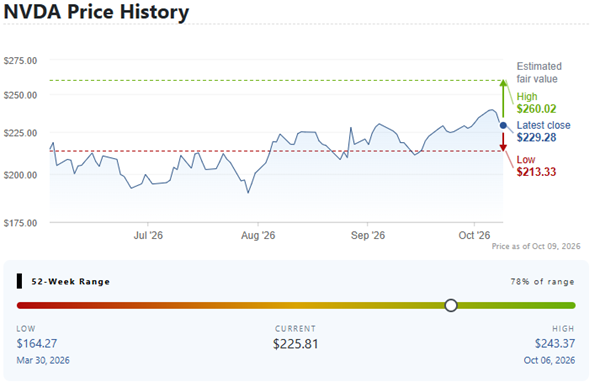
The Weiss chart presents an estimated fair value range of $213.33 to $260.02.
To compare the two on equal terms, here is what each valuation implies relative to that same closing price:
|
Valuation reference |
Price |
Difference from $229.28 |
|
Weiss lower fair value estimate |
$213.33 |
-7% |
|
Weiss upper fair value estimate |
$260.02 |
+13.4% |
|
Wall Street average 12-month target |
$324.64 |
+41.6% |
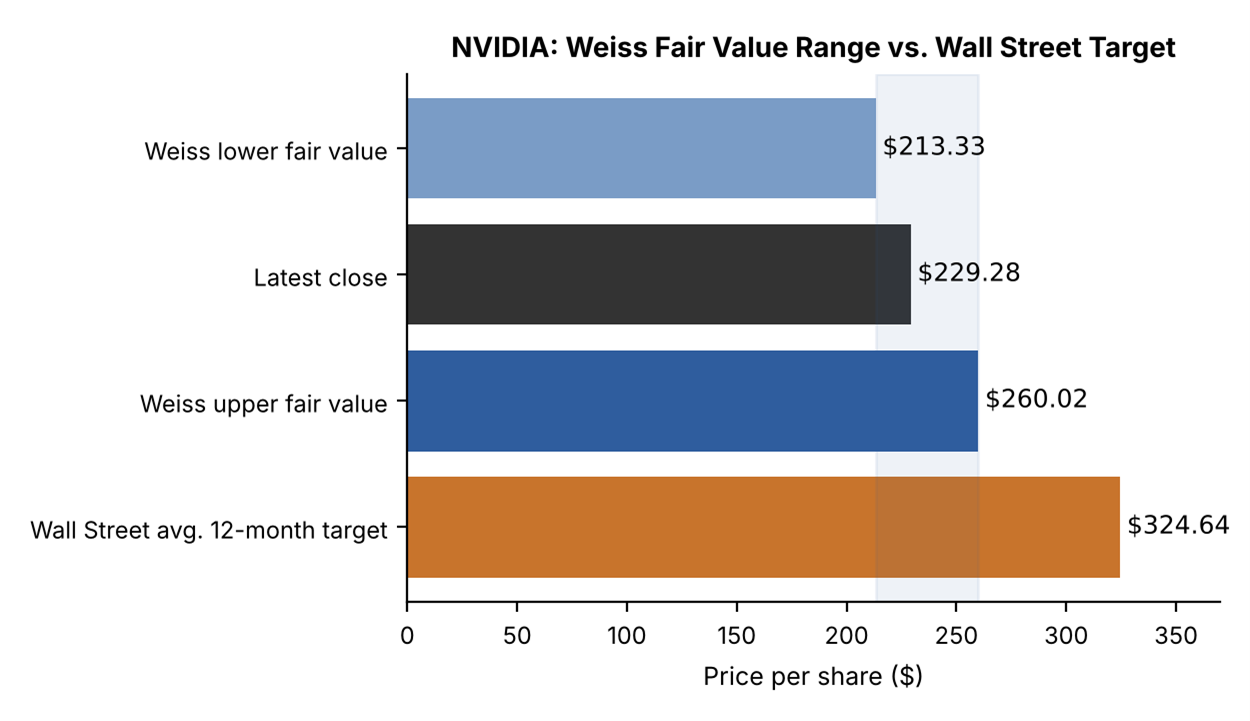
Nvidia is trading inside the Weiss estimated range.
Wall Street's target sits almost 25% above its upper end.
Not the Same Kind of Number
The distinction matters.
A 12-month target estimates where analysts expect the stock to trade in the future.
The Weiss chart provides an estimated fair value range.
The figures should not be treated as interchangeable forecasts.
Excellent, Excellent, Excellent, Excellent
The Weiss rating factors show why Nvidia commands attention.
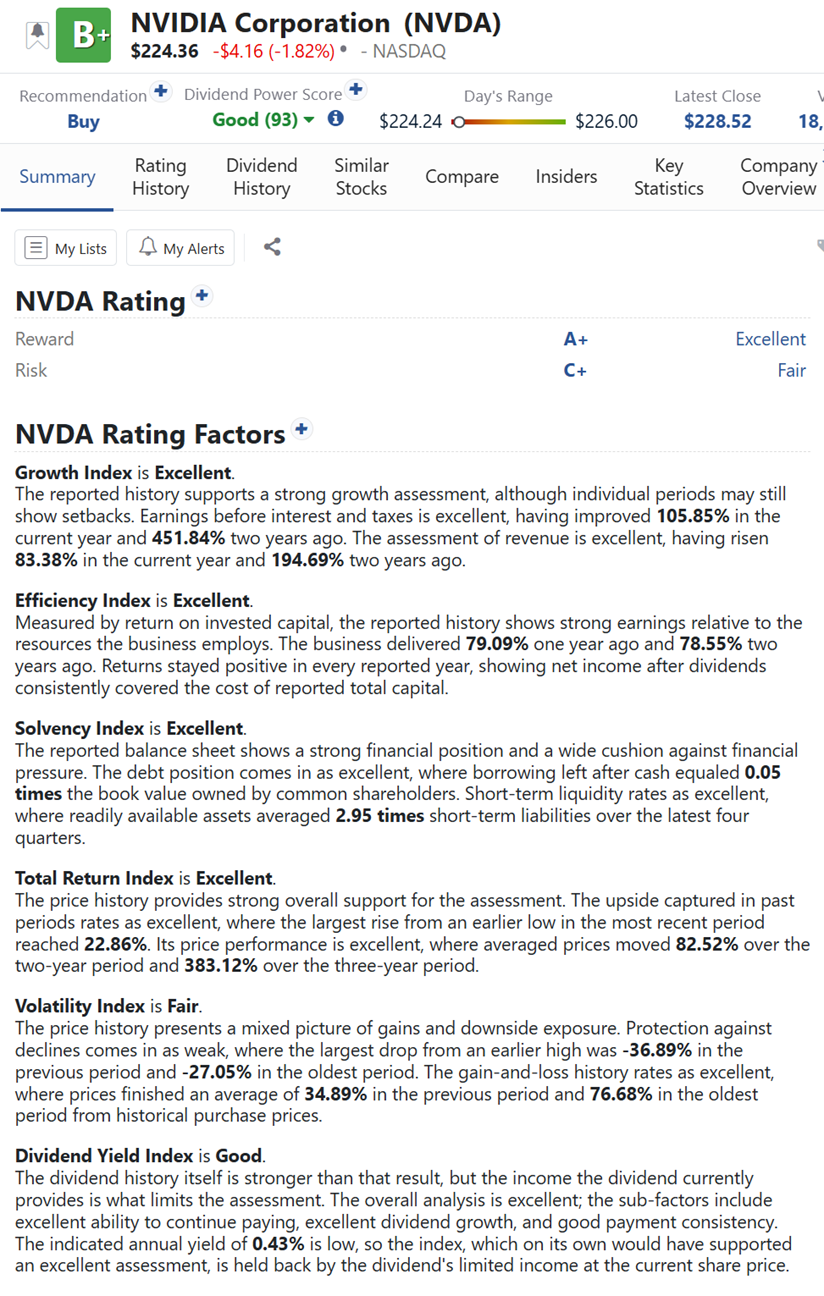
Growth, Efficiency, Solvency and Total Return are all rated Excellent.
The growth assessment cites reported revenue growth of 83.38% in the current year.
The efficiency assessment reports a 79.09% return on invested capital one year ago, indicating strong earnings relative to the capital employed.
The solvency assessment also shows substantial short-term liquidity, with readily available assets averaging 2.95x short-term liabilities over the latest four quarters.
These are meaningful strengths.
They help explain investor enthusiasm, but they do not establish that every price is attractive.
The One Box Marked Fair
Nvidia’s Volatility Index is rated Fair.
The assessment cites a 36.89% decline from an earlier high in a previous measured period.
That's a reminder that impressive long-term performance can include uncomfortable losses along the way.
So, Is It Already in the Price?
The comparison suggests a more measured interpretation than the bullish analyst consensus alone might encourage.
Nvidia’s reported business performance is strong.
Its share price also sits within the Weiss estimated fair value range.
That supports a different conclusion from describing the stock as deeply discounted solely because Wall Street sees 41.6% upside.
Nvidia carries a Weiss rating of “B+,” a BUY.
We expect the business to keep earning the enthusiasm.
If you're buying, let the Weiss range of $213.33 to $260.02 be your guide, not the Street's $324.64.
The question is whether future growth and profitability will justify paying more.
And whether you can withstand volatility while that outlook develops.
Our take: Nvidia may continue to deliver exceptional results, but the average price target out there may not be considering the full scope of risks.
What We're Watching
- Deployment constraints: In its latest quarterly filing, Nvidia identifies power, data center infrastructure and access to customer financing as potential constraints on deployment.
- Sales timing: Strong demand does not automatically translate into sales on the timetable investors expect.
- The bottom of the range: The lower boundary is a valuation estimate, not a promise that the shares will stop falling at $213.33.
- The top of the range: The upper boundary does not prevent the stock from trading above $260.02.
Bottom Line
Nvidia’s latest numbers make it easy to understand Wall Street's enthusiasm.
The Weiss fair value range makes it easier to understand the price.
At $229.28, the shares sit inside that range, well short of the Street's $324.64.
With a Weiss rating of “B+,” a BUY, the business has earned the attention.
But as for what price you can expect, we recommend you stick to our fair value range.
Cheers!
Gavin
P.S. We highly recommend you check with our fair value range before entering any new trade. And you should also monitor it for any positions you already hold.
But it is just one tool. And we have many more ways to juice gains here at Weiss Ratings. One of them my readers have enjoyed with great success this year is our Ultimate AI system.
We’ll be showing it off — including its successes and why it is even more profitable during this pre-election window — on Tuesday, Oct. 20, at 2 p.m. Eastern.