Oil Tankers Are the Best Way to Play the Energy Shortage

 |
| By Sean Brodrick |
Oil is flowing through the Persian Gulf again. So, oil prices should come down, right?
That’s certainly what much of the media is saying. Restore the flow of Middle Eastern crude and prices drop.
I think they’re missing something BIG.
The problem isn’t just getting oil out of the Persian Gulf anymore.
It’s getting that oil to customers without somebody blowing up the ship carrying it.
And until the war with Iran ends, I believe oil prices will remain painfully high.
$1.3 Million a DAY
Take a look at this chart from Poten & Partners. It shows the cost of chartering a Very Large Crude Carrier, or VLCC, has gone vertical.
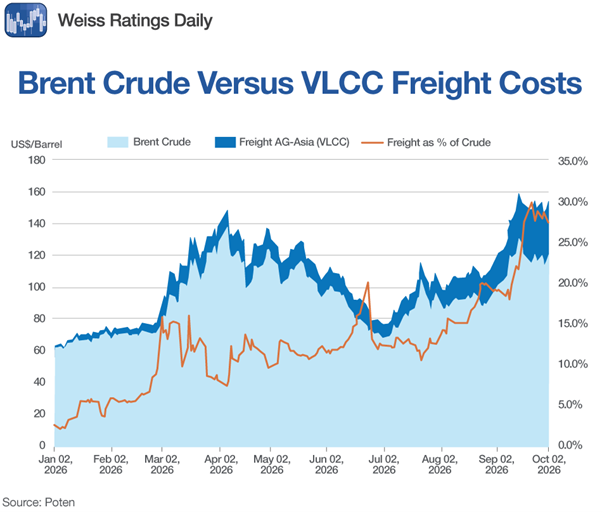
At the beginning of this year, the benchmark VLCC rate from the Arabian Gulf to the Far East was around $30,000 per day.
Recently, it hit an astonishing $1.3 million per day. That’s 43 TIMES the January level!
Poten, which tracks tanker prices, says in its Oct. 2 report that tanker rates have reached levels “never seen before.”
The implications are enormous.
Back in January, VLCC freight added about $1.73 per barrel to the cost of Middle Eastern crude delivered to Asia. Shipping represented just 2% to 3% of the delivered price.
Today, freight alone can add almost $33 per barrel.
That’s now about 27% of the delivered cost!
Transportation has gone from minimal to one of the biggest components of the physical oil price.
Your $90 Oil Can Cost $140
Pull up a futures screen and oil may appear relatively cheap. But that's not necessarily what a refinery pays to get physical barrels delivered.
A recent calculation using actual crude prices, tanker rates, freight and war-risk insurance showed the actual cost of Middle Eastern crude delivered to China is about $140 per barrel.
And it’s potentially $149 to $166 for crude shipped from inside the Strait of Hormuz. This, despite the fact the price for crude in the futures market is less than $90.
The fact is, if you need 2 million actual barrels delivered halfway around the world, somebody has to put them on a ship. And right now, that ship costs a fortune.
Why Tanker Rates Are Going Berserk
The biggest reason is insurance.
Tankers traveling through the Strait of Hormuz, the Bab el-Mandeb Strait and other conflict zones are sailing through waters where commercial vessels are attacked.
War-risk insurance has exploded accordingly.
But insurance isn't the only problem. Sanctions have reduced the number of tankers readily available to mainstream buyers.
Ships have been trapped or displaced by the conflict. Some owners simply won't enter dangerous waters.
Then there are longer voyages.
If an Asian refinery decides Middle Eastern crude is too dangerous or expensive and buys American or Brazilian oil instead, that tanker may be tied up for weeks longer.
That removes capacity from the market and pushes tanker rates still higher.
Even if oil exports recover, attacks on commercial shipping aren't going to stop. Heck, the attackers just have more targets!
The Oil Cushion Is Disappearing
Now add one more ingredient to this explosive cocktail. Global oil inventories are scraping the bottom of the barrel.
According to the International Energy Agency, global inventories dropped a record 2.8 million barrels per day over the past six months.
Stocks are now 507 million barrels lower than they were in February, before the Middle East conflict began.
Here’s a chart I picked up from Clio Insights …
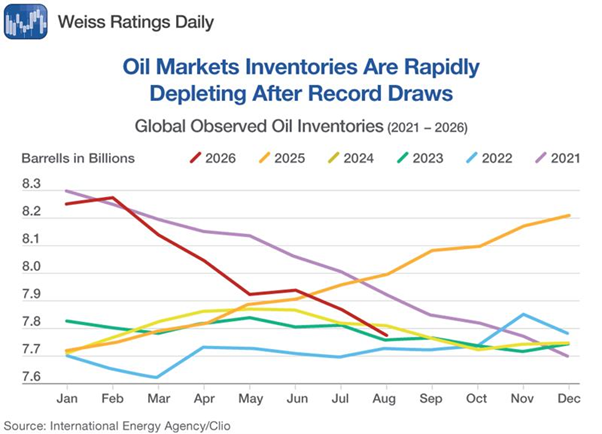
Half a BILLION barrels of cushion — gone.
That leaves the world increasingly vulnerable to another supply interruption, tanker attack or shipping bottleneck.
The War Premium Isn't Going Away
So, I believe Wall Street is looking at this backward.
Yes, Persian Gulf oil flows are recovering. But restoring oil production doesn't eliminate the cost of transporting it through a war zone.
As long as tankers are being attacked, insurers will demand enormous premiums. Shipowners will demand enormous charter rates. Some ships won't go at all.
Eventually, the Iran war will end. Insurance premiums should plunge. Tankers will return. Freight rates could fall remarkably quickly.
But until then, the world is paying a war premium that doesn't necessarily show up on your futures screen.
So, Wall Street can keep watching the quoted price of crude. I'll be watching the tankers.
One way to play this is DHT Holdings (DHT).
It’s a pure play crude-tanker owner focused exclusively on very large crude carriers (VLCCs) — the 2-million-barrel ships that move crude on major long-haul routes.
The company’s earnings are therefore highly leveraged to VLCC spot and time-charter rates.
It also sports a dividend yield near 10%!
Let’s look at the weekly chart …
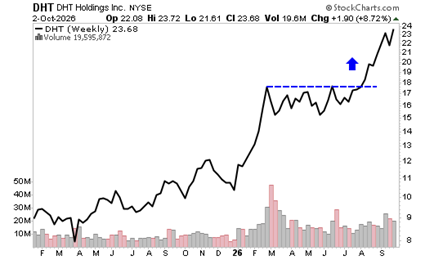
The stock has moved up, but seems to be trailing the move in tanker rates. That means there should be plenty of upside to come.
This is a case where you need to move before the ship sails.
All the best,
Sean Brodrick
P.S. My colleague Chris Graebe has another case where you need to move fast. He just revealed his 25x IPO Advantage. See how it can find the top 10% of IPO profit opportunities here.