Oil Tops $112 as Treasury Yields Fall: Why I’d Buy a 5-Year TIPS

 |
| By Gavin Magor |
If you're sitting on cash and wondering whether to lock in a bond yield, Thursday gave you two opposite answers.
Your fuel bills say inflation isn't going away.
The bond market doesn’t appear to be worried.
Only one of them can be right about your money.
And the answer decides which kind of bond you should own.
What Oil and Bonds Are Telling Us
Brent crude, the global oil benchmark, closed Thursday above $112 a barrel.
That's its highest close in about five months.
Reports of damaged tankers in the Strait of Hormuz and attacks on Saudi targets drove the jump.
You've already felt it at home.
In September, fuel oil prices were up 74% from a year earlier.
Gasoline was up 34%.
The same day, the 10-year Treasury yield fell back below 5%.
It was its largest one-day drop since March 2023.
Falling yields usually mean investors expect slower growth, lower inflation, or both.
Oil at five-month highs feeds straight into what you pay for gasoline, food and clothing.
That's not the backdrop for falling interest rates.
Consumer prices rose 3.7% in the year to September.
And the Federal Reserve (Fed) raised rates at its last meeting to bring inflation down.
Why the Bond Rally Is Misleading
Thursday's bond buying came from fear about artificial intelligence (AI) stocks, not from good news on inflation.
The Nasdaq fell 2.6% as investors worried about how AI companies will pay for their spending.
When stocks wobble, money runs to Treasurys first and asks questions later.
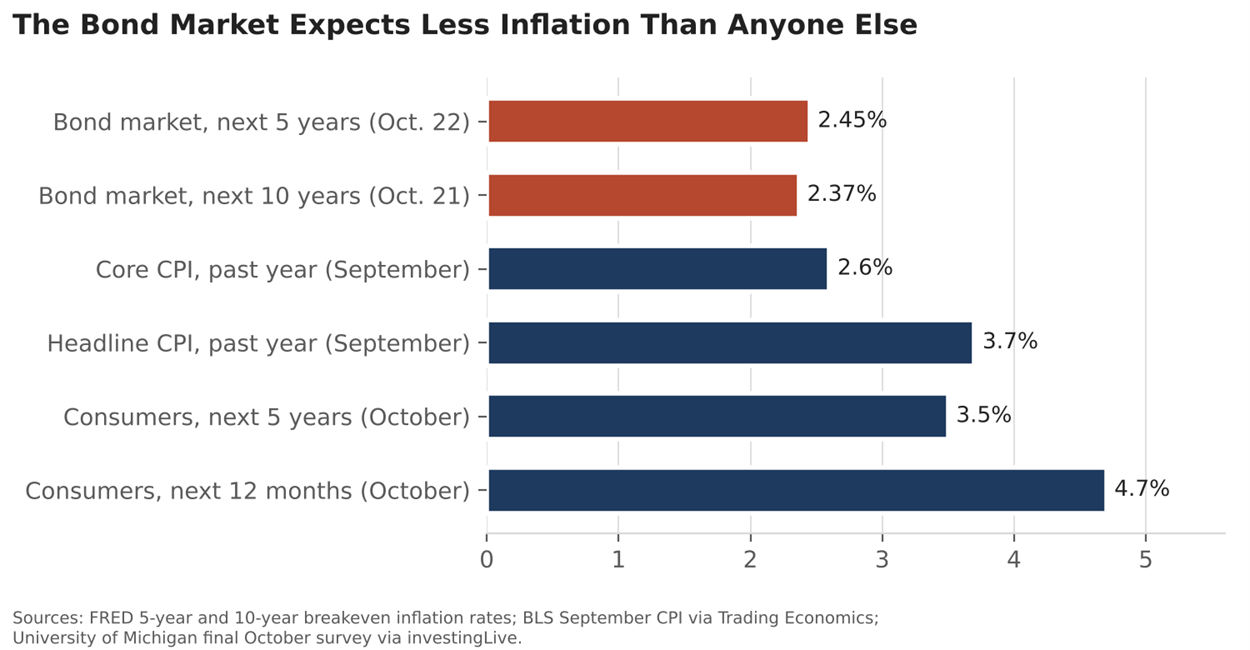
The bond market's own inflation gauge moved the other way.
It's called the breakeven rate, the gap between regular Treasury yields and inflation-protected ones.
On Wednesday, the five-year breakeven stood at 2.40%.
By Thursday's close, it had risen to 2.45%.
So even as yields fell, bond investors quietly raised their inflation bet.
That bet is still far below what consumers expect.
Consumers expect 4.7% inflation over the next year.
Over the next five years, they expect 3.5%.
And inflation is already running at 3.7%.
For my part, I think the bond market is underpricing inflation.
What It Means for Your Money
If yields fell on fear rather than on falling inflation, the drop may not last.
I expect them to drift back up once the fear fades, as long as oil stays high.
That's a risk for anyone buying long-term bonds after Thursday's rally.
A popular long-bond exchange-traded fund (ETF), the iShares 20+ Year Treasury Bond ETF (TLT), earns a D, a SELL, from us.
Treasury Inflation-Protected Securities (TIPS) pay a fixed rate on top of inflation.
Their principal rises with consumer prices, so your buying power is protected.
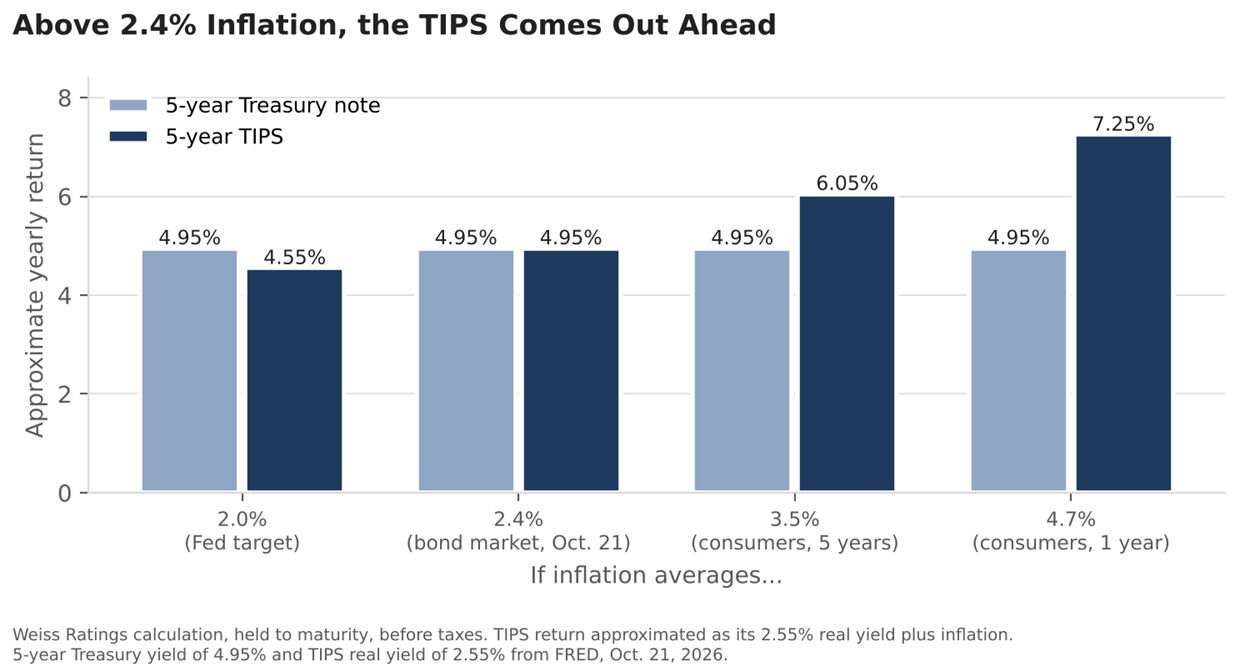
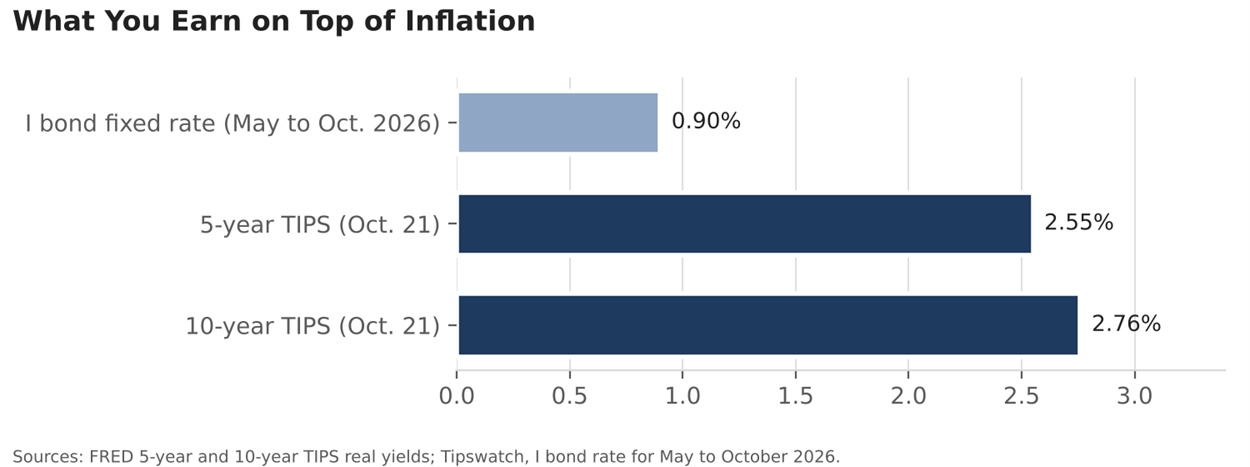
On Wednesday, a five-year TIPS paid 2.55% above inflation.
At the start of the year, it paid just 1.46%.
A regular five-year Treasury note paid 4.95% on Wednesday.
The gap between the two is that 2.40% breakeven.
So the TIPS comes out ahead if inflation averages more than 2.40% over five years.
Inflation itself, and what consumers expect, are both running above that.
Why Not a TIPS Fund?
The iShares TIPS Bond ETF (TIP) earns a D+, a SELL.
It owns TIPS of many maturities and never holds them to the end, so its price swings with interest rates.
Short-term TIPS funds score better but still not well.
The Vanguard Short-Term Inflation-Protected Securities ETF (VTIP) earns a C, a HOLD.
An individual TIPS held to maturity pays back your inflation-adjusted principal, whatever happens to bond prices in between.
Series I savings bonds (I bonds) are the Treasury's other inflation-protected IOU.
Bonds bought through Oct. 31 pay a fixed rate of just 0.90% above inflation.
The Treasury announces the new rate on Nov. 1.
Tipswatch expects the fixed rate to rise to about 1.3%.
Even then, it's well below what a five-year TIPS pays above inflation.
If you want I bonds anyway, wait for the Nov. 1 rate.
And note that TreasuryDirect logins move to ID.me on Oct. 28.
Two A-Rated Insurers That Benefit
Insurers collect premiums up front and invest the money until claims come due.
Higher yields for longer mean more income on that money.
Travelers (TRV) earns an A+, a BUY.
Its after-tax investment income rose 7% in the third quarter.
It credited a higher yield on its bond portfolio and more money invested.
Chubb (CB) earns an A, a BUY.
Its adjusted investment income reached a record in the third quarter, up 6.3%.
Its chief executive credited rising interest rates and a strong market for bond investors.
Both stocks have tended to move independently of the broader market.
Let the Ratings Do the Sorting
Every rating in this report came from the live Weiss Ratings pages on Friday.
Weiss Ratings Plus puts that same work in front of you, with real-time ratings, instant alerts and exclusive analysis.
It's how you'd know that a fund sold as inflation protection carries a SELL from us.
Click here to see what Weiss Ratings Plus can do for you.
Your fuel bill and the bond market can't both be right.
A five-year TIPS lets you stop guessing which one is.
If inflation runs hot, its principal rises with it.
If inflation cools, you still lock in a solid return above inflation.
You can buy one through TreasuryDirect or most brokerage accounts.
Hold it to maturity, and the price swings in between don't matter.
Cash you'll need within months still belongs in six-month Treasury bills, as I said on Oct. 21.
The five-year TIPS is for money you can leave alone for five years.
For my part, I'd rather own the inflation protection now, while the bond market still prices it cheaply.
The five-year TIPS is my pick for new bond money in this market.
What I'm Watching
- The Fed's Oct. 27-28 meeting, after Wall Street leaned toward a December rate hike.
- The September personal consumption expenditures (PCE) price index on Oct. 29, the Fed's preferred inflation gauge.
- The new I bond rates on Nov. 1.
- Brent crude, and whether it holds above $110 a barrel.
- The five-year breakeven rate, for a move toward what consumers expect.
- Any change in our ratings on long-term Treasury funds.
Bottom Line
On Thursday, your fuel bill and the bond market told you two different stories.
I believe the fuel bill.
Don't chase long-term bonds after the rally.
Put new bond money into a five-year TIPS and look to Travelers or Chubb on the stock side.
Cheers!
Gavin