Plug In to Profit From AI’s Desperate Need for Power

 |
| By Sean Brodrick |
For the past few years, the AI arms race has focused on chips.
Companies raced to secure the most Nvidia GPUs and build the biggest data centers.
But those ambitions were limited by the supply of available semiconductors.
Now there’s a new bottleneck.
The AI boom is running smack into America’s aging electrical grid.
And that’s creating what could be one of the biggest infrastructure investment opportunities of the decade.
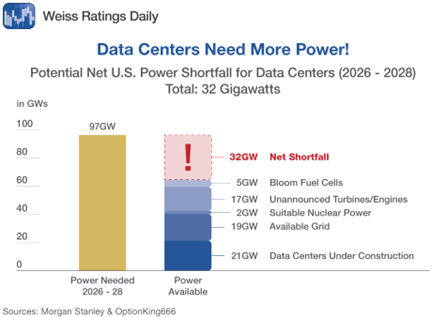
Morgan Stanley estimates U.S. data centers will need 97 gigawatts of additional power from 2026 through 2028.
Even after counting data centers already under construction, available grid capacity and “time-to-power” solutions such as nuclear, gas turbines and fuel cells, Morgan Stanley still sees a 32-gigawatt shortfall.
Unlike the semiconductor shortage, you can’t solve this problem by simply building another chip fab.
AI Moves Fast. The Grid Doesn’t
A hyperscaler can build a standard data center in 18 to 24 months. Try doing that with a power plant or high-voltage transmission line.
You can’t.
New power generation, transmission and permitting can take seven to 12 years.
Meanwhile, interconnection queues in major markets can stretch four to seven years.
In other words, Microsoft, Amazon, Meta and the other AI giants can have the money, land, servers and GPUs ready to go — and still find themselves waiting years for an electrical hookup.
And the problem is getting worse because AI data centers are absolute power hogs.
Traditional cloud data centers might use 10 to 15 kilowatts per server rack.
Advanced AI clusters can demand 40 to 100 kilowatts or more. A single AI campus can suck down anywhere from 50 megawatts to more than 1 gigawatt.
One gigawatt is power-plant territory.
Worse, AI needs that electricity 24-7.
You can't tell a billion-dollar cluster of GPUs to take the afternoon off because the wind stopped blowing.
Then There’s the Hardware
Even if you have enough electricity, you still have to get it into the data center.
And here we find another bottleneck.
Lead times for large high-voltage transformers have exploded from 16 to 24 weeks to three or four years.
Switchgear, breakers, substations and other critical equipment are also facing huge backlogs.
That explains why the tech giants are becoming increasingly creative — and desperate.
Developers are looking at co-locating data centers next to nuclear plants.
They're installing natural-gas turbines and building their own microgrids.
They're signing long-term power agreements and exploring fuel cells.
If the grid can't come to AI, AI will bring its own grid.
And somebody is going to make a LOT of money building it.
How You Can Play It
There are plenty of individual winners here.
Quanta Services (PWR) builds the transmission infrastructure.
GE Vernova (GEV) makes turbines and grid equipment.
Eaton (ETN) makes electrical equipment.
Vertiv (VRT) provides critical data-center power and cooling infrastructure.
Bloom Energy (BE) offers on-site fuel-cell generation.
But rather than picking just one winner, why not own a basket of companies positioned to profit?
The Defiance AI & Power Infrastructure ETF (AIPO) is specifically designed around the collision between artificial intelligence and America's need for more electricity.
Here's a weekly chart …
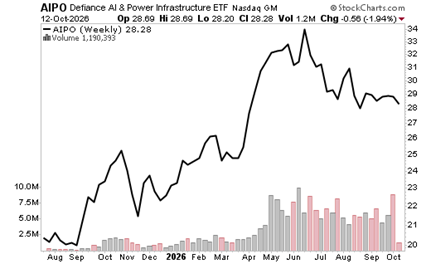
The fund owns companies involved in AI hardware, data centers, utilities, power generation, electrical infrastructure and construction.
Its holdings include many of the names I just mentioned, along with AI heavyweights such as Nvidia and Broadcom.
As of early October, assets had already grown to roughly $900 million.
The expense ratio is 0.69%, so it isn't cheap compared with a broad-market ETF.
But you're paying for targeted exposure to a group of companies I believe has legs.
For years, investors have focused on the companies building the AI brains.
Now comes the next stage of the boom — building the electrical muscles, arteries and heart needed to keep those brains running.
And as AI’s demand for electricity continues to climb, AIPO offers a way to profit from the companies racing to keep the lights on.
All the best,
Sean