 |
| By Sean Brodrick |
Wall Street babblers love to talk about the big bottlenecks in artificial intelligence: Nvidia chips, advanced memory or fiber.
But the biggest bottleneck may be something much more basic: electricity.
And AI is about to need a LOT more of it.
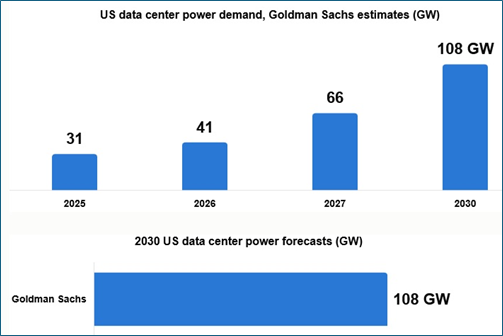
Goldman Sachs projects U.S. data center power demand will rise from about 31 gigawatts (GW) in 2025 to 41 GW this year — then explode to 66 GW in 2027, assuming roughly 70% utilization of installed capacity.
That’s more than DOUBLE in just two years.
And the growth doesn’t stop there.
Goldman’s newer outlook calls for roughly 125 GW of U.S. data center capacity by 2030, requiring about 108 GW of power.
McKinsey is even more bullish.
It estimates U.S. data center power demand could grow about 27% annually through 2030, reaching 121 GW of IT load.
Here’s another way to wrap your head around that number: McKinsey estimates America is building data centers at a pace that requires adding nearly 30 GW of new electricity supply EVERY YEAR.
There’s just one problem. America isn’t ready for it.
The Department of Energy cites a Berkeley Lab estimate that data centers consumed about 4.4% of all U.S. electricity in 2023.
Its reference case has that surging to 11.8% by 2030 — with scenarios ranging as high as 15.3%.
Meanwhile, the International Energy Agency expects overall U.S. electricity consumption to increase by more than 420 terawatt-hours through 2030.
Data centers alone should account for nearly HALF of that growth.
Note: Power demand is measured in gigawatts consumed.
Annual electricity use in terawatt-hours.
Data center IT load is the equipment’s computing draw.
And generator capacity is the potential output of on-site power equipment.
These measures are related, but not interchangeable.
America hasn’t seen anything like this in decades.
For years, U.S. electricity demand barely budged.
So utilities had little reason to build generating capacity, transmission lines and other infrastructure for an economy suddenly demanding tens of gigawatts more.
Now they’re scrambling to catch up.
The Grid Was Already in Trouble
AI’s gigantic new appetite for electricity is being met by a power grid that was already creaking like an old car.
According to the U.S. Department of Energy, more than 70% of U.S. transmission lines and large power transformers are more than 25 years old.
Much of America’s grid was built during the 1960s and 1970s, with an engineered lifespan of roughly 40 to 50 years.
More than 55% of the nation’s 60 million to 80 million distribution transformers are over 33 years old.
In other words, we’re plugging the biggest new source of electricity demand in generations into infrastructure that is already getting long in the tooth.
Utilities were already staring at a multi-trillion-dollar rebuilding bill. Now AI is stomping on the accelerator.
The good news — for investors, anyway — is that the hyperscalers desperately need that power.
Data center operators are increasingly willing to help pay for the infrastructure required to deliver it.
That adds another firehose of money to the billions already pouring into power generation, transmission, substations and grid modernization.
And I know a way we can get in front of it.
How You Can Play It
You can buy a basket of stocks leveraged to the power grid buildout.
I’m talking about the First Trust NASDAQ Clean Edge Smart Grid Infrastructure Index Fund (GRID).
This ETF has a Weiss rating of “C” and owns companies involved in electric-grid modernization, transmission networks, substations, power equipment and smart-energy infrastructure.
It has about $12 billion in assets under management, an expense ratio of 0.56% and roughly 120 global stocks.
Some of its biggest holdings are smack-dab in the middle of the coming power-spending boom.
- Schneider Electric SE (SBGSY): GRID’s largest holding at around 9%. Schneider specializes in power distribution, data center power management and automated grid software.
- Eaton (ETN): Just under 9% of the fund. Eaton supplies electrical switchgear, circuit breakers, transformers and other equipment needed to move and manage all those electrons.
- Quanta Services (PWR): Roughly 8% of GRID. Quanta is one of the companies actually BUILDING the infrastructure — high-voltage transmission lines, substations and connections between utility-scale power generation and regional grids.
Now let’s look at the chart …
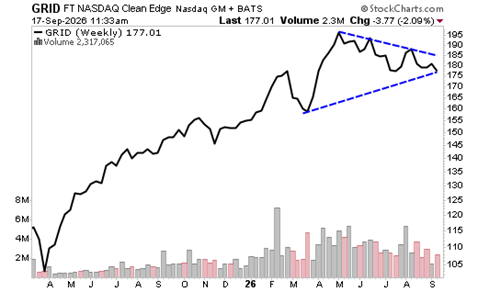
GRID ramped up — and amped up — into March of this year. Since then, it has been consolidating.
Now it looks like it’s coiling inside a triangle.
A successful breakout from that triangle gives us a price target of $234. That’s more than 32% above recent levels.
And remember what’s driving this.
AI’s hunger for electricity is ravenous. The grid isn’t ready. And when Big Tech needs power badly enough, money gets thrown at the problem. Buckets of it.
So grab a bucket of your own — and get busy scooping up profits.
All the best,
Sean
P.S. After this week’s rate hike, we have an emergency income opportunity coming up. Grab your spot here to attend on Monday, Sept. 21 at 2 p.m. Eastern.