Railroads & Cannabis Bubbles Show What’s Coming in AI

 |
| By Sean Brodrick Reviewed by: Jim Nelson |
Well, THAT was exciting! And here I thought Thanksgiving week was supposed to be a quiet time on Wall Street.
We’ve seen Jensen Huang ousted as Nvidia's (NVDA, “B-”) CEO, then reinstated.
We’ve seen investors flee AI stocks as if they were radioactive, then rush back into those same stocks.
I hope you spent more time enjoying turkey with your family than watching the markets. It’s probably better for your blood pressure, if not your waistline.
But amid all the wild swings on Wall Street, I think investors are losing sight of something important. The financial problems that came to light with Huang’s ouster didn’t magically disappear with his return.
And the problem isn’t whether AI will live up to its promise. The problem is whether the companies borrowing enormous sums of money to build out AI infrastructure will ever generate enough cash to pay it back.
As a white-bearded investor, I can tell you we’ve been down this road before.
The general view among the bulls on Wall Street seems to be that the recent sharp correction (though it’s actually been going on for weeks) was a necessary reset after a bout of irrational exuberance.
Expectations have been lowered, valuations have been trimmed and now Huang is back at the helm of Nvidia.
The worst is in the rearview mirror. The crisis is past. It will be fine.
If you believe that, I have a bridge in GTA 6 to sell you.
What Can Weed & Railroads Teach Us?
I’m a student of history, and man, I am seeing some cycles set up to rhyme, if not repeat.
America’s railroad boom and the Canadian cannabis boom, two examples from different eras, were built on enormous expectations for future growth and the assumption that capital would remain readily available.
AI may very well transform the world, just as railroads transformed transportation in an earlier era. In fact, railroads went bust not once, but twice.
The first one ended in the Panic of 1873.
In the aftermath, 25% of all operating railroads went bust within two years.
Meanwhile, within 24 to 36 months, one-third of all railroad bonds defaulted.
Surely, investors learned their lesson, right? Ahahaha!
The Panic of 1893 was even bigger, and a railroad bust also drove it.
More than 33% of all U.S. railroads collapsed into insolvency, and roughly 25% of all U.S. rail debt went insolvent, too.
But that was then, when investing was the Wild West, yes? Now we’re all civilized, yes? That’s why I brought up the Canadian cannabis boom.
Deep in the Weed
Canadians are among the more polite, civilized, intelligent people on Earth (behavior in hockey rinks is an exception). Surely, they wouldn’t get caught up in something so stupid.
Well, hold on to your Tim Hortons …
I lived through the Canadian cannabis boom.
It followed the classic railroad mania playbook almost beat for beat — massive speculative capital rushes in to build fixed infrastructure ahead of actual demand, followed by brutal price compression, debt defaults and wholesale equity destruction.
Canada’s cannabis insolvencies accounted for 30% to 40% of all major commercial restructuring filings between 2021 and 2024.
What about the U.S.? Canadian cannabis is legal; U.S. cannabis is in a Federal gray area.
In the U.S., cannabis companies were legally barred from filing Chapter 11. Many went out of business; many others exist as “zombies,” not really doing business. Only a handful survived.
Building fixed infrastructure — where have I heard that recently? Why, in the AI data center boom, of course!
The Dominoes Fall
Neocloud providers — such as CoreWeave (CRWV, “E+”), Nebius Group (NBIS, “D+”) and IREN (IREN, “D”) — were among the most aggressive builders of the AI cycle. And they are leveraged to the eyeballs:
- Debt-Financed GPU Collateral: Many neoclouds funded billions in cluster buildouts by pledging Nvidia GPUs as debt collateral.
If GPU valuations face pressure, capacity costs drop or secondary market hardware floods the ecosystem, debt covenants and refinancing costs become substantially more punitive.
- The End of Free Money: Nvidia acted not just as a chip vendor, but as an anchor equity investor, debt backer and buyer of last resort for unused cloud capacity.
CFO Colette Kress says she would have reined in speculative balance-sheet financing and venture-style commitments.
Huang was also hinting that he planned to tamp down the deals even before his scandal.
That means the free money party is over (or at least greatly diminished) for neoclouds.
- The Fallout: Companies like Astera Labs (ALAB, “C”), where an estimated 70%+ of revenue is directly or indirectly tied to Nvidia's system architecture, face immediate valuation compression if rack shipments or next-generation Blackwell rollouts hit administrative friction.
- More Fallout: Companies that entered multi-year development agreements for multi-hundred-megawatt campuses (such as Applied Digital (APLD, “D-”) or third-party colocation landlords) risk delays or contract renegotiations if neocloud tenants struggle to secure debt financing for the GPUs meant to fill those halls.
- Hyperscaler Retrenchment: With Nvidia caught in a maelstrom of regulatory mayhem, the large hyperscalers (Microsoft (MSFT, “B”), Alphabet (GOOGL, “B-”), Amazon (AMZN, “B”) may accelerate their own custom chip efforts to insulate against single-supplier and regulatory disruptions, reducing their reliance on independent neocloud leasing.
Related story: Which Neocloud Stock Is Most at Risk? CoreWeave, Applied Digital, Nebius, IREN and Hut 8 Ranked
The Debt Tsunami Is on the Horizon
AI debt is already starting to go bad. Some examples …
- HSBC (HSBV, “B-”) dumping its $300 million Project Jupiter/Project Miner loan tranche at 85 cents on the dollar.
- ING (ING, “B+”) tried unloading $500 million worth of bank loans and credit facilities directly to wholesale data center operators but couldn't attract sufficient bids at acceptable prices.
- Reuters reports that banks are becoming reluctant to finance additional AI projects.
We don’t know what Nvidia under Jensen Huang’s reinstated leadership will do.
But if more public scrutiny causes Nvidia to curb vendor financing, equity support and cloud capacity buybacks, a bunch of companies will feel financial support fall away from under their feet.
The corporate debt exposed across the ecosystem falls into distinct risk tiers totaling over $600 billion in direct credit risk.
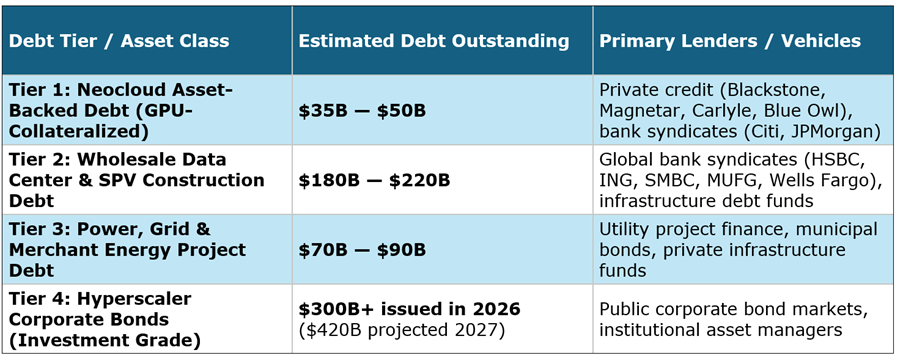
It gets worse! Much of this debt is structured with short maturities.
For instance, when Nebius pulled back from a planned 5-year high-yield bond, it pivoted to a $3.5 billion senior secured credit facility with a 364-day maturity.
That debt must be extended, refinanced or replaced within 12 months in a market where syndicates are slamming the brakes.
What’s more, that's just the debt already on the books.
Goldman Sachs estimated that new hyperscaler debt issuance would surge 68%, from $250 billion in 2026 to $420 billion in 2027 — precisely when lenders are becoming more cautious.
I bet that forecast gets revised.
Speaking of the data centers, they are financed by construction loans designed as temporary bridge financing.
Once the campus is powered and operational, banks expect to be “taken out” by commercial mortgage-backed securities (CMBS), long-term private credit or infrastructure bonds.
When secondary buyers demand deep discounts, the bridge lenders get stuck holding illiquid, unrated construction paper on their balance sheets.
More Power! Oops, Never Mind!
And power infrastructure for those data centers is also expensive.
Developers and independent power producers have leveraged project finance debt to secure multi-hundred-megawatt grid allocations and order long-lead electrical hardware (transformers, switchgear, turbines).
If data center construction stalls or leases falter, the cash flows designated to service grid infrastructure debt evaporate, leaving utilities and merchant energy developers carrying stranded capital.
As one domino falls, others wobble. Other companies could be dragged down as the maelstrom of mayhem churns.
Undefined Risk
So, is this a train wreck? I think so! Is it behind us? I think not!
The good news is that, in the short term, governments around the world are coordinating a response, and Huang is back as Nvidia's CEO, which reassures tech investors.
In the short term, cyclically, we should be in a good time for stocks.
The election cycle and seasonal forces want to push stocks higher through April.
If Huang’s return can paper over debt and circular financing issues in the AI space, then we should get that rally.
I remain cautiously optimistic. Heck, maybe Huang will fix what’s wrong with that corner of the market.
We’re still in a tech supercycle.
But the longer-term issues remain, and for now, the risk is undefinable. And the market HATES undefined risk.
So, after the bounce, after the rally, I’d look for more pain among stocks that took on debt to overpay for capacity. They face further, significant haircuts.
We’re coming to a time when cash will be king.
Those with war chests can make ready to acquire unfinished or distressed infrastructure at deep discounts, and the stocks of distressed companies that still have solid underlying businesses at pennies on the dollar.
I’m not recommending you buy anything at this time.
I do recommend you use the rallies to raise cash, if you haven’t already.
I’ll be recommending to my subscribers where I believe they should deploy it.
If you’re doing this on your own, good luck.
All the best,
Sean Brodrick
P.S. To be among my readers — and to see one rare opportunity I’m focusing on — watch my latest presentation.