 |
| By Gavin Magor |
On Friday, the Nasdaq-100 closed at a fresh record.
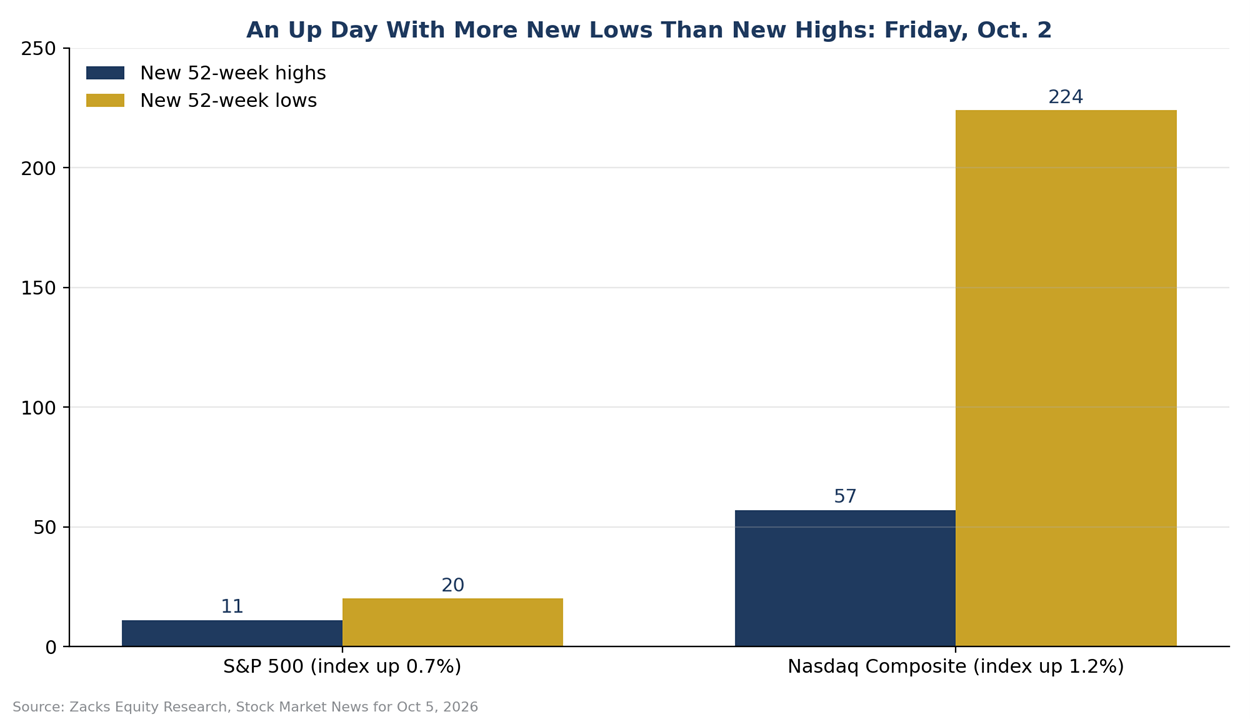
On the very same day, the broader Nasdaq Composite logged nearly four times as many new 52-week lows as new highs.
It's the clearest sign yet that this market is being carried by a small group of very large companies as most stocks quietly drift the other way.
Today, I want to walk through what that means for anyone whose retirement savings sit in an index fund, which describes a great many of us.
And I'll show you how to position for it without having to guess which way the next big move goes.
The Headline Versus the Headcount
On the surface, Friday looked healthy.
The S&P 500 gained 0.7% to close at 7,722.72, the Dow Industrials added 0.5% and the Nasdaq Composite rose 1.2%.
A weaker-than-expected jobs report eased worries about another rate hike from the Federal Reserve (Fed).
That left the S&P 500 about 1.2% below its August intraday all-time high of 7,816.70.
The headcount tells a different story.
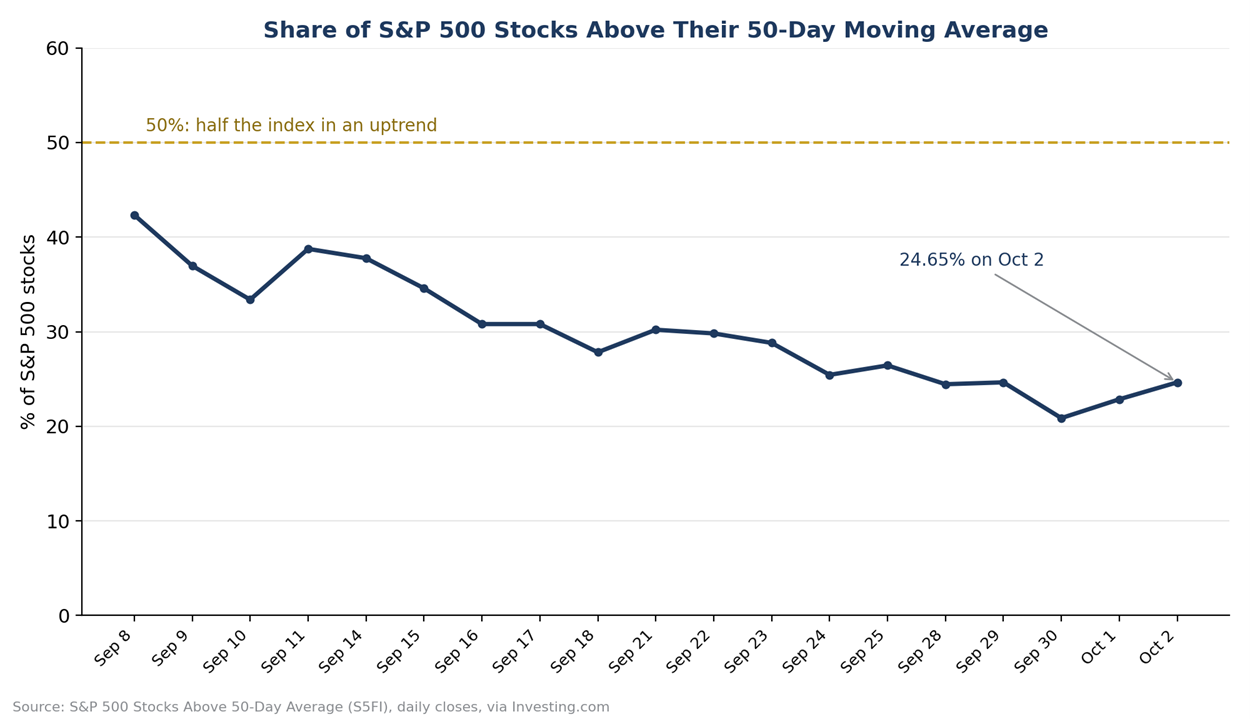
Only 24.65% of S&P 500 stocks closed Friday above their own 50-day moving average.
On Sept. 8, that figure was 42.3%.
By Sept. 30, it had sunk to 20.9%.
The 50-day moving average is simply a stock's average closing price over roughly the last 10 weeks of trading.
A stock above that line is in a short-term uptrend.
A stock below it is in a short-term downtrend.
So, on Friday, roughly three out of every four stocks in the index were trending lower. Even as the index itself sat within shouting distance of a record.
StreetStats, which tracks the same measure, puts its own comparable reading at about the 10th percentile of its history.
In plain English, participation has been this thin only about one-tenth of the time.
The 52-week tally was starker still: The S&P 500 posted 11 new 52-week highs against 20 new lows on Friday.
The Nasdaq Composite recorded 57 new highs against 224 new lows.
Remember, that was a rally day.
Just a Few Generals Are Doing the Fighting
The S&P 500 is weighted by market value. So, the biggest companies get the biggest say in where the index goes.
In September, the 10 largest companies made up about 37% of the index's total market value, according to MacroMicro.
Historically, that share has averaged closer to a quarter.
Related story: The AI Buildout Is About to Begin
So, when a handful of mega-cap technology and AI names rally, they can lift the whole index — even as hundreds of smaller members slide.
The bond market is a big part of why the other stocks are struggling.
The 10-year Treasury yield remained around 5.25% even after the soft jobs report, as Capital.com analyst Daniela Hathorn pointed out.
High borrowing costs weigh hardest on smaller and more indebted companies, and far less on cash-rich giants that can fund themselves.
Yet the options market doesn't seem worried.
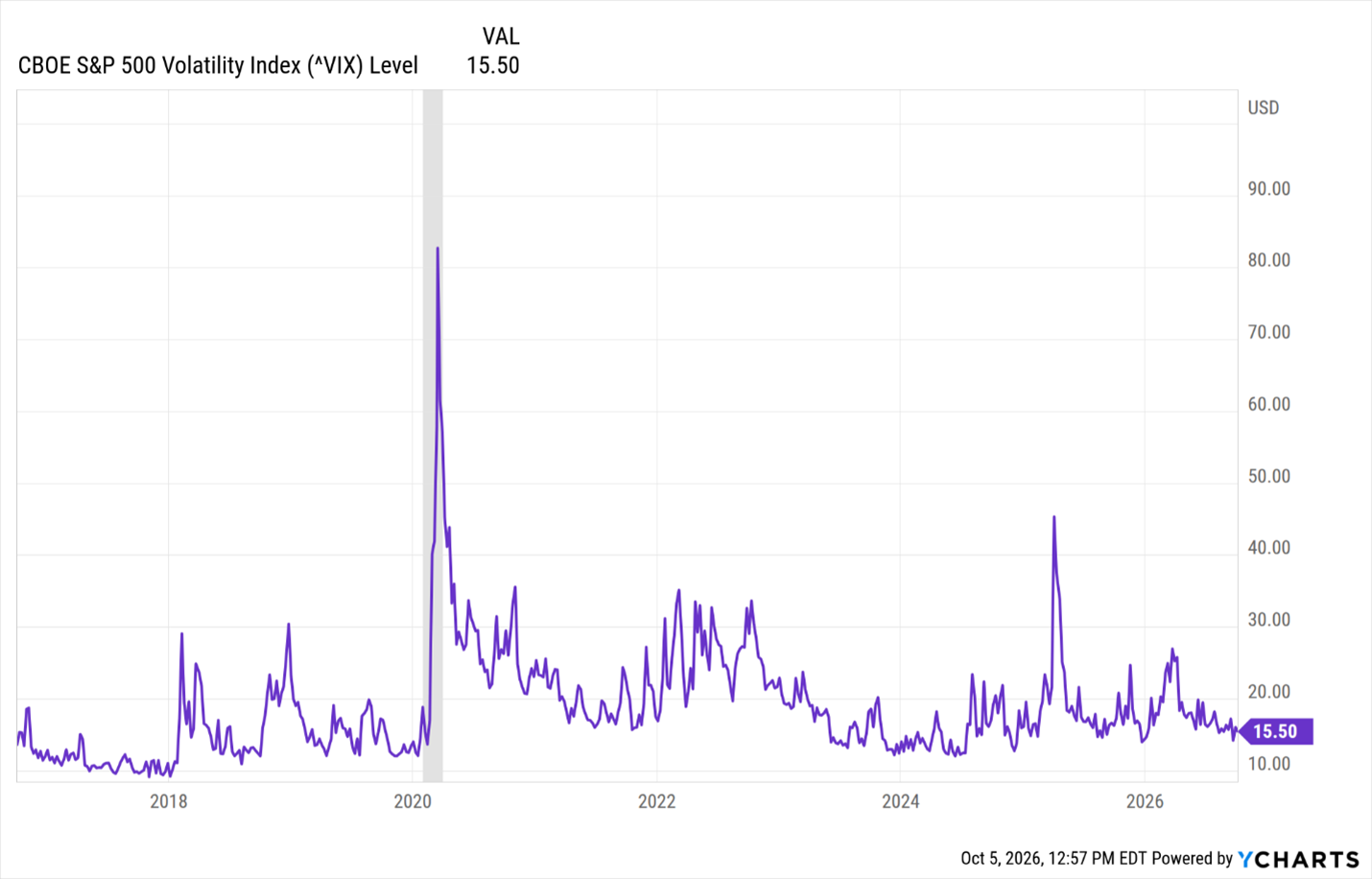
The Chicago Board Options Exchange (Cboe) Volatility Index (VIX), Wall Street's fear gauge, fell 6.6% on Friday to 15.31.
That's a calm reading for a market with this little participation.
What This Means for Your Index Fund
Many individual investors own the S&P 500 through a cap-weighted index fund or ETF, such as the State Street SPDR S&P 500 ETF Trust (SPY).
Its Weiss rating is “C+,” a HOLD.
That's a perfectly reasonable core holding.
But it means more of your money rides on a short list of companies than the word "index" suggests.
If those leaders stumble, there's no broad army of rising stocks underneath to break the fall.
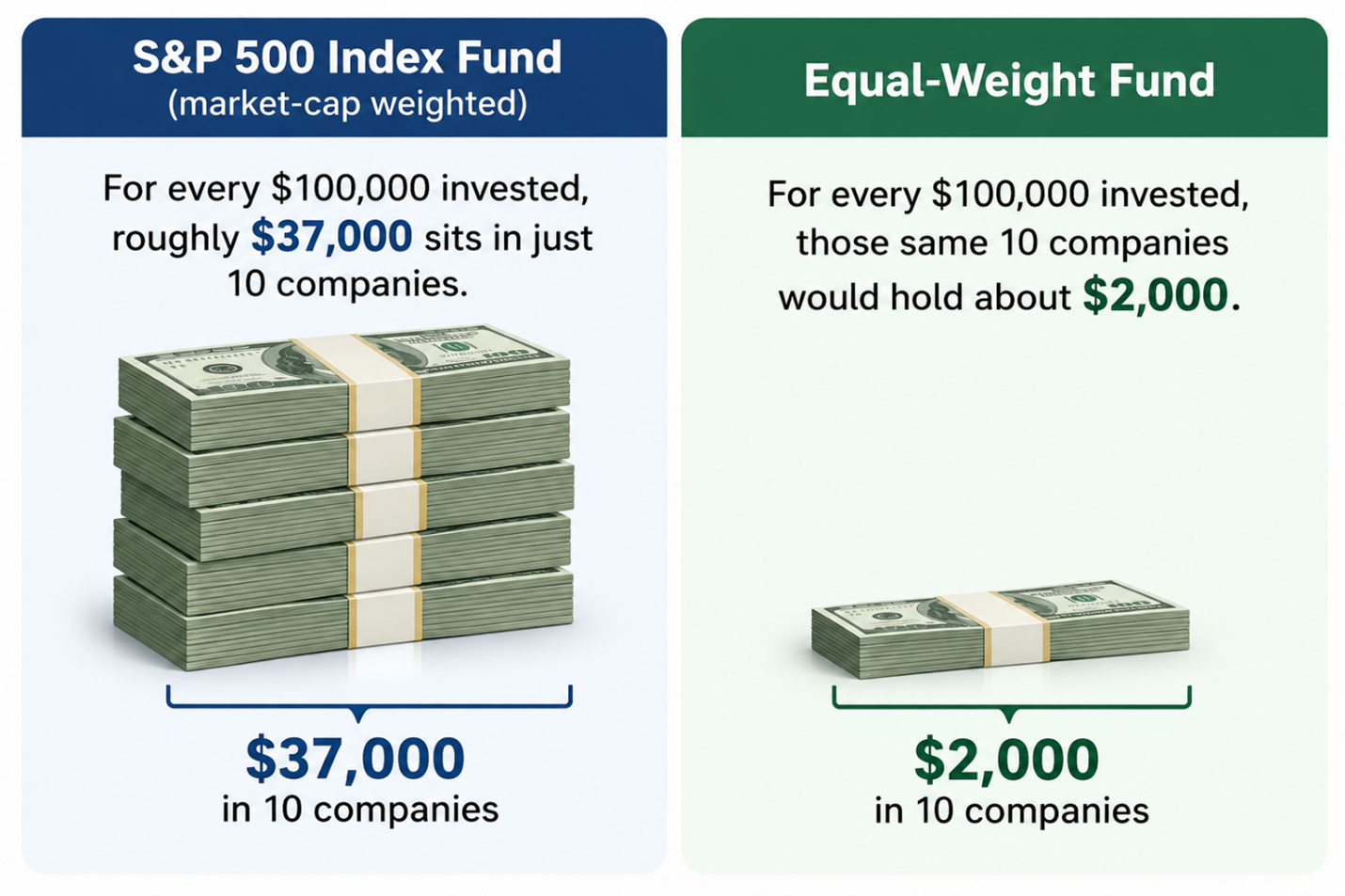
For every $100,000 in an S&P 500 Index fund, roughly $37,000 sits in just 10 companies.
In an equal-weight fund, those same 10 companies would hold about $2,000.
Narrow markets don't have to break.
But they leave much less room for error.
The equal-weight version of the index shows what most stocks have actually been doing.
The Invesco S&P 500 Equal Weight ETF (RSP) holds the same companies. But RSP gives each one roughly the same slice and rebalances every quarter.
It closed Friday at $209.73, about 5.9% below its Aug. 14 high of $222.77.
Its total return over the last 30 days was negative 3.7%.
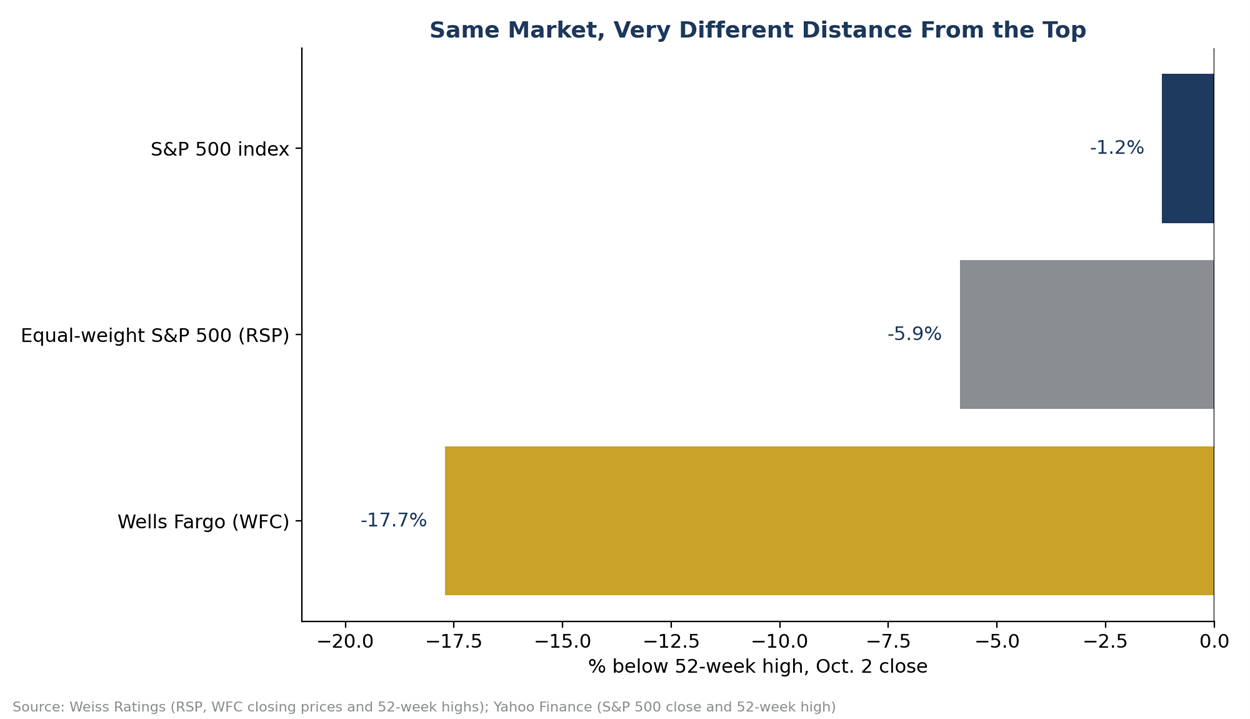
In other words, the typical S&P 500 stock has been in a pullback that the index quoted on the evening news barely shows.
The Rotation Trade Is Knocking
On Monday morning, Morgan Stanley (MS) upgraded Wells Fargo (WFC) to Overweight from Equal-weight, keeping a $102 price target.
The stock closed Friday at $80.45.
Morgan Stanley said Wells Fargo has been the worst performer in its coverage this year, down 14% against a 7% gain for the median bank it follows.
Its case is that the growing pains following the removal of the bank's asset cap are easing.
Growing the balance sheet after the cap came off squeezed the bank's net interest margin.
That’s the gap between what it earns on loans and investments, and what it pays for deposits and other funding.
Morgan Stanley expects that margin to hold around 2.42% through the first quarter of 2027, then improve to about 2.49% by the fourth quarter.
Morgan Stanley sees 2026 as a transition year, with the payoff to come in earnings and returns.
Weiss rates Wells Fargo “B,” a BUY.
Over three years, though, its total return is 116.20%. So, this year's slide is a setback inside a strong run, not a broken story.
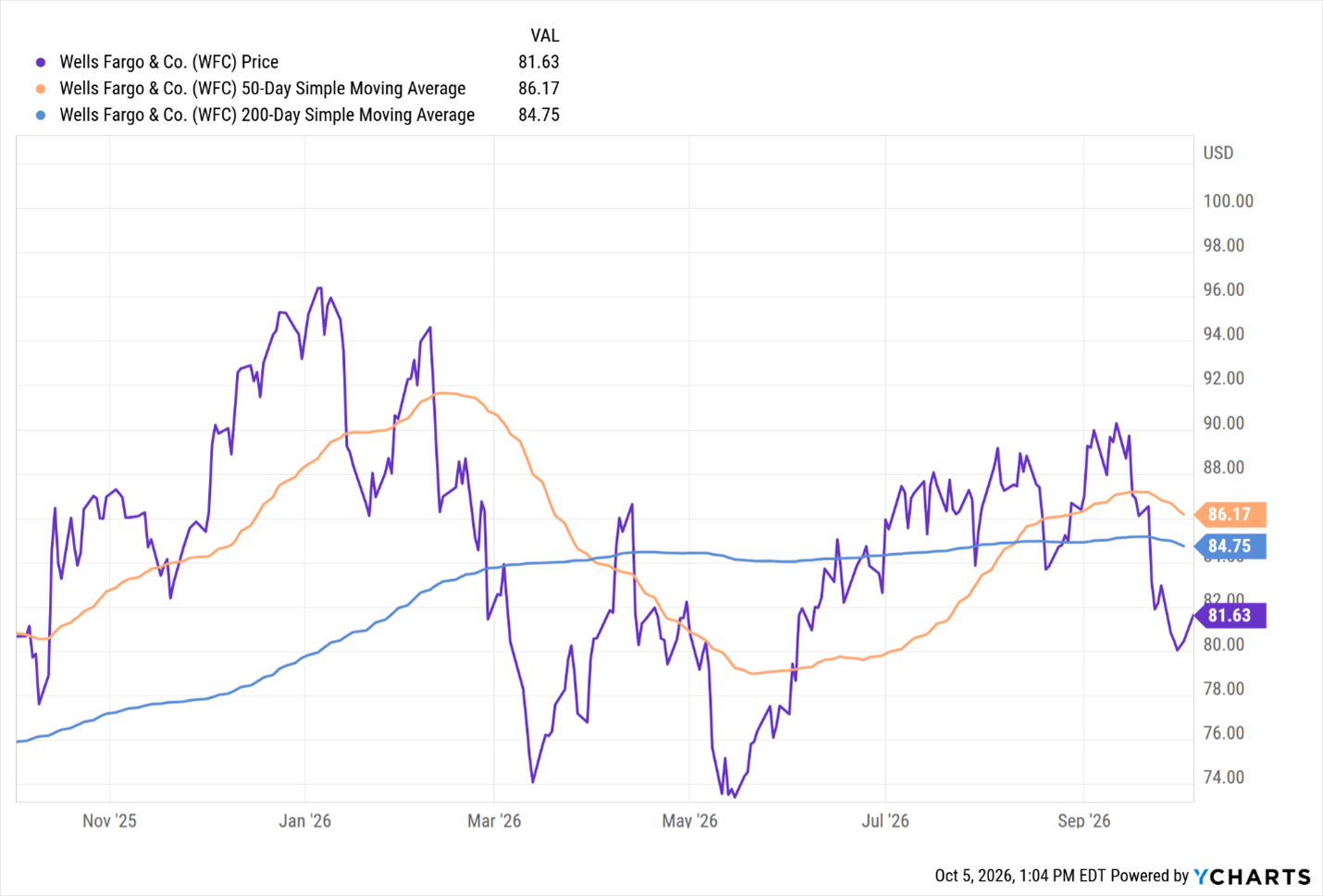
The stock trades at 11.69x trailing earnings and yields 2.3%.
Bank of America (BAC) trimmed its target to $100 from $102 Monday, and UBS (UBS) cut its target to $102 from $104.
But both targets still sit well above Friday's close.
There's a near-term catalyst for the shares: Wells Fargo reports third-quarter results on Oct. 13.
This is what a broadening market looks like when it starts.
Money moves toward overlooked, reasonably valued companies with improving stories … rather than piling further into the leaders.
How to Position Without Guessing
The point isn't to bet against the leaders.
It's to stop depending on them for everything.
First, check how concentrated you already are.
Look up the top 10 holdings of your main stock fund or 401(k) option.
If they add up to more than a third of the fund, your diversified core is more concentrated than it looks.
Second, add balance rather than making a wholesale swap.
Directing new contributions, or a slice of your next rebalance, into an equal-weight fund like the Invesco fund spreads your bet across all 500 companies.
Its “C+” HOLD rating tells you this isn't a fund to chase.
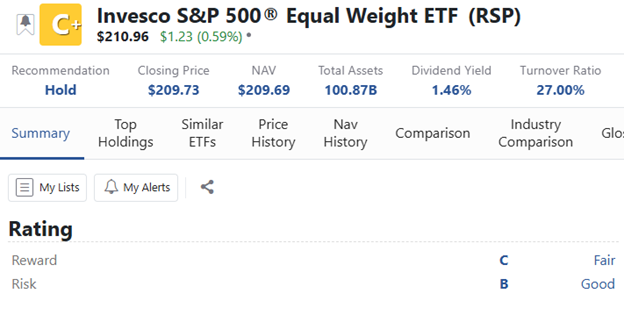
But within that rating, its risk grade is a “B.”
That’s better than its “C” reward grade, which is exactly the profile you want from a balancing position.
Its expense ratio is 0.20%, against 0.09% for the SPDR fund.

That’s a small price for a lot less single-stock risk.
In a taxable account, using new money rather than selling avoids handing the Internal Revenue Service (IRS) a share of your gains.
Third, consider a measured position in a quality laggard.
Wells Fargo is BUY-rated, out of favor and reports in eight days.
Size it so that a disappointing earnings day wouldn't keep you up at night.
Fourth, don't dump your winners just because they're crowded.
If your big technology holdings have grown past your target weight, trim them back to it.
That's rebalancing, not a forecast.
What Comes Next
I expect the gap between the index and the average stock to narrow over the coming month.
The laggards can catch up, or the leaders can give some back.
The first is the healthier outcome, and it's the one I'd lean toward, with rate-hike odds cooling after Friday's jobs data.
Bank earnings will be the first real evidence of which way it's going.
Strong results from lenders like Wells Fargo would argue the rest of the market is ready to carry its share of the load.
Weak ones would leave the index leaning on the same handful of names, with even less underneath them.
Key Items We're Watching
- The share of S&P 500 stocks above their 50-day average: A move back above 50% would confirm the rally is broadening, and a drop below Sept. 30's 20.9% would warn that the leaders are increasingly on their own.
- Minutes from the Fed's September meeting, due Wednesday, for clues on whether another rate hike is still on the table.
- Wells Fargo's third-quarter report on Oct. 13, and whether management signals that margin pressure is bottoming.
- The 10-year Treasury yield, which held around 5.25% even after Friday's soft jobs report.
- New highs versus new lows: On a healthy up day, new highs should outnumber new lows, not trail them by nearly 4-to-1.
Bottom Line
Whilst the Nasdaq-100 set a record on Friday, the broader Nasdaq posted nearly four times as many new lows as new highs.
Records make headlines.
Participation makes durable rallies.
Until that ratio flips, build your portfolio for the market underneath the headline, not just the headline itself.
Cheers!
Gavin