 |
| By Gavin Magor |
For most families, their house is the biggest thing they own.
Right now, a lot of them can't afford to sell it.
Which means they can't afford to buy the next one, either.
If a new job, a growing family or retirement means you have to move, today's market will send you the bill.
That bill went up again this week.

The Mortgage Bankers Association (MBA) reported Wednesday morning that mortgage applications fell 4.2% in the week ending Oct. 2.
That's the fifth straight weekly decline.
It also left applications at their lowest level since January 2025.
The reason: The average 30-year fixed rate climbed to 7.5%, up from 7.3% the week before.
That’s their highest in nearly three years.
A year ago, the same loan cost 6.4%.
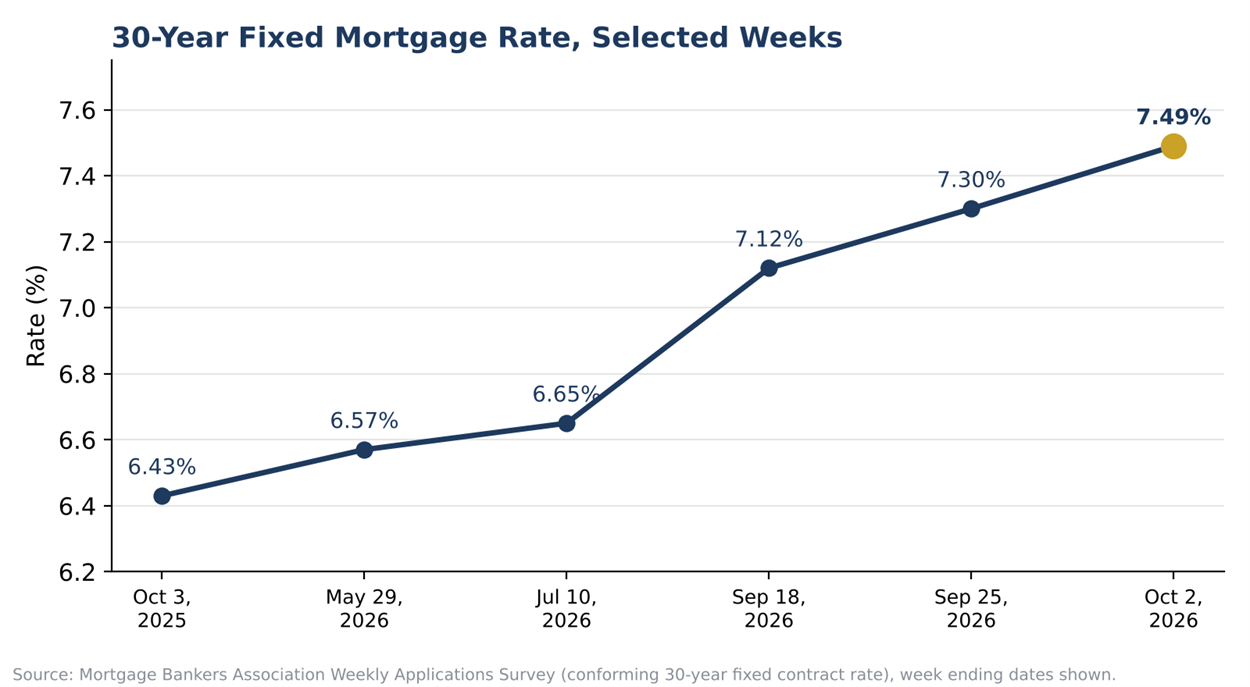
What 7.49% Interest Does to a Monthly Budget
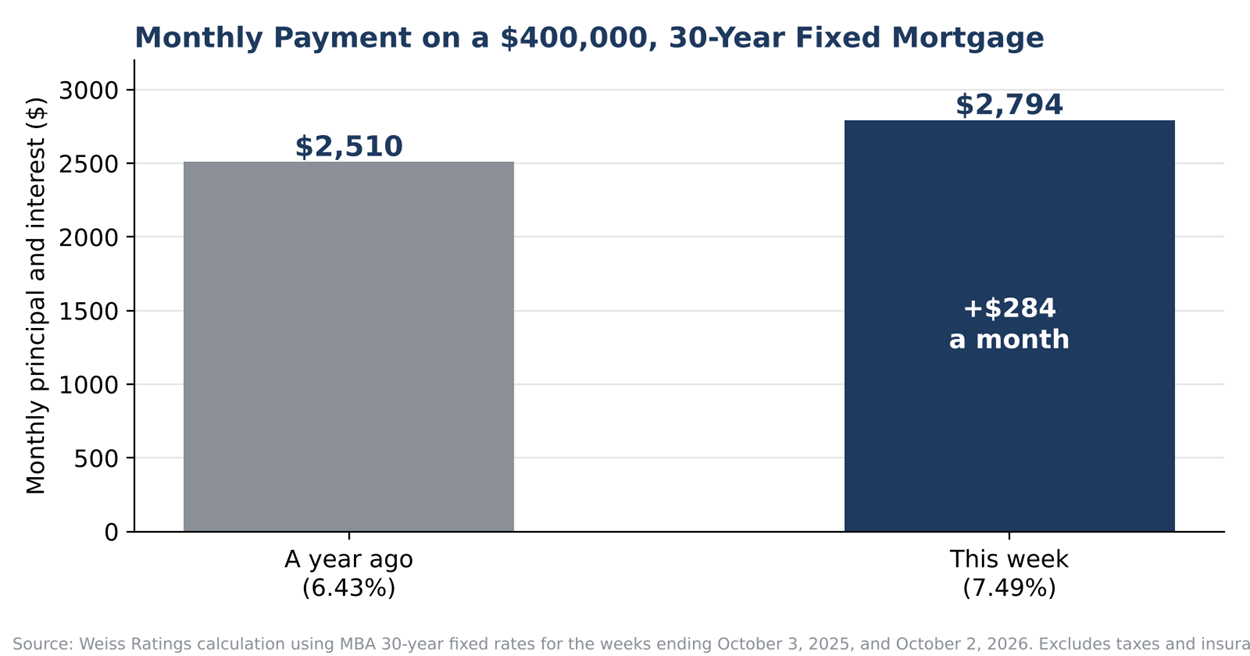
Take a $400,000 mortgage.
At last year's 6.4%, principal and interest come to about $2,510 a month.
At 7.5%, the same loan costs about $2,794 a month.
That's $284 more every month, or about $3,400 a year.
Over the full 30 years, the difference tops $102,000.
So, it's no surprise that refinance applications fell 7.5% in a single week.
Purchase applications slipped 2.1%.
For anyone sitting on a lower rate, moving now means trading it in for a far more expensive one.
And anyone hoping to buy is being asked to pay more every month for the same house.
Why Rates Aren't Coming to the Rescue
Mortgage rates take their cue from the 10-year Treasury note, not from the Federal Reserve.
The 10-year yield rose to 5.3% this morning, the highest since 2002. The 30-year Treasury bond reached 5.7%, a peak it hasn't seen in 24 years.
And Washington keeps borrowing more, so long-term lenders are demanding more in return.
Markets expect the Fed to hold rates steady at this month’s policy meeting. But a steady Fed won't pull mortgage rates down on its own.
For my part, I expect mortgage rates to stay above 7% through the end of the year.
Trane Gets Paid While Homeowners Wait
A frozen housing market is bad news for buyers.
But it is good news for businesses that keep existing homes running, and for the landlords who house the people who can't buy.
Trane Technologies (TT) sells the replacement furnaces that homeowners can only put off for so long.
Families who stay put still need heat in January and air conditioning in July.
When an aging system quits, they replace it — regardless of their mortgage rate.
Trane's residential business is built for exactly that.

On its July earnings call, management put new builds at less than a fifth of that business, with replacement purchases making up the rest.
And business is growing.
Residential bookings rose in the high 20s in percentage terms in the second quarter, and organic residential revenue grew in the low teens.
And housing is only part of the story.
Companywide, second-quarter bookings jumped 39% to $7.8 billion, and revenue rose 11% to $6.4 billion.
Its order backlog reached a record $12.1 billion, up 70%, helped by a 130% jump in orders for large commercial cooling systems.
Management raised its full-year outlook and now expects organic revenue growth of about 9%.
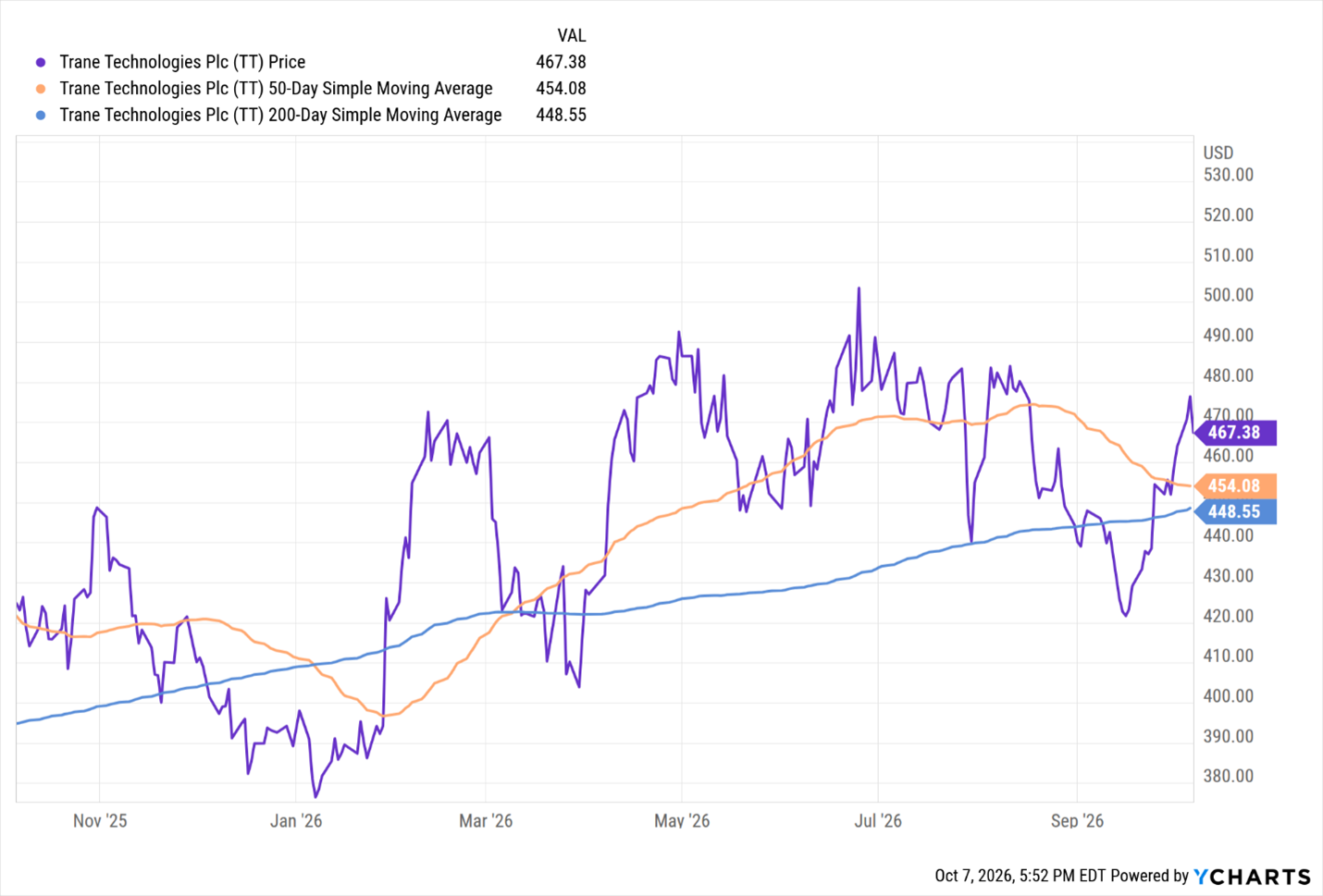
Trane earns a Weiss rating of B, a BUY, and its shares are up about 19% this year.
That gives you a company that wins whether families move or stay, with a record backlog behind it.
An ‘Invitation’ to Rent Longer
Apartment living isn’t for everyone.
Having limited bedrooms, a small kitchen and no backyard for pets may be fine for some. But renters who dream of more space and fewer neighbors have options.
Invitation Homes (INVH) is a landlord for would-be buyers. It rents out single-family houses, not apartments.
When buying gets more expensive, renting — especially if it’s a unit that offers some of the perks that owning does — gets more attractive.
One of those potential perks? Saving money.
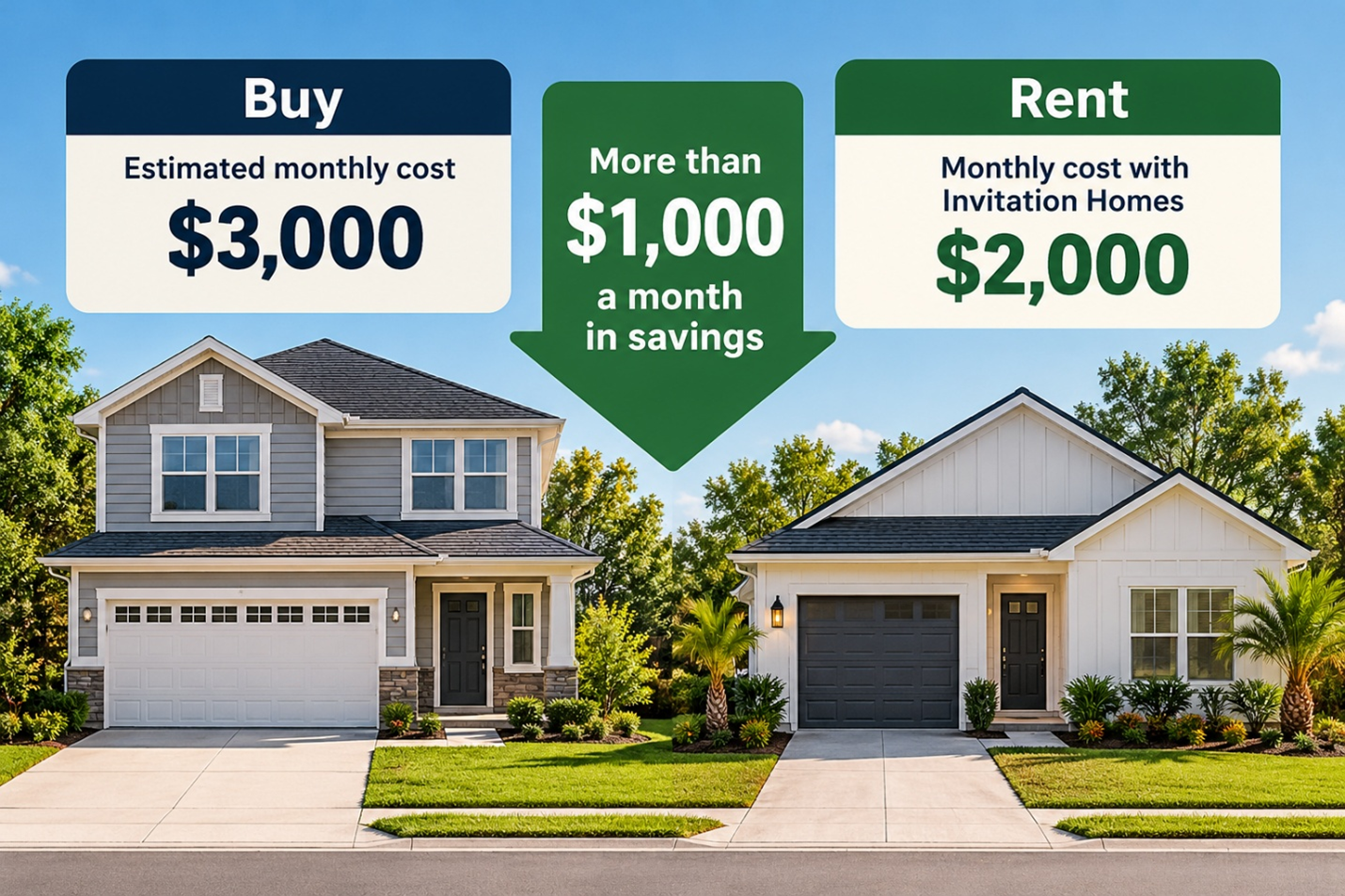
Invitation Homes’ management said in July that, according to John Burns Research and Consulting, renting one of its homes saves a family more than $1,000 a month compared with owning.
In the second quarter, 97.1% of its homes were occupied, on average.
Rent increases for renewing tenants averaged 3.3% in the quarter and reached a preliminary 4.3% in July.
The stock holds a Weiss rating of C, a HOLD.

Repair Bills Arrive at Everyone’s ‘Front Door’
Let’s face it, everything breaks. That’s why Frontdoor (FTDR) sells home warranties.
Its yearly plans cover the bill when a furnace, water heater, wiring or appliance gives out.
In the second quarter, revenue rose 5% to $645 million.
Frontdoor ended the quarter with 2.11 million warranty members, up 1%. That’s notable because this was the company’s first organic member growth in five years.
Its "other" revenue line rose 19%. This was driven mainly by a new heating, ventilation and air conditioning (HVAC) upgrade program.
Management raised its full-year revenue outlook to between $2.19 billion and $2.21 billion.

Frontdoor carries a Weiss rating of C+, a HOLD, and its shares are up about 36.5% this year.
It's on my Worth Watching list, because the longer homeowners stay put, the more their aging furnaces and water heaters need help.
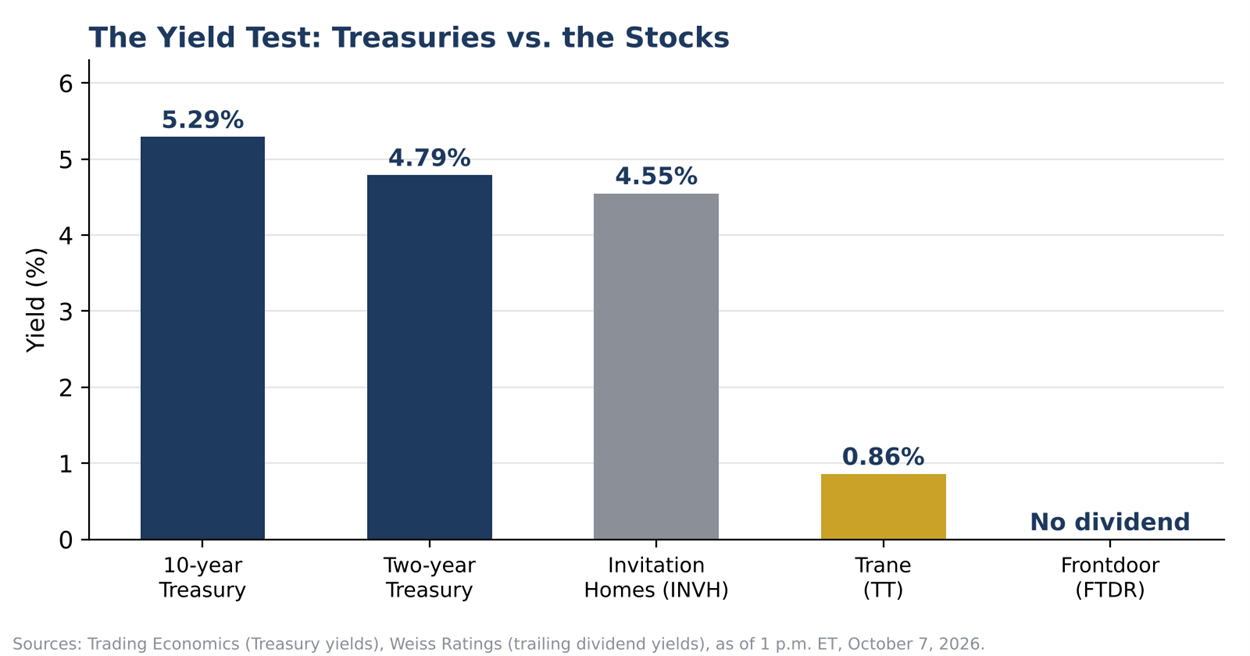
Trane, Invitation, Frontdoor vs Treasurys: The Yield Test
We’ve talked about one Weiss “Buy”-rated stock, Trane, and two “Holds,” Invitation Homes and Frontdoor.
If you wanted to buy just one of these stocks, you could do well with a bet on the “Buy.”
But when I’m researching stocks, there's one more number I like to check first — what kind of income can they help our readers bring home.
The first thing I do is look at Treasurys. Right now, the two-year Treasury note yields about 4.8%. And the 10-year pays about 5.3%.
Invitation Homes yields about 4.55%.
That's less than either Treasury. So, its dividend alone doesn't pay you for owning a stock instead of a government note.
If you already own INVH, the rising renewal rents give you a reason to hold. But if income is what you're after, the Treasury pays more today.
What about Trane? It yields under 1%.
Trane earns its place on today’s list through growth, a record backlog and its rating.
And Frontdoor pays no dividend at all.
Neither Trane nor Frontdoor are income stocks, and neither is meant to be. And Invitation isn’t in “Buy” territory yet.
So, none of these stocks have everything going for them.
But for those who are OK with taking on some more risk to earn their mortgage money, there are plenty of worse ways out there.
The Move for Savers: The Two-Year Treasury Note
If you or someone you know is saving for a downpayment, the same high rates that squeeze borrowers tend to reward savers.
Match the Treasury note to when you'll actually need the money.
So, a home purchase a couple of years out fits the two-year note.
Hold it to maturity. You collect that rate and get your principal back, which a bond fund can't promise.
The interest is also exempt from state and local income taxes.
Whilst buyers wait for better mortgage terms, that note keeps paying.
Key Items We're Watching
- Next week's MBA survey on Oct. 14, which will show whether applications fall for a sixth straight week.
- The 10-year Treasury yield, which needs to settle back below 5% before mortgage rates can ease meaningfully.
- Trane's and Invitation Homes' third-quarter results, both expected in late October, for residential bookings and renewal rents.
- Frontdoor's third-quarter results, expected in early November, against its guidance of $642 million to $652 million in revenue.
Bottom Line
Your house may be the biggest thing you own, and right now it's also the hardest thing to trade.
For a replacement-driven business like Trane, and for savers holding short-term Treasurys, that frozen market is the opportunity.
Cheers!
Gavin