Small-Cap Sell-Off: Why Gold Miners Sank and Grocers Held Up

 |
| By Sean Levine |
Smaller companies had a rougher stretch than the S&P 500 during our Sept. 11–Oct. 23 lookback.
On an equal-weighted basis, companies outside the index lost 3.5% over that six-week lookback window.
Meanwhile, the average S&P 500 stock gained 1.2%. The index itself slipped 0.6%, dragged down by a few huge tech stocks.
Related story: S&P 500 Sector Performance: Healthcare & Consumer Staples Rally as Technology Stalls
So, why the selloff for small companies?
Rates, Oil & AI Worries Squeeze Small-Caps
First, the Federal Reserve voted 12-to-0 on Sept. 16 to raise interest rates.
Within days, the 10-year Treasury yield closed above 5% for the first time since 2007.
Then oil topped $100 a barrel, and a hot inflation report in mid-October pushed yields higher still.
On top of that, worries about how AI spending would be financed spread.
Now admittedly, that’s a lot of bad news to react to, and a lot of companies of ALL sizes did fall. But smaller companies are a lot less resilient, and this time the news hit them a LOT harder.
Grocers Keep the Lights On
Now, while everybody fell, that’s REALLY only true on a technicality.
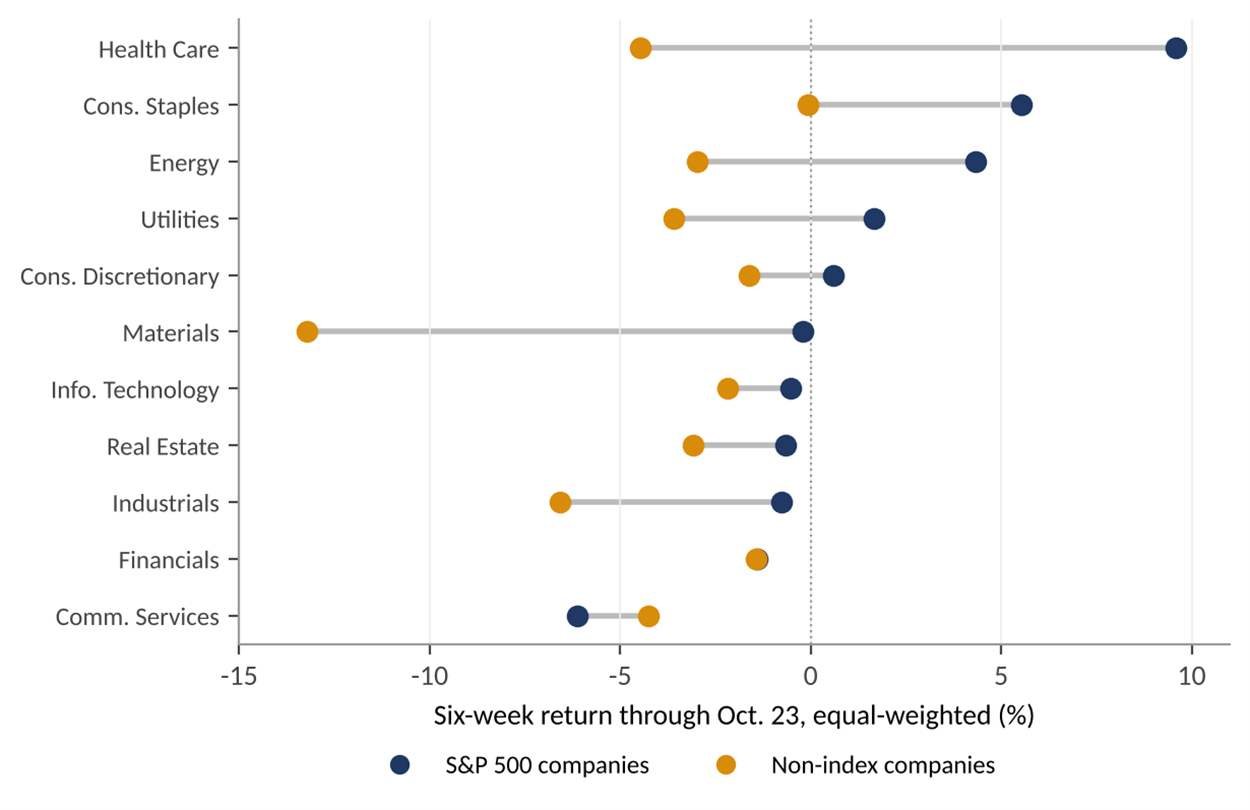
Consumer Staples lost just 0.1%, essentially flat, and the best of the 11 sectors outside the index.
That said, Staples have already had a rough go of things lately, following losses of 4.2%, 7.9% and 7.4% over the three previous windows.
Keeping things steady, grocers and club stores rose as much as 17% as investors rushed into defensive stocks.
But cannabis grower Glass House Brands (GLAS), with a Weiss rating of “D,” a “Sell,” lost 73% as cannabis stocks sold off.
Behind the move, a judge paused the easing of federal cannabis rules.
If not for Glass House’s breaking down, the sector would have gained 1.5%.
Brazil Parties, Crypto Gets The Hangover
Next, Financials lost 1.4%, the second-least bad for smaller names, in its third straight losing window.
Surging Brazilian stocks and strong trading volume lifted some brokerages and trading platforms.
But this ultimately wasn’t enough, as digital-asset companies, online brokers and consumer lenders fell as much as 40%, with no single cause standing out aside from the macro headwinds.
Gold Miners Lose Their Shine
Meanwhile at the uglier end of the tape, Materials lost 13.2%, the worst performer of the 11 sectors, and the sector’s weakest reading since we started tracking data at the beginning of the year.
That was also Materials’ third straight loss, with each coming in worse than the one before.
Behind it, the Fed's rate increase and higher yields pressured precious metals, which pay no interest, so lose a lot of their shine compared to higher-paying government debt.
As a result, gold and silver miners fell as much as 35%, much more than the metals themselves.
By comparison, the S&P 500's only gold miner lost 14%, so the smaller miners fared far worse.
AI Builders Run Out Of Mortar
Likewise, Industrials lost 6.6%, the second-worst performer, in a fourth straight losing window.
Specifically, companies that build and power data centers fell as much as 38% as doubts about AI financing spread.
But more broadly, those high fuel costs continued weighing on the whole sector.
Momentum: Flight-to-Safety Wins Outside the Index, Too
But we don't just monitor winners and losers, we also want to know which sectors shifted gears the most.
So we compare each sector to how it did in the previous window.
Coming in first, Consumer Staples outside the index gained the most momentum, improving 7.3 points and leaping from ninth place to first.
Meanwhile, Information Technology lost the most, falling 4.9 points from first place to fourth.
Behind that drop, bitcoin miners that pivoted to AI data centers fell as much as 53% as the cost of data-center debt repriced.
This was offset a bit by cybersecurity and software companies rising as much as 65% as fears that AI would disrupt software receded, so smaller IT players were a bit more of a mixed bag than their larger peers.
Energy slipped too, losing 3.1 points since our last read and falling from essentially flat to a 3.0% decline.
Within the sector, uranium miners and oil-service companies fell as much as 42%, even as refiners rose up to 17%.
Biotech's Bitter Pill
The biggest gap between the two universes (S&P vs. not) was in Healthcare, up 9.6% inside the index and down 4.5% outside it.
Inside, investors rotated into defensive drug and tool companies.
But outside, small biotechs fell as much as 50% on disappointing trial results, rising rates and slower takeovers of public biotechs.
What It Means for You
When markets get nervous, smaller companies with weak finances fall hardest. That’s exactly when our ratings earn their keep.
Some of the steepest drops came from stocks we already rated a Sell:
- Glass House Brands (GLAS), rated “D,” a “Sell,” lost 73%.
- CoreWeave (CRWV), rated “D-,” a “Sell,” lost 39%.
- NuScale Power (SMR), rated “D-,” a Sell, lost 38%.
So before you buy a smaller stock, check its Weiss rating first. If you want to buy, then stick with stocks that are rated “B-” or better.
And don’t write off small-caps. Over the past year, companies outside the S&P 500 still returned 22%, beating the index’s 17%.
This is just a slice of our new Weiss Sector Pulse report. Every two weeks, Weiss Ratings Plus members get the full picture: every sector, inside the S&P 500 and out, plus the ratings to tell the winners from the wreckage.
Click here to get Weiss Sector Pulse with Weiss Ratings Plus.
Stay tuned,
Sean Levine
Associate Director of Research
Weiss Ratings
P.S. Glass House, CoreWeave and NuScale are all rated “Sell.” Weiss Ratings Plus members don’t have to wait for us to point those out. Our one-click screener, Wall Street’s Danger Zone, flags stocks as soon as they’re downgraded to “Sell,” so you can get out before losses can spiral. Click here to see everything Ratings Plus includes, like how you can get a real-time alert when a stock flips to “Buy” for the first time.