Small-Caps Just Beat the S&P 2-to-1 — Here's Why It’s Not Over

 |
| By Michael A. Robinson |
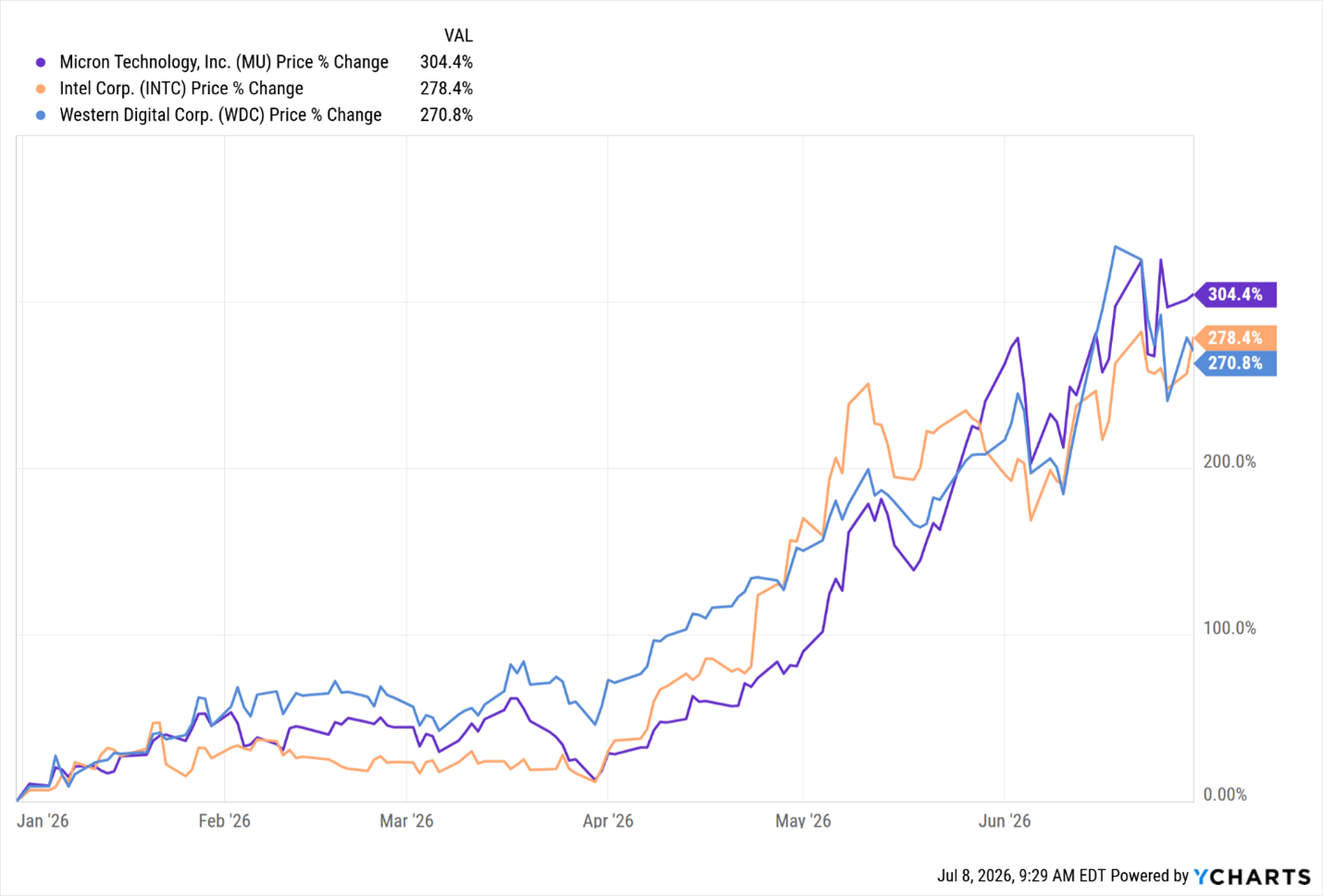
The broad market has been on a tear since the bottom in late March, with many large AI chip firms leading the field.
Names like Micron Technology (MU), Intel (INTC) and Western Digital (WDC) shot up 304.4%, 278.4% and 270.8%, respectively, through June this year.
But while the chip bottleneck continues to grab the headlines …
A massive rotation into smaller, more explosive stocks has been taking shape.
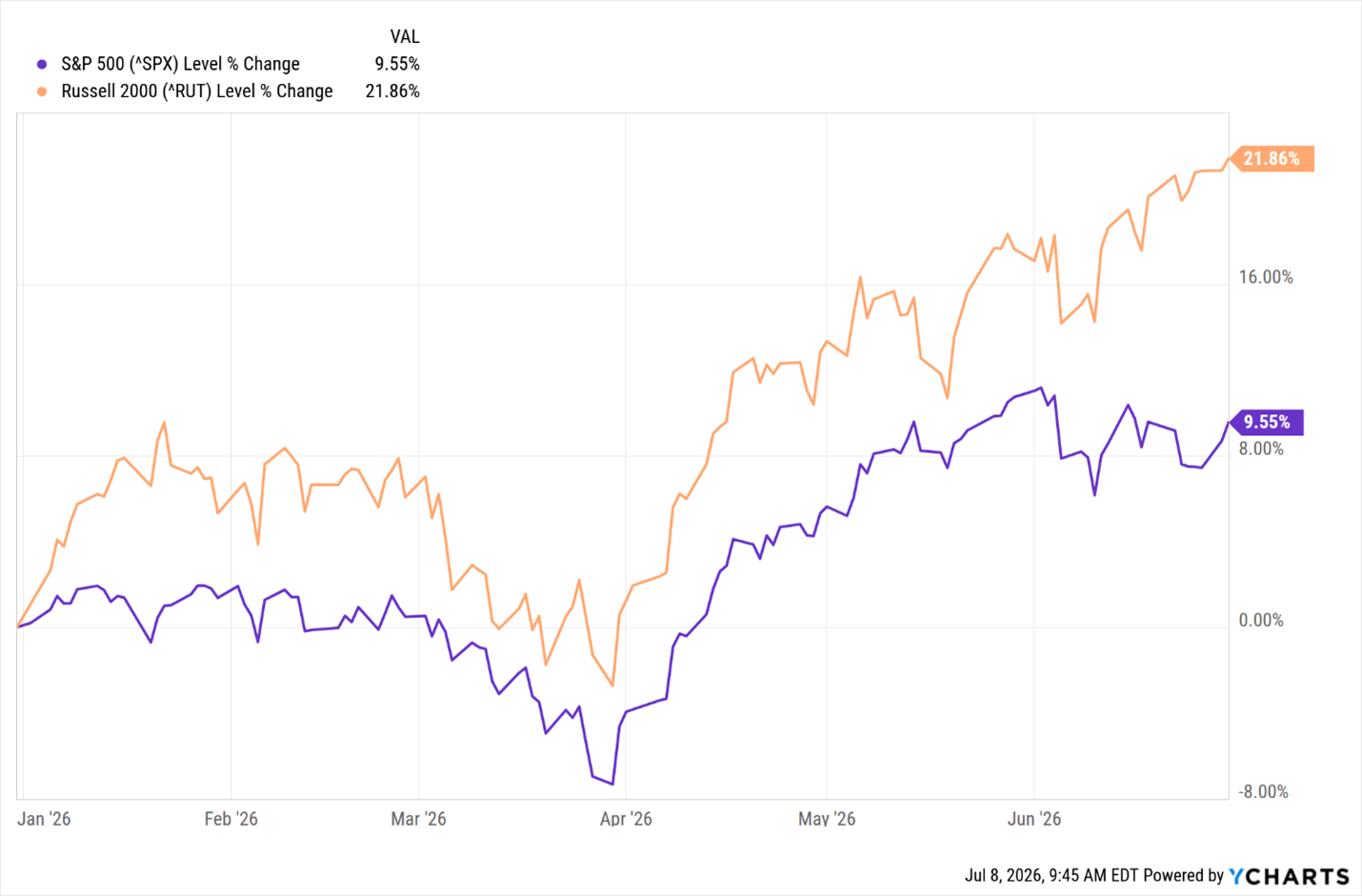
In case you missed it, small-cap stocks have been crushing their larger peers year-to-date.
And the competition’s not close …
What does it all mean for the rest of the year, and what's the best way to play this massive shift underway?
Let me show you …
A Banner Year
The Russell 2000 has had its best first half of the year in the market since way back in 1991.
The small-cap benchmark ran up 21.9% through June 30, more than double the S&P 500's 9.6% gain.
And the index is graduating winners fast.
Forty-two companies just moved up to the large-cap-focused Russell 1000, most of them techs and industrials.
That's the clearest tell of where the momentum baton is passing …
Catch-Up Meets Buildout
Two forces are driving the rotation. First, let’s look at valuation.
Right now, the Russell 2000 trades at roughly 20x earnings vs. 32x for the S&P 500.
That's a valuation discount of more than a third, near the widest gap in three decades.
But cheap stocks tend to stay cheap until a proper catalyst arrives.
This year, that catalyst is the AI buildout itself.
Massive spending on data centers, chips, power and networking is finally spilling past the mega-caps and into their suppliers.
Chip-related firms account for 16 of the Russell 2000's 50 best performers this year.
Take a Look at This Leaderboard
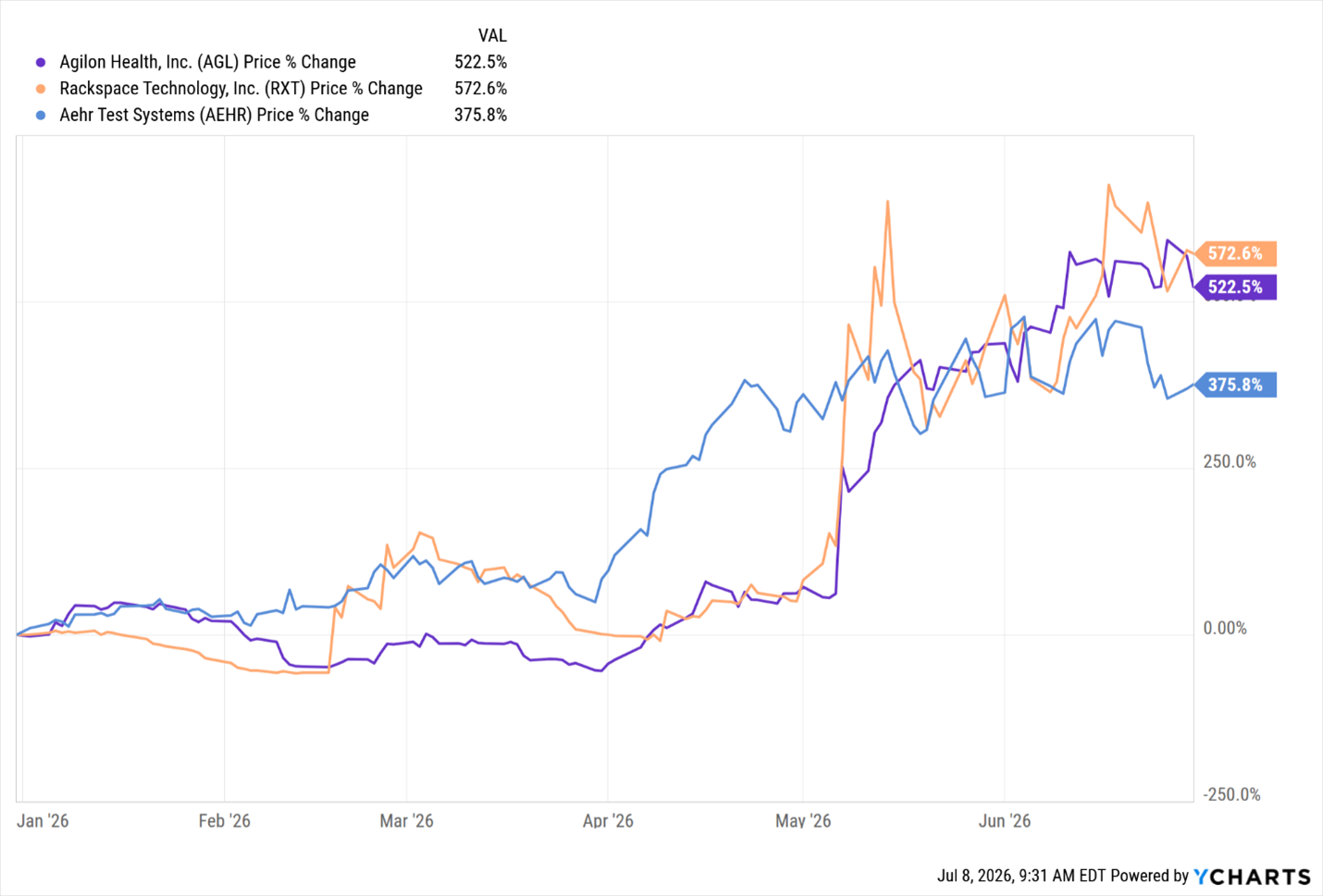
Subscription-based healthcare provider agilon health (AGL) is up 522.5% through Q2.
Rackspace Technology (RXT) is up 572.6% on its pivot to managed AI infrastructure.
Aehr Test Systems (AEHR), up 375.8%, makes the machines that stress-test chips before they ship — a classic picks and shovels play on the AI Supercycle.
And there’s plenty more left in the tank for small-caps to run this year.
That’s because a tiny $2 billion supplier that lands a big contract with a hyperscaler can double its revenue.
A mega-stock like Nvidia or Apple — both with market caps over $4.5 trillion — is a LOT less likely to do so.
That difference is showing up in earnings forecasts.
Wall Street now expects Russell 2000 profits to grow 35%-40% over the rest of 2026. That’s against 20%-24% for the S&P 500.
In other words, small-caps are both cheaper and growing faster.
The M&A Kicker
A global rebound in dealmaking could fan the small-cap flames the rest of the year.
M&A deals exceeding $10 billion have surged to their highest levels since 2021, with AI and biotech leading the charge.
Cash-rich large caps are hunting for bolt-on acquisitions, and small caps are the natural targets.
That’s especially the case in biotech, where big pharma faces a wall of patent expirations and needs to add new pipelines as soon as possible.
Notably, 82 of the 237 companies that recently joined the Russell 2000 are health firms — the largest single cohort.
Of course, it won’t be all smooth sailing for small-caps, which are much more sensitive than their larger peers to interest-rate hikes.
Small firms typically have far more floating-rate debt than their large peers. That means higher borrowing costs (if interest rates go up) hit them first and hardest.
Bank of America (BAC) estimates every additional quarter-point hike shaves about 2% off Russell 2000 operating earnings.
But a hawkish turn from the Fed still looks unlikely.
The Fed’s new chairman, Kevin Warsh, is working under heavy White House pressure to keep policy easy.
The path of least resistance for rates is sideways to down. Exactly the backdrop that can give small-caps a big boost.
It’s Happened Before …
So, what happened the last time the Russell 2000 had a banner first half of the year like this year?
The index kept climbing through the second half and finished the year up 43.7%, powered by aggressive Fed rate cuts and the early innings of a new economic expansion.
Now, this isn't 1991, and the chance for rate cuts in the near term look unlikely at this point.
But we are in the early innings of something bigger. A new industrial revolution built on AI.
The buildout is still accelerating, and the smaller picks-and-shovels players still have the most room left to move.
The Little Guys’ Year Is Only Half Over
So, there’s still time to get in. Here are the simplest ways …
The iShares Russell 2000 ETF (IWM) gives you broad small-cap exposure.
The Vanguard Russell 2000 ETF (VTWO) if you want the same index at a rock-bottom 0.06% expense ratio.
For a sharper tilt toward the AI suppliers driving this rally, the iShares Russell 2000 Growth ETF (IWO) leans into the index's fastest growers.
The rotation is real, the earnings are on track to outperform and the Fed could be standing down.
And with this week’s pullback in the broad market, you can get in on the great small-cap rotation at a discount.
Best,
Michael A. Robinson
P.S. I’ve already been targeting smaller, lesser-known suppliers to the AI Supercycle.
In fact, I just identified one that could get a lift from the White House’s aggressive direct investments into companies in this field.
I laid out my research in this special presentation: Uncle Sam’s Portfolio.