 |
| By Nilus Mattive |
My dad celebrates his 79th birthday this week.
And I’m happy to say he’s still doing great, golfing three times a week and otherwise enjoying a fruitful retirement.
At this point, he is also well past the point of “breaking even” on his decision to delay his benefits from Social Security as long as possible and using a few other advanced strategies that we employed back in his 60s.
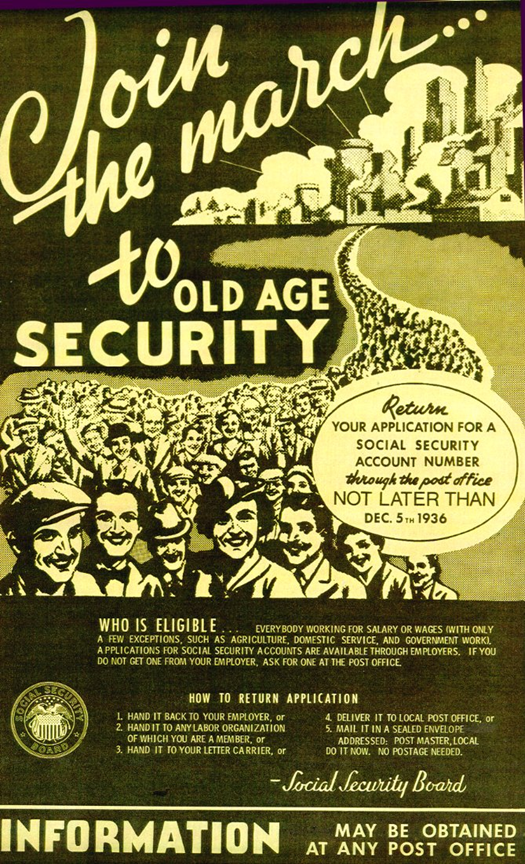
Which is ironic because the program itself also celebrates a birthday this week … and I can’t say it’s aging well at all.
This is nothing new, of course.
Back in 2000 — when I was just starting my career on Wall Street — the program’s Board of Trustees projected that the combined Old-Age and Survivors Insurance and Disability Insurance (OASI and DI) trust funds would remain solvent until 2037.
Now, here we are, 26 years later, and guess what?
According to the most recent report from the program’s Board of Trustees — released back in June2 — things only look worse:
- The combined reserves of the Old-Age and Survivors Insurance and Disability Insurance (OASI and DI) Trust Funds are projected to have dedicated revenue to pay all scheduled benefits and associated administrative costs until 2034, three years sooner than projected back in 2000.
- If we just look at OASI, which is where regular Social Security benefits come from, the reserves are projected to run out in the fourth quarter of 2032, with only 78% of promised payments being possible at that point.
- Meanwhile, the annual cost of the program is projected to exceed its annual income this year, a situation that first began back in 2021 and will remain permanent without changes.
So Social Security is taking in less money than it pays out every year.
Its reserves are running out.
And unless something changes, it will only be able to pay out roughly four-fifths of what it currently promises just six years from now.
These are still just guesstimates, of course.
There are all types of variables involved — demographics, life expectancies, interest rates, economic growth and other factors.
But if lawmakers don’t officially cut benefits … increase payroll taxes … or do some combination of the two … it’s almost certain the Social Security trust fund will die before it hits 100.
And from that point, the program itself would continue but beneficiaries would receive a lot less than they’re currently being promised.
Here’s the truth most people don’t want to talk about …
Social Security started with bad genetics.
It was essentially a “pay as you go” system that relied on favorable demographics to keep things working properly.
In addition, its funds could only ever be invested in government bonds with relatively limited long-term returns.
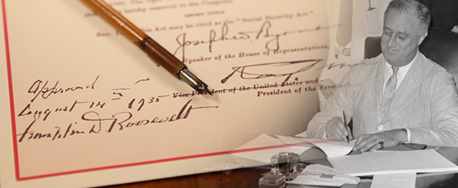
And lawmakers have only done things to make it worse ever since Franklin Roosevelt signed the Social Security Act on Aug. 14, 1935.
They repeatedly expanded who was covered.
They created more generous survivor benefits.
They added the disability component.
All these changes were made with great intentions. But they only amplified the inherent structural problems.
Meanwhile, the underlying demographics have gotten worse.
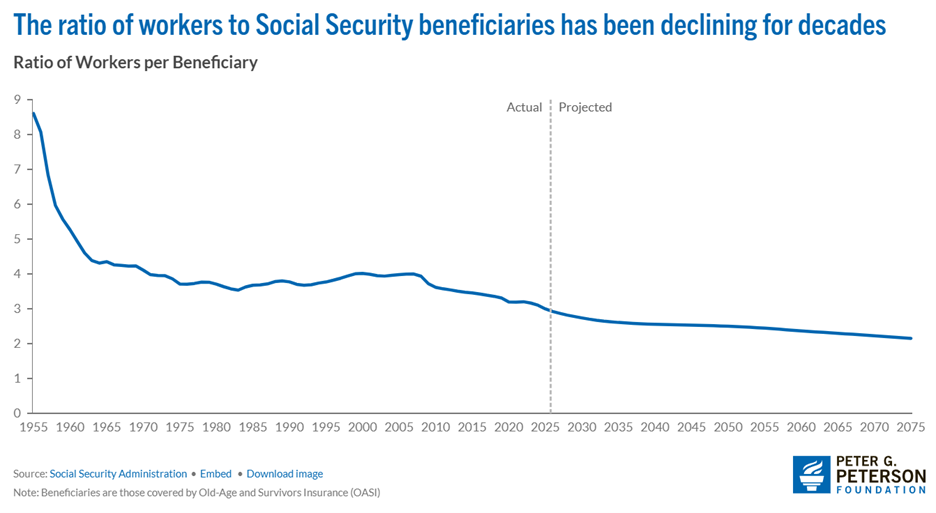
We had more than five workers for every Social Security beneficiary back in 1960.
Right now, there are fewer than three workers for every retiree.
And two more decades out, there will only be two workers for every American receiving Social Security benefits.
To accommodate this widening gap of money coming in and money going out, the initial payroll tax rate of 2% — which is split between employer and employee — has already risen to a combined 12.4%.
So here we are, about 91 years after the birth of Social Security, and the baby is certainly all grown up.
Indeed, it is now the single largest category in the federal budget, accounting for about 20% of all government spending.
What will it look like a few more years into the future?
The answer will have implications for all of us — my dad included.
Best wishes,
Nilus Mattive
P.S. That’s why you’ll need to look elsewhere to fill the gap that Social Security might leave you with.
If you're looking to grow your personal nest egg as quickly as possible, then you should check out this new private investment that Chris Graebe has just uncovered.
1https://www.ssa.gov/history/pubaffairs.html
2https://www.ssa.gov/news/en/press/releases/2026-06-09.html