Tech Fell 4% in a Week of Inflation and AI Debt Worries. The S&P 500 Is 1% From Its Record. Here's My Seat-Belt Stock.

 |
| By Al Qureiyeh |
If the last few days left you wondering whether to sell everything and wait it out in cash, you're not alone. More individual investors called themselves bearish than bullish in the American Association of Individual Investors' survey for the week ended Oct. 14.
Technology stocks fell more than 4% in the week through Oct. 15, measured by the Technology Select Sector SPDR Fund (XLK), in a week that brought a hot inflation report and new worries about the debts behind the artificial intelligence (AI) boom.
Yet the S&P 500 closed Thursday only about 1% below its Oct. 6 record high. In the same week, health care stocks rallied.
The ride is bumpy, but the bumps are in particular places. I'd fasten a seat belt, a steady BUY-rated company, rather than jump out of the car.
What Happened
Here's what rattled the market.
First, inflation. On Oct. 15, the Labor Department said wholesale prices jumped in September by the most since March 2022, mostly because of energy. It also revised earlier months, without changing its method.
Bond traders shrugged off the headline number. Treasury yields fell on Oct. 15, because prices outside energy rose far less. After Federal Reserve (Fed) Chair Kevin Warsh said he doesn't prejudge meetings, by Friday morning before the open traders put the odds of a rate hike on Oct. 28 at less than one in five, by CME Group's FedWatch measure.
Second, AI debt. Chip makers such as Nvidia (NVDA) and companies borrowing to build AI data centers, such as CoreWeave (CRWV), fell hard. The price of insuring CoreWeave's debt against default now implies better-than-even odds that it defaults within five years, Reuters reported.
On my scorecard, if you avoided CoreWeave, Oklo (OKLO) and NuScale Power (SMR) when I said to, you sidestepped falls of 13% to 23%.
We've felt the bumps too. Nvidia, the Technology Select Sector SPDR Fund, Eaton (ETN) and GE Vernova (GEV) are down since I suggested them in early October, as is Taiwan Semiconductor (TSM) since Wednesday. We hate losses, but all are still rated BUY.
Why the Worriers Are Half Right
Many investors are nervous. CNN's Fear & Greed Index, which reads investor mood from signals such as volatility, sits in "Fear," meaning investors are acting cautiously. Some of their worries are real.
First, plenty of stocks have already had their own correction. Only about half of the stocks in the S&P 500 trade above their 200-day average, a common measure of the long-run trend.
Second, calm can turn fast. The Cboe Volatility Index (VIX), which measures how much movement options traders expect, closed Thursday below its long-run average. That's not a promise; it can jump in a day.
Where the crowd overreaches is "sell everything." Cash pays a decent yield right now. But selling in a scare has been costly for long-term investors. JPMorgan found that from 2005 through 2024, missing just the 10 best days in the S&P 500 cut an investor's gain by more than half. Most of those best days came soon after the worst ones.
Weiss Rates the Steady Funds HOLDs and Some Steady Stocks BUYs
Weiss rates the popular "defensive" funds HOLDs: the iShares MSCI USA Min Vol Factor ETF (USMV) "C," and the Vanguard Dividend Appreciation ETF (VIG) and Health Care Select Sector SPDR Fund (XLV) both "C+."
Some steady companies rate higher. Travelers (TRV) is "A+," Coca-Cola (KO) "A," and Johnson & Johnson (JNJ) "B+," all BUYs.
A Weiss Ratings Daily piece on Oct. 10 passed along the view that October weakness is a chance to buy, and I agree. Pieces on Oct. 12 and Oct. 13 warned about the debt behind AI spending. I agree the danger sits there, which is why I'd own a company far from it.
On Oct. 11, I wrote that defensive stocks haven't helped when yields jump. This time yields fell, and the pressure came from chips and AI debt, the kind of sell-off in which Johnson & Johnson has held up.
Related story: AI's 'Circular Financing' Will End in Tears
The Bumps Come From Two Places
Over the past week, tech was the only sector fund to fall hard.
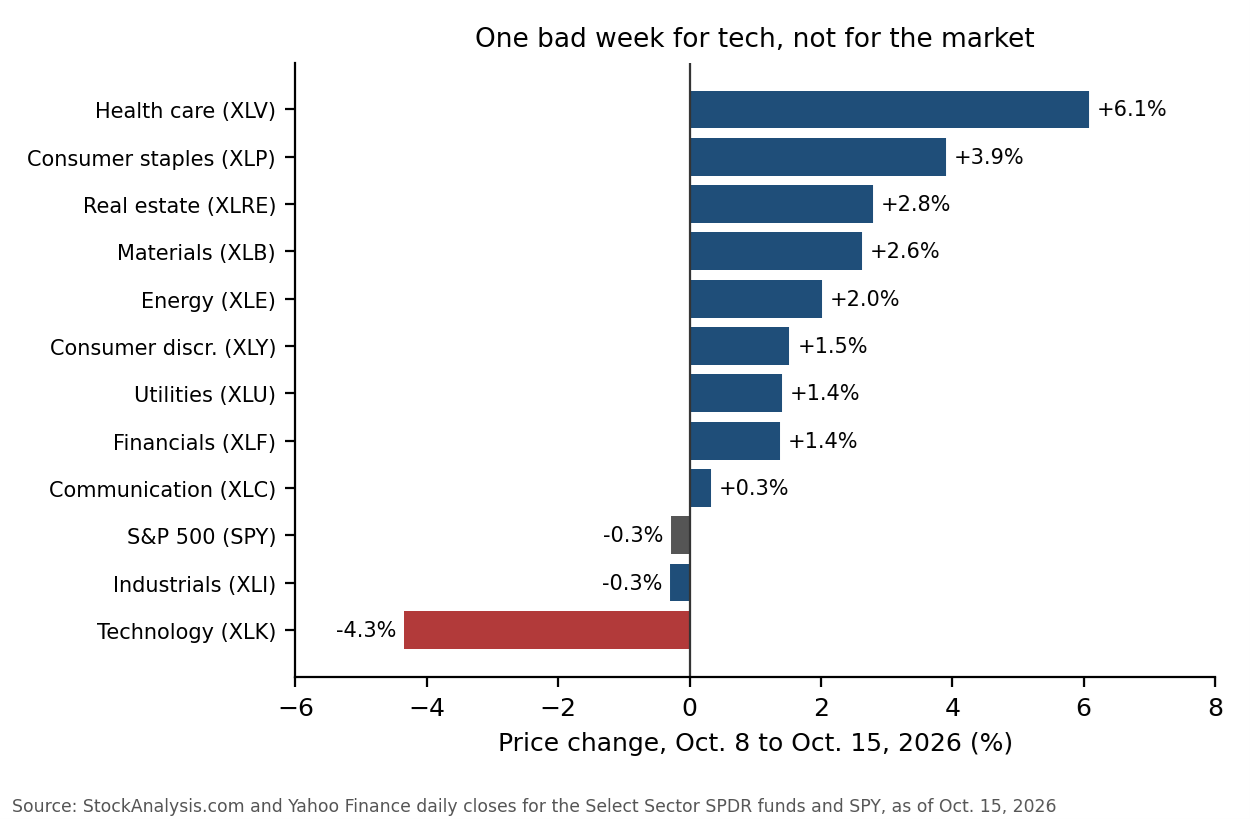
Energy-driven inflation has the Fed leaning toward another hike by year-end, and the AI build-out is running into questions about who pays for it. In my view, neither one changes whether people take their medicines.
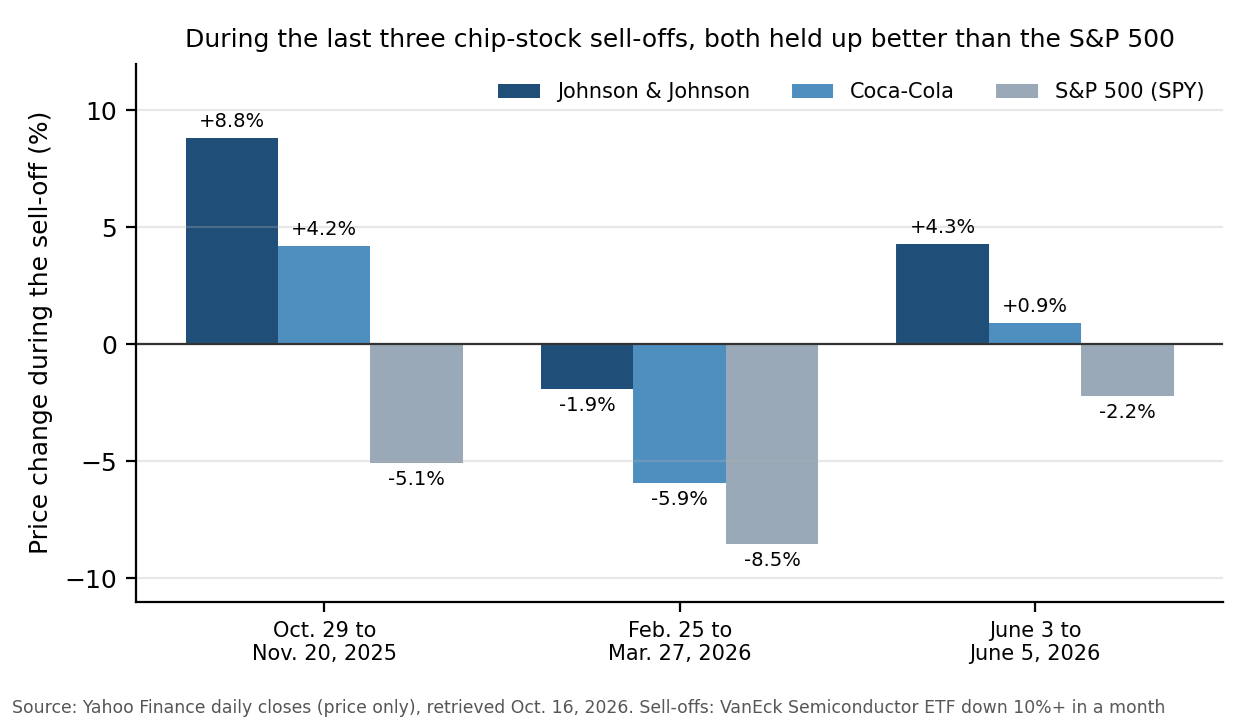
This "B+" BUY Held Up in Each of the Last Three Chip Sell-Offs
Buy Johnson & Johnson (JNJ) at the next close; the stock closed Thursday at $253.
Johnson & Johnson sells medicines and medical devices that people need whatever chip stocks do. Weiss rates it "B+," a BUY, with Solvency, its ability to pay its debts, rated Excellent.
In each of the last three times chip stocks fell 10% or more within a month, it held up better than the S&P 500, and it usually kept leading in the months after.
It raised its full-year outlook on Oct. 13, yet the stock fell sharply that day, after a charge for its talc lawsuit settlement and slower growth in its medical-device business.
The average Wall Street target is about $274 at MarketBeat and $279 at StockAnalysis, as of Oct. 15. That's roughly $21 to $26 above Thursday's close.
That's a potential gain of about 8% to 10%. Leerink Partners trimmed its target on Oct. 15 but kept its buy rating.
Johnson & Johnson pays you to wait: $1.34 a share each quarter, a yield of about 2%. Give it a year; buying before the Nov. 24 ex-dividend date collects the Dec. 8 payment.
What could work against it: the talc settlement needs 95% of claimants to accept. And if tech rebounds sharply, steady stocks can lag, as health care did in 2023.
The Takeaway
What happened: Tech stocks had a rough week of an inflation scare and AI debt worries, while the S&P 500 stayed near its record and bond traders shrugged off the headline number.
What it means: The bumps are in particular places, and the answer is a steady BUY-rated company you can hold through the swings, not selling everything.
If tech rebounds sharply, Johnson & Johnson would likely lag; that is the risk we take.
Johnson & Johnson is the kind of idea my process surfaces. If you want ideas tested against a stricter, fundamentals-first screen and tracked for you, that's what my AI Profit Accelerator does.
What to do today: Buy Johnson & Johnson (JNJ) at the next close; the stock closed Thursday at $253.
What We're Watching
First, the talc vote. If Johnson & Johnson's settlement falls short of the claimants it needs, I would sell, and I will say so.
Second, the VIX. If it closes above 20 and the S&P 500 falls 5% below its record, the sell-off has spread, and I'll tell you what to change.
Third, the Fed on Oct. 28. A surprise hike would weigh on every stock.
Fourth, Coca-Cola, "A," a BUY. It reports on Oct. 27 and trades near its high. What would make me buy it is a pullback after that report.
Take care,
AL Qureiyeh