 |
| By Nilus Mattive |
The final Federal Reserve meeting of the year just came and went.
Its third-straight quarter-point interest rate cut captured all the headlines. But the real story lies within what Fed Chairman Jerome Powell said afterward.
Contrary to popular opinion, Fed meetings aren’t just for economic nerds.
What the Fed governors say and do has a huge bearing on how you should position your portfolio.
And even how you run your family’s day-to-day financial decisions.
So, I’ll start with the most important word Powell said — “tension.”
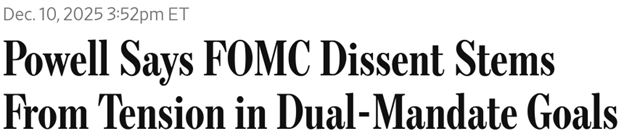
You can find it several different times across his written remarks and the transcript of his question-and-answer session with reporters.
What is the source of this tension?
Powell puts it this way:
“In the near term, risks to inflation are tilted to the upside and risks to employment to the downside — a challenging situation. There is no risk-free path for policy as we navigate this tension between our employment and inflation goals.”
This is the Fed admitting that it’s facing a bit of a dilemma.
After all, it has two big mandates: Keeping inflation at bay and supporting the labor market.
- Rate hikes are like water. They cool off inflation but drown the economy.
- Rate cuts are like gasoline. They fuel the economic engine but stoke the flames of inflation.
You see the problem.
And this has been the problem for a long time now.
Can they keep running back and forth between the two problems and hold it all together?
If not, which of the two should they focus on more intently?
FOMC members themselves seem unsure.
Officially, nine agreed with a quarter-point cut. But as the New York Times’ Colby Smith pointed out in his question, four of those people expressed “soft dissents” — essentially, worry that they were voting the right way.
On top of that, two more voting members actually dissented and voted to keep rates steady.
Meanwhile, the most recent appointee — Stephen Miran — voted once again for an even BIGGER cut!
Tension, indeed.
It’s Real Tension, Too
On the inflation front, Powell himself tried to minimize rising prices by saying they were just reverberations of the much-worse inflation rates we saw in 2022 and 2023.
That’s true, yet a bit misleading.
Yes, inflation was much worse then. And it’s still at the core of what we’re feeling today.
But put aside the fact that all those increases happened on Powell’s watch …
First off, inflation rates today are still running about 50% higher than the Fed’s own stated target.
What’s worse, those above-normal rates are coming on top of the much bigger increases we experienced not that long ago.
It’s a doubly-bad compounding effect that Americans are feeling in many corners of their lives.
Which is why I laugh when I hear some people try to dismiss it as some type of “windchill effect.”
The nuance is irrelevant and unhelpful. You’re still standing out on the street in your boxer shorts, freezing your butt off.
Yet the Fed has clearly decided that it can’t keep rates steady — let alone raise them — to keep trying to work our way back down to its stated goal of inflation at 2%. (Which is still not all that great for the regular person, but what we have become used to.)
Why not?
Because it seems to believe that the economy is cracking at an even more alarming rate.
Indeed, as Powell also said in response to a question …
“First of all, gradual cooling in the labor market has continued. Unemployment is now up 3/10 from June through September. Payroll jobs averaging 40,000 per month since April. We think there's an overstatement in these numbers by about 60,000. So that would be negative 20,000 per month.”
In other words, the Fed thinks the job market is even worse than most people believe.
Powell also echoed something I’ve been saying to Safe Money Report readers over the last couple of months …
That AI spending, and some associated productivity gains and related wealth effect spending from richer Americans, are really what’s keeping the U.S. economy afloat right now.
Put it all together, and it’s obvious what a delicate situation this all is …
Everyday prices are high and rising …
The economy shows signs of cracking …
Its main support structures are all premised on AI’s future promises and rising asset prices …
The Fed’s easier money can only feed into all of this …
Yet, one false move and everything comes crashing down around us.
For all these reasons, my basic recommendations are as follows …
Own assets that will continue to keep pace with, or outperform, inflation but that can also do well in tougher times.
Those assets include precious metals and related stocks … high-quality real estate investments … and profitable, defensive businesses that generate lots of cash and pay good dividends.
We have many such investments in the Safe Money Report model portfolio right now.
They’re already doing quite well in the current environment.
And I’m confident they will continue doing well even if the Fed’s current tension turns into much bigger problems in 2026.
Best wishes,
Nilus Mattive
P.S. Another recommendation would be to pay attention during tomorrow’s Weiss 3.0 unveiling.
There, you’ll see the biggest upgrade to Weiss Ratings in 22 years … and the culmination of 100 years of effort.
It starts at 2 p.m. Eastern. Here’s the link to grab your spot.