The 1848 Tea Heist: What Robert Fortune’s Theft of China’s Secrets Teaches Investors Today

 |
| By Sean Brodrick |
Hollywood portrays James Bond as an impeccably tailored spy armed with a Walther PPK and a martini — shaken, not stirred.
But Britain once had another real-life secret agent who pulled off a mission with consequences far greater than anything dreamed up by Ian Fleming.
And this super-spy wasn’t armed with a Walther. His kit consisted of a pair of pruning shears, sealed glass cases and a fake braid of hair literally sewn onto his head.
His name was Robert Fortune.
And in 1848, the British East India Company dispatched him on an audacious espionage mission across the forbidden interior of Qing dynasty China.
Fortune’s Mission Impossible: Break an economic stranglehold that was draining the British Empire of silver and bringing it to its knees.
The Silver Drain
By the 18th century, Great Britain had mastered the high seas. Yet it was economically hostage to a single beverage. No, not beer. Tea!
The British public had developed an insatiable thirst for tea, consuming more than 30 million pounds a year. The average Londoner drank about one pound of tea per year!
Tea duties alone generated roughly 8% to 10% of the British Crown’s entire annual tax revenue.
The problem: China held a tightly guarded global monopoly on tea production, and the Qing emperors had little interest in British trade goods.
When British merchantmen arrived on China’s shores laden with woolens, iron and manufactured wares, Chinese merchants turned up their noses.
Instead, China wanted hard currency: silver.
As a result, an astounding 75% to 90% of the outbound cargo value the East India Company sent to China consisted not of manufactured goods, but physical silver bullion. That came via Spain’s territories in the New World.
Britain got that silver by supplying Spain with trade goods, including slaves. Yeah, it was awful!
During the 18th century, Britain poured an estimated 100 to 150 metric tons of pure silver into Chinese coffers each year during peak decades.
But Britain’s silver piggy bank was running dry. Domestic silver coin supplies dwindled, and the empire’s balance of payments stood perched on the edge of a precipice.
Britain desperately needed a secure tea supply on home soil, specifically in its colonial territories in India. By the 19th century, it was ready to do something about it.
Enter Fortune. Robert Fortune.
Undercover in the Middle Kingdom
Fortune was a gritty Scottish botanist who collected plant specimens for the Royal Horticultural Society. He was tough, observant and possessed the nerve of a veteran agent.
The East India Company assigned him a daunting task that was explicitly illegal under Chinese imperial law: penetrate hundreds of miles beyond the treaty ports into China’s interior, map the secret centers of tea cultivation in the Wuyi Mountains and smuggle out living specimens and processing secrets.
Any foreigner caught wandering these forbidden zones risked losing his head — literally.
So Fortune went undercover.
He shaved his head in the Manchu style, had a braided pigtail attached to the remaining hair and dressed in silk mandarin robes.
He traveled with servants, adding to the illusion that he was someone important.
When locals stared at his tall, European frame and un-Chinese features, his guides explained he was a visiting dignitary from a distant northern province.
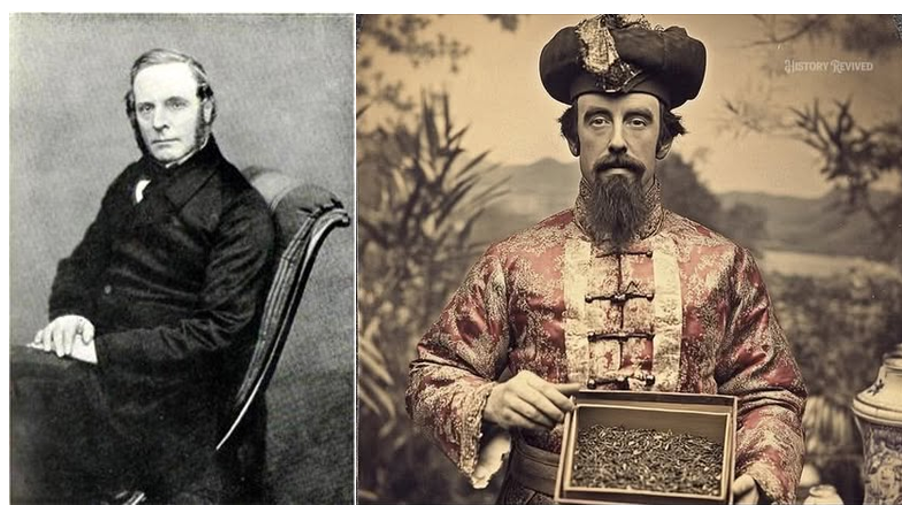
And somehow, it worked.
Traveling by sedan chair and canal boat, Fortune slipped past imperial checkpoints and penetrated the heart of China’s closely guarded tea industry.
The Secrets of Tea
As recounted in Sarah Rose’s book, “For All the Tea in China, How England Stole the World’s Favorite Drink and Changed History”:
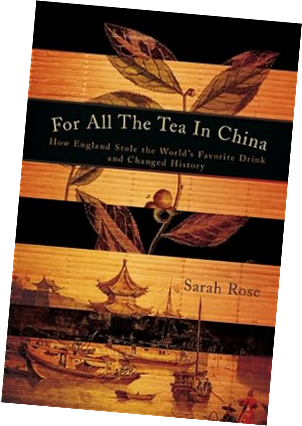
“Proceeding into the otherwise empty courtyard, Fortune found fresh tea set to dry on large woven rattan plates, each the size of a kitchen table. The sun beat down on the containers, ‘cooking’ the tea.
“The sun-baked leaves were then taken to a furnace room and tossed into an enormous pan — what amounted to a very large iron wok. Men worked before a row of coal furnaces, tossing the contents of their pans into an open hearth. The crisp leaves were vigorously stirred, kept constantly in motion and became moist as the fierce heat drew their sap toward the surface. Stir-frying the leaves in this way breaks down their cell walls, just as vegetables soften over high heat.”
Over three years, Fortune learned the secrets of Chinese tea production — knowledge that had been refined over centuries and carefully guarded from foreigners.
He also learned something absolutely shocking: The Chinese were poisoning their British customers!
Believing their British customers preferred the greenest of teas, the Chinese added coloring agents consisting of iron ferrocyanide and calcium sulfate dehydrate. These are, in fact, poisons.
The Chinese didn’t know it. They just wanted the tea to be as green as possible for their barbarian customers.
Q’s Miniature Greenhouses
Espionage is only half the battle. Fortune also had to get thousands of living tea plants from China to India.
His first attempts were a disaster.
Seeds shipped in paper wraps, canvas sacks and wicker hampers rotted or grew moldy in the tropical heat, while fragile saplings withered under saltwater spray.
Fortune needed the 19th-century equivalent of a gadget from James Bond’s Q.
He found it in the Wardian case, an innovative glass terrarium invented by London physician Nathaniel Bagshaw Ward.
Think of it as a miniature self-contained greenhouse.
Fortune planted sprouted tea seeds in rich soil inside the cases and sealed them shut. As the tropical sun heated the cases aboard merchant ships, water evaporated from the soil, condensed against the glass and trickled back down to the roots.
The glass protected the plants from saltwater spray and harsh winds while still letting sunlight pour through.
It worked spectacularly.
When the shipment finally reached the botanical gardens of northern India, more than 12,000 healthy seedlings had survived the voyage.
But Fortune still wasn’t finished.
Stealing the Minds, Not Just the Seeds
The delicate chemistry of black and green tea — picking schedules, pan temperatures, rolling techniques and fermentation — was as much art as science.
A British planter reading Fortune’s field notes had little chance of duplicating techniques Chinese tea makers had spent generations mastering.
So, Fortune poached the human workforce as well.
In 1851, he recruited eight master tea processors from Zhejiang and Fujian provinces.
He loaded them onto British ships with their wok-like drying pans, bamboo rollers and traditional implements, then transported them to the Himalayan foothills to run experimental plantations and train local laborers.
Fortune hadn’t merely stolen the seeds. He had stolen the technology and the minds to make it work.
The Fallout
The repercussions of Fortune’s botanical heist were profound.
By combining Fortune's stolen Chinese stock and know-how with the indigenous wild tea plants of the Assam valley, the British Empire built an industrial plantation network in India and Ceylon (now Sri Lanka).
Within a generation, Indian tea output eclipsed China’s exports, shattering China's ancient global monopoly and permanently shifting the global balance of trade.
For the British Empire, the silver drain was fixed and world trade redrawn — all thanks to a mild-mannered botanist who proved that sometimes the most dangerous weapon is a man with the determination to change the status quo.
What Do We Learn?
I draw three lessons from what may have been the biggest heist of the 19th century.
1. A Lack of Hard Currency Can Bring an Empire to Its Knees
Trade imbalances can cause economic chaos. For Britain, the relentless outflow of silver to China threatened the Bank of England's reserves and forced the riskiest of geopolitical gambits.
And there’s a lesson here that remains relevant today.
Paper wealth is useful. But when confidence in currencies, governments or financial systems starts to crack, people rediscover the value of wealth that can’t simply be printed into existence.
That means gold and silver.
2. Intellectual Property Can Be the Most Valuable Property of All
Land, factories and mineral reserves mean very little without the proprietary know-how required to turn raw inputs into high-value finished products.
Fortune smuggled out two millennia of China’s refined, trade-secret chemistry spanning heat management, enzyme deactivation and artisanal rolling techniques.
When that proprietary knowledge was reverse-engineered into British hands, China’s monopoly pricing power collapsed.
Imperial decrees cannot defend an economic moat if the trade secrets inside walk out the front gate.
That lesson should sound familiar today as the U.S., China and other major powers fight over semiconductors, artificial intelligence, batteries, rare earths and advanced manufacturing.
The factories matter. The minerals matter. But the know-how may matter most of all.
3. Human Capital Can Be the Hardest Resource to Replace
You can steal blueprints. You can buy machines. You can acquire seeds, patents and mineral deposits.
But that doesn’t mean you know what to do with them.
Fortune’s mission might have failed if he had brought home nothing but tea plants.
The East India Company also needed experienced Chinese tea makers who understood the thousand tiny details that never make it onto a blueprint or instruction sheet.
That’s the expertise accumulated through years of actually doing the work. And it remains one of the most valuable resources on Earth.
Nearly 180 years later, countries are still fighting over the same things: critical resources, technological secrets, skilled workers and control of strategic supply chains.
The resources change. The technology changes. The Great Game doesn’t.
All the best,
Sean
P.S. As this story shows, it all comes down to precious metals — Spanish silver in this case. That’s why I track down lucrative mining operations like one I found nestled within the Rocky Mountains recently.
It is a relic that’s already produced more than 250 million ounces of silver — enough to fund the China tea trade for decades.
But I didn’t visit this mine just to see its silver or gold. It has another metal that has a vital future. Check out my trip here.