The 2026 Midterms Moved Stocks. A Deadline in 2027 Could Move Them More

|
Key Takeaways
|
 |
| By Sean Levine Reviewed by: Dawn Pennington |
Wall Street’s first full day of trading after the 2026 midterm elections ended in a split decision.
Stocks finished higher on Wednesday, but tech stocks took a beating, the U.S. dollar fell and gold rose.
Now, on Thursday, the stock market is lower in early trading, likely on profit-taking. But in a surprise twist, tech stocks started a rally of their own.
The bigger test is still months away: a Treasury deadline that, by our estimate, could arrive as soon as February or March. More on that below.
First, the question everyone is asking …
Why Wall Street Is Cheering the Results
Why would Wall Street cheer a Congress that probably won’t be nearly as friendly to markets as the current one …
That may, for that matter, struggle to pass any legislation at all?
Because markets like stability, and a stalled Washington is a stable one.
Democrats won control of both the House and the Senate on Tuesday, setting up a very different second half of President Trump’s term.
Stocks treated the Democrats’ wins as good news.
- The Dow Jones Industrial Average spiked more than 1,100 points Wednesday morning.
- The S&P 500 was up about 1.6% at that point.
- The Nasdaq Composite was up about 2%.
Beneath those gains, the moves were far from even. They also happen to align well with the companies that may win and lose over the next two years.
Gridlock Is Not a Dirty Word on Wall Street
Divided government usually means fewer sweeping laws.
Fewer sweeping laws mean fewer surprises for companies to price into their budget operations.
History backs that up, because the Dow was higher a year after each of the last six midterm votes.
The table below shows how the S&P 500 fared after six midterms going back to 1994.
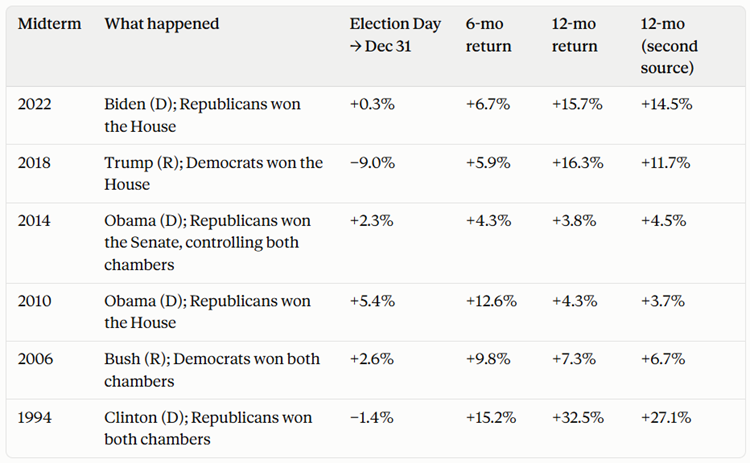
The short run from Election Day through year-end was bumpier.
But over 12 months, the index was higher in all six cases.
That said, six data points make a small sample, and the backdrop this year is far from calm.
Trump in the Post-Midterms World
Politics may matter more than usual this time, because in my view, this president has not governed like a traditional Republican.
I also believe he respects power, cares a great deal about how he is perceived, and may cooperate with opponents when his views happen to align — or when he can claim credit.
His tone after the results seemed conciliatory to me.
Moreover, Tuesday offered an example of policy flexibility
Trump said U.S. aid to Israel, about $4 billion a year, will stop at the end of the year.
That breaks sharply with his earlier position, and it looked partially like an attempt to read the room and give Republicans a last-minute boost.
Or, at the very least, to adapt himself to a shifting political landscape.
The same instinct could shape how he handles investigations.
If Democrats go after Cabinet members or other Republicans and not Trump himself, he may simply cast those targets off and make it look like his idea.
And if he is not targeted directly too often by the new Democratic Congress, such an approach would still leave wiggle room for possible dealmaking.
That same fast-and-loose approach toward allies could also impact the wealthy backers who poured money into his 2024 campaign and into state races this year.
Trump-Musk in the Post-Midterms World
Trump and Elon Musk have already had one very public falling out, so that relationship is not exactly a safe bet.
Texas offered a fresh test of that relationship on Tuesday, when Democrat Gina Hinojosa unseated Republican Gov. Greg Abbott.
Musk, who’s relocated his business operations to the Lone Star state from California, backed Texas Republicans with roughly $224 million, according to The New York Times.
Electric vehicle maker Tesla (TSLA), with a Weiss rating of C-, a HOLD, fell about 3% in morning trading Wednesday.
Rocket and satellite company SpaceX (SPCX), D, a SELL, fell about 2% over the same stretch.
Both declines seem related not just to the Texas power shift and its risk of a slowdown in data center buildouts …
But also to the fact that Tesla and SpaceX investors are ELON MUSK investors. And Musk’s power appears to have taken a lump with the outcome of the race.
Trump is a big believer in AI, but that does not shield every AI company, or its leadership, from scrutiny.
He can back the technology and still go along with (or at least not bar the way of) action targeting individuals, or even companies such as Meta, which already faces social media lawsuits.
Here’s another headwind …
AI Data Centers Face a Rare Bipartisan Fight
Local resistance to data centers is growing, and it is no longer only a Democratic cause.
Democrats generally favor more regulation, and Republicans in some districts are feeling the heat too.
The tracker below counts 529 local moratoriums on data centers through October.
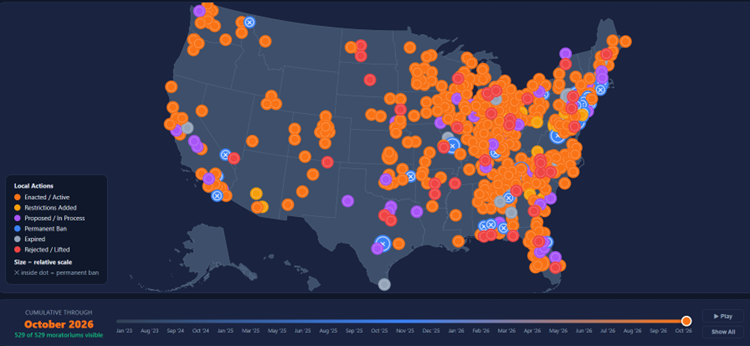
All told this Election Day, some 44 separate data center moratorium initiatives were on ballots across America.
43 passed.
If that opposition stays bipartisan, it could produce majorities large enough to override a Trump veto, depending on how big the Democratic margin ends up.
And even if not, since so much of this action is taking place at the state and local levels, AI compute needs at the very least will likely struggle even if we take national politics completely out of the equation.
Early Wednesday, AI cloud provider CoreWeave (CRWV), with a Weiss rating of D-, a SELL, fell about 6% on fears of limits on data centers.
Crypto Braces for Subpoenas
Democrats are preparing hearings and subpoenas on Trump’s crypto and financial ties, which could bring scrutiny to firms connected to him.
Do not expect more crypto-positive legislation either, since Democrats are much less friendly to the industry.
Drug pricing, defense and detention contractors
Trump has already been active in the drug price wars, and to the degree the Democrats won on any sort of policy position, affordability is certainly front-and-center.
That makes it an area where he and Democrats could become strange bedfellows, and owners of high-priced patented drugs could be in for trouble.
Defense is a smaller risk, because spending cycles move slowly and Democrats have long feared seeming unpatriotic.
This cycle leaned heavily on opposition to the Iran war, though, so Democrats may draw a harder line.
Larger contractors with deep backlogs should be better insulated, while smaller players may struggle.
By contrast, if the push shifts toward cheaper, smarter systems such as drones, smaller players could end up outperforming.
Elsewhere, private detention contractors face the sharpest oversight, because scrutiny of immigration enforcement is a core Democratic priority.
Expect hearings, spending-bill riders and state-level limits, and the group sold off earlier this year as the backlash over ICE grew.
Concerns about both of the latter bled into the tape, as defense and private prison stocks both fell Wednesday morning.
Oil and gas is a lower-confidence call, since Democratic states may tighten climate and permitting rules but federal rollbacks stay in place.
That points to a modest near-term hit.
As to the oil outlook in regard to a possible end to hostilities in the Middle East, there’s been a massive degree of infrastructure damage in the region that will take years to repair, and we’ve also depleted our Strategic Petroleum Reserve aggressively.
That will need to be replenished, which means additional demand over what’s being consumed, again likely for several years.
So we think the current oil pullback and ripple effects are overblown, and completely unsustainable over the longer term.
The Biggest Headwind: The Debt Ceiling
Of everything the election changes, the debt ceiling fight is the one most likely to hit markets.
The limit is $41.1 trillion.
Total debt stood at about $40.5 trillion on Monday.
At the recent pace of borrowing, I estimate we could hit the ceiling around February or March.
There’s a small chance Congress could still raise the ceiling in the lame-duck session before new members arrive.
If not, Treasury has accounting measures that can stretch the deadline for six to nine months.
That points to a danger zone from mid-2027 into early 2028.
The timing may also collide with spending bill deadlines, since the federal fiscal year starts Oct. 1.
Democrats could use the standoff to press for defense cuts.
More broadly, markets dislike any doubt about whether the government will pay its bills, and that doubt can lift borrowing costs and rattle stocks.
And if we get another shutdown, this one would have potential to be the mother of all shutdowns.
Which of course could have significant ill effects on the economy, and thus the market.
So this will remain a major issue to watch.
Where the Tailwinds Are
Health insurers and hospitals
The coverage changes in the Big Beautiful Bill were written to take effect after the midterms.
They will be unpopular with part of Trump’s own electorate.
Democrats want to renew the expired ACA tax credits and reverse the Medicaid cuts.
A veto would not end the push, because Democrats can use spending bills as leverage and Democratic states can backfill coverage.
Additionally, Trump could even reverse course, cooperate and take a victory lap.
The market appears to be seeing this opportunity as well.
Early Wednesday, health insurer Centene (CNC), with a Weiss rating of C-, a HOLD, was up about 5%.
Hospital operator HCA Healthcare (HCA), B-, a BUY, was up about 7%.
Homebuilders
Cost of living, including housing, is the Democrats’ top priority.
State and local Democrats control zoning and housing funds, so affordability policy may move faster at the grassroots level than in Washington.
And either way, whatever happens will be outside of the DC “Gridlock Zone.”
Homebuilders stand to gain if that means more homes get approved and built.
Clean Energy and EV Supply Chains
Federal rollbacks stay in place under Trump, so the gains here come mostly from states.
Investors still reacted, on hopes that federal support for clean energy will hold up and that approvals for projects will speed up.
Solar panel maker First Solar (FSLR), with a Weiss rating of C, a HOLD, was up about 13% in morning trading Wednesday.
Firearms: a Maybe
In some past cycles when Democrats won big, gun and ammunition stocks have performed well on fears of new restrictions.
What to Watch Next
The first test comes by Dec. 11, when the current stopgap spending bill runs out.
The next comes in January, when House Democrats plan to move quickly on health care and oversight.
AI regulation may also be a hot, early topic.
After that, the debt ceiling takes over.
For now, markets are cheering the change so far.
The open question for 2027 is how long it will last.
The Democrats opening moves will give some indication.
The President’s response will probably pretty quickly give us the rest.
Sean Levine
Associate Director of Research
Weiss Ratings