The AI Cybersecurity Arms Race Is Upon Us — Here’s How to Play It

 |
| By Sean Brodrick |
You’ve heard the worries — voiced by experts who work at AI companies — that artificial intelligence could kill us all by the end of the decade.
If the experts are correct, there’s about a 10% chance of that. But do you know what has a 100% chance?
AI-equipped bad guys will try to rob you blind and mess up vital systems and services you depend on.
That’s creating a new cybersecurity arms race — one that could send spending on digital defenses soaring for years to come.
The craziest thing (to me) is that we’ve seen multiple AI execs say they’re worried that AI will kill us all. And yet, at the same time, they keep building and training these same AI models.
That’s crazy! That’s like the mad scientist whispering into the ear of his atomic robot: “Faster, robot! Kill! Kill!”

Well, if the AI companies won’t fix the problem themselves, regulators will do it for them.
And that’s GREAT for cybersecurity companies, who will find their services actually written into regulations!
Holy Hackers, Batman!
AI is a supercharger for hackers searching for vulnerabilities, stealing credentials and more.
Importantly, AI allows them to do these things FASTER.
CrowdStrike's (CRWD) 2026 Global Threat Report found that attacks by AI-enabled adversaries surged 89% year over year.1
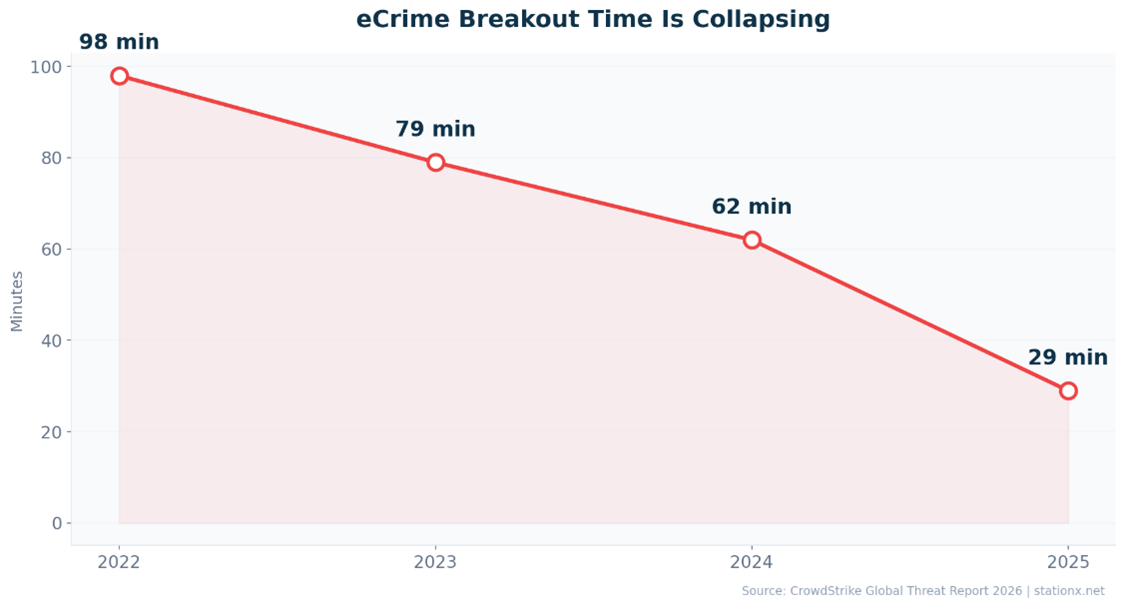
The average time between initial compromise and an attacker moving laterally into another system plunged to just 29 minutes.
The fastest attack CrowdStrike observed?
Just 27 seconds.
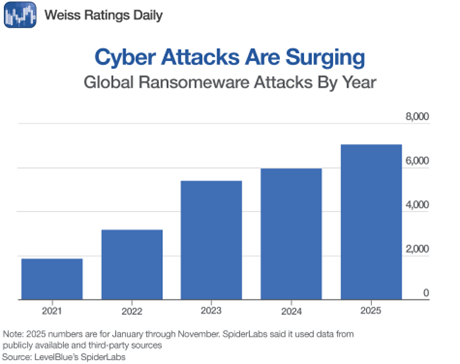
No wonder cybersecurity attacks are rising alarmingly.
And this isn't just criminals looking for a quick payday.
China-linked hackers have penetrated U.S. telecommunications and critical infrastructure.
Iran-linked attackers have targeted American water infrastructure.
Other state-sponsored groups are targeting everything from cloud systems to technology companies.
AI-boosted cyberwarfare is becoming another weapon nations can use against one another.
But here's where the investment opportunity gets really interesting.
AI Creates TWO Cybersecurity Booms
Companies increasingly need AI-powered cybersecurity tools that can identify and stop attacks at machine speed.
Humans can't react to a hacker who can move through a network in 27 seconds.
But AI is also creating an entirely NEW category of things that need protection.
Think about all the AI models, applications and autonomous agents companies are deploying.
CrowdStrike says attackers are already exploiting AI infrastructure, abusing enterprise large-language models and attacking AI software supply chains.
So, companies need AI to defend themselves from cyberattacks. And they need cybersecurity to protect their AI.
Gartner estimates the specialized market for securing AI applications and infrastructure will explode by 83% this year to $2.84 billion.
Then it should surge another 69% to $4.78 billion in 2027 and reach nearly $7.7 billion in 2028.
That's a compound annual growth rate of roughly 65% from 2026 through 2028!
No wonder Wall Street is suddenly paying attention.
Cybersecurity stocks exploded higher this week as investors reassessed which companies might benefit from increasing concerns about AI safety.
I think this is just the beginning of a much bigger trend.
The New AI Arms Dealers
Picking the eventual winners isn't easy. An easier way to play is to buy the whole kit and kaboodle!
The iShares Expanded Tech-Software Sector ETF (IGV) gives us broad exposure to the software companies that could benefit as Wall Street rotates toward security, governance and enterprise software.
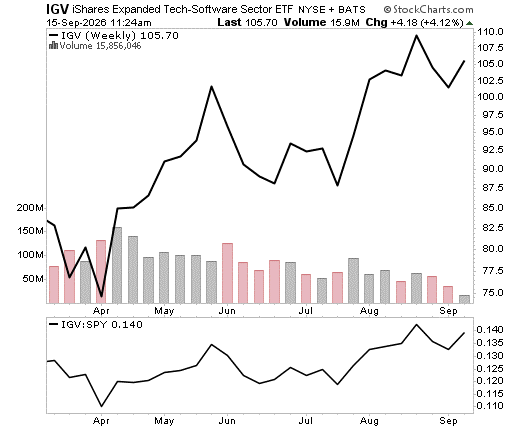
This is a weekly chart of IGV.
Below it, I’ve put the IGV divided by the S&P 500. This shows IGV is not only outperforming the S&P 500, but it’s also accelerating.
IGV has a “C+” from Weiss Ratings, an expense ratio of 0.38% and $15.7 billion in assets under management.
It isn't a pure cybersecurity fund. And I actually think that's a feature rather than a bug.
It owns cybersecurity leaders including Palo Alto Networks (PANW), CrowdStrike and Fortinet (FTNT), while also giving us exposure to some of America's dominant enterprise software companies.
For the past few years, investors couldn't get enough of the hardware needed to BUILD artificial intelligence — GPUs, memory chips, networking equipment and data centers.
Now Wall Street is starting to ask what comes next.
The answer could be software that makes AI useful, manageable — and SAFE.
We got a taste of that rotation this week.
As cybersecurity and software stocks surged, semiconductor stocks sold off sharply.
IGV jumped 5.2% Monday as investors poured money into software.
I don't think the AI hardware boom is over.
But the next stage of this megatrend could increasingly reward companies that protect, manage and deploy all that computing power.
The AI revolution isn't slowing down. Neither are the hackers.
And that means the companies building the digital defenses could be among the biggest winners of AI's next chapter.
All the best,
Sean
P.S. It’s not only the major cybersecurity companies of today that will make out in this boom. It’s the cybersecurity companies of tomorrow that will do even better.
Watch this video before we must take it down to see exactly which company could be the biggest winner of all.