 |
| By Gavin Magor |
The most important chipmaker — and possibly company in general — reported its latest earnings last night.
It will take the market some time to digest all it heard from Nvidia (NVDA) CEO Jensen Huang.
We, too, are crunching all the numbers from last night’s release to see if anything changes for our rating of Nvidia.
But one thing we can take away from the primetime event already is what happens next.
Nvidia continues to design and develop newer, faster, more powerful and game-altering chips for AI.
Every time it launches a new AI GPU, the company is flooded with orders … so many that it has a never-ending backlog of sales.
That’s what’s driven its historic growth over the past few years. But it can’t do any of this alone.
This takes me back to an idea I shared last year.
There’s another company that both Nvidia and its chief chip manufacturer Taiwan Semi (TSM) need for this growth to continue: Lam Research (LRCX).
As I said back in October last year, Lam doesn’t design chips.
It doesn’t manufacture chips.
Instead, it makes the machines that make the chips.
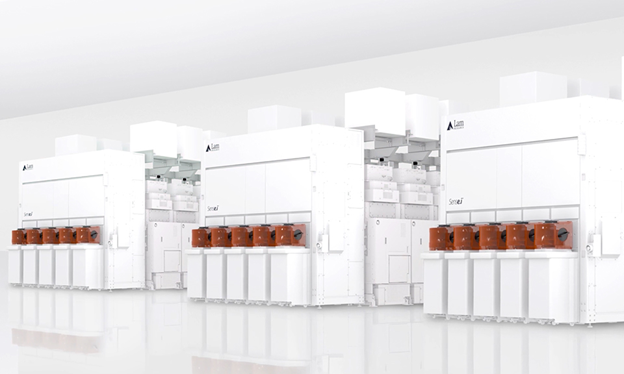
These are massive machines that produce chips with the smallest transistors in history.
And it is not an easy thing to make. That’s why Lam has such a wide moat.
Taiwan Semi is the company’s largest customer. And it just so happens that Taiwan Semi also controls three-quarters of all semiconductor chip manufacturing worldwide.
That’s part of the reason why our ratings value Lam so much:
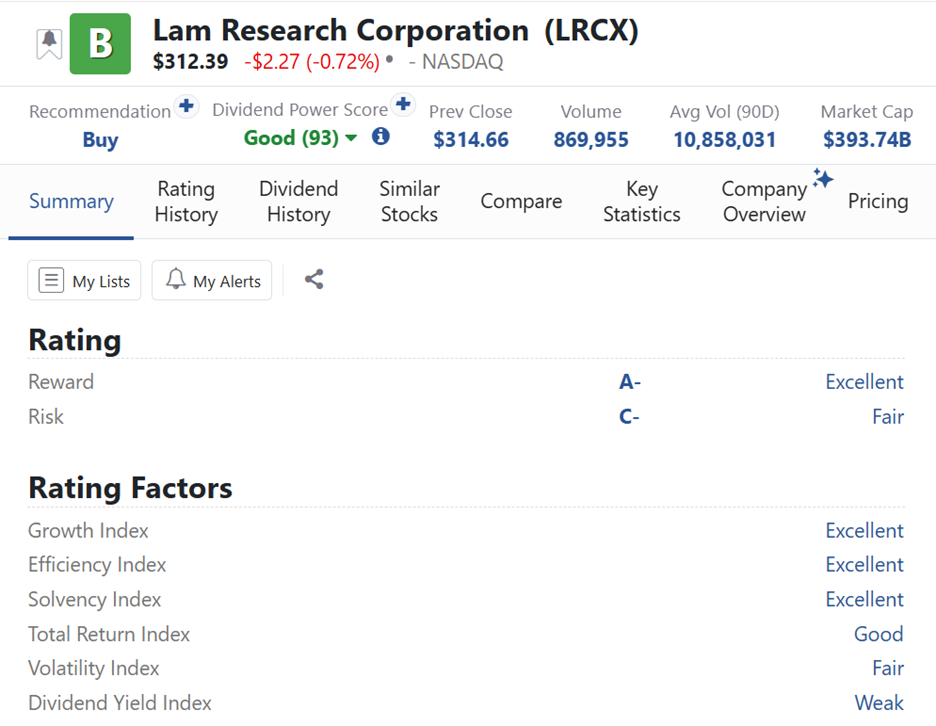
You can see we give it a “Buy” rating. We have already processed Lam’s most recent earnings figures.
So, that “Buy” should stick around. And it’s held that top-tier rating for more than a year now.
That’s why I was so confident it could be a great performer when I recommended you look into it last October.
Turns out, I was right:
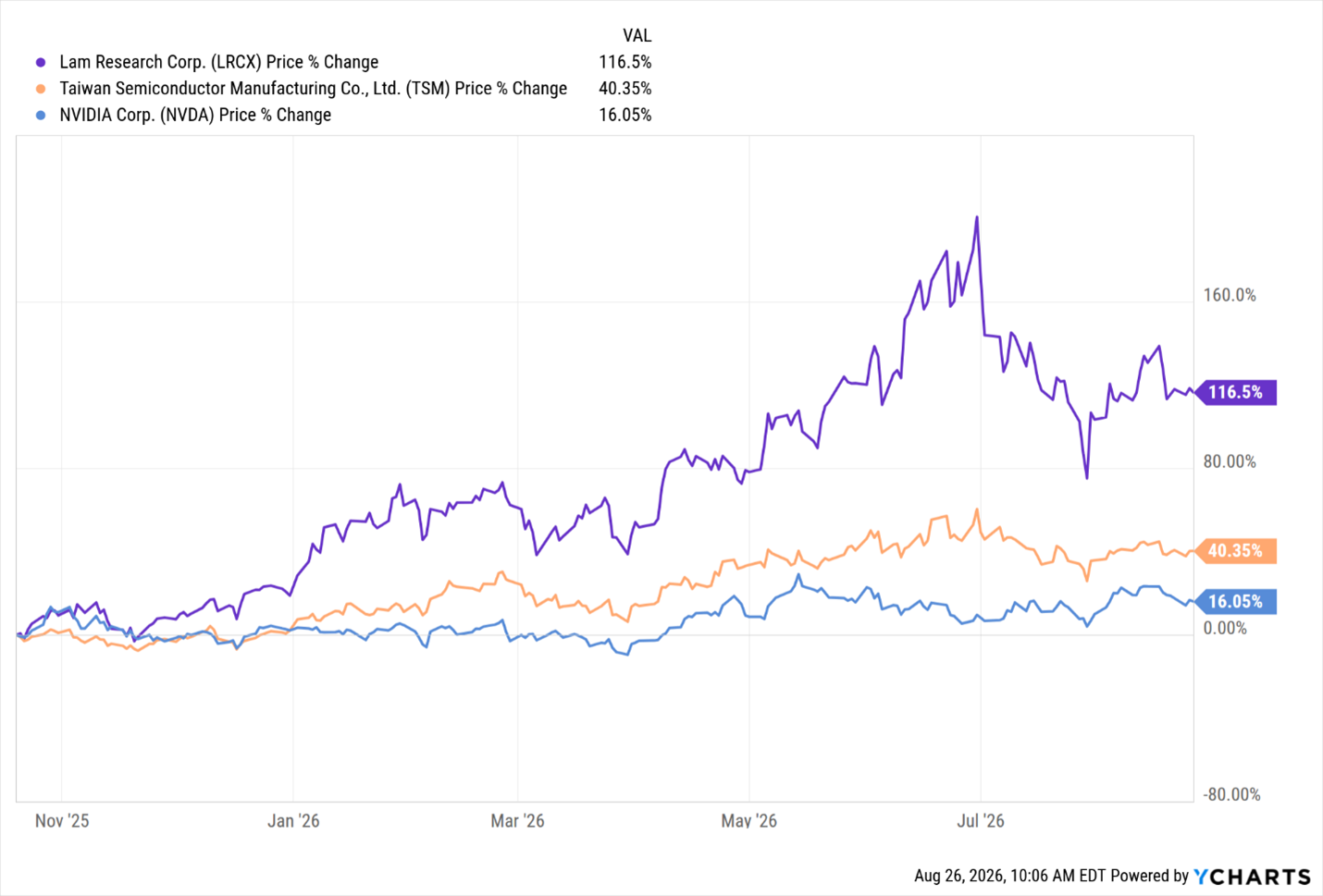
As you can see, LRCX outpaced both NVDA and TSM since I wrote about it. And by a large margin.
The chip designer and AI poster child, Nvidia, saw its shares go up 16% since then.
The largest chip manufacturer in the world, TSM, saw its stock jump 40%.
But Lam, the company behind both of those larger companies’ success saw its shares fly 116% in less than a year.
How did this relatively unknown chip star conquer two goliaths? Simply because it had more runway. And it still has runway left.
Sure, it’s a much bigger company now with a market cap of $394 billion. But that’s still a fraction of TSM’s and NVDA’s size.
What’s more, it has a huge advantage. As I wrote last time about Lam:
“Semi manufacturing should only become more and more complex as the AI revolution ramps up. Its position as a supplier to leading chipmakers like TSM stands to widen an already wide moat.”
Nvidia’s most recent report verifies that. There will always be a “next generation” of semiconductors, each more complex than the last one.
And only one company has been able to keep up with the increasingly precise designs coming out of Nvidia and other chip designers.
Our ratings showed it was a good bet to be a great stock to own last year.
And as nothing has changed in our rating or the future of chipmaking, that’s still true.
Of course, there are many other ways to play the AI buildout.
Using our recently revealed “U-AI” system, I showed readers three turbo-charged bonus AI plays last Friday.
These three are at the center of the demand for data centers.
They have the advantage of already collecting rents from large AI players like Meta (META), Alphabet (GOOGL) and Microsoft (MSFT).
It’s not too late to see what they are all about.
It is also not too late to get in on what my system has for my readers next.
Tomorrow, I’ll share at least one (possibly more) turbo-charged plays. You can find out how it works here.
Cheers!
Gavin Magor