 |
| By Gavin Magor |
Data centers are getting a bad rap currently, one that’s hard to dodge.
Yes, they provide the compute, networking, storage, power and more needed to train trillion-parameter AI models and run them at scale.
Without data centers, today’s AI would be much slower, pricier and harder to deploy.
So, they make a real difference for the roughly 40% of American workers, and the 1.4 billion people around the globe, who already use large language models (LLMs).
But for a variety of reasons, not as many people want to see data centers built in their backyard. Not in the U.S., and not abroad.
Surprisingly, the situation is opening a window on a sector many investors left for dead two years ago. One that’s worth another look right now …
Why REITs Are Back
Economic textbooks say inflation is toxic for real estate stocks, and it makes sense why.
The idea is that REITs are built on borrowed money.
When inflation is elevated, bond yields climb, borrowing costs rise and leveraged properties get marked down.
For investors, dividend yields become less attractive compared to long-term Treasurys.
We saw the textbook version in 2022, when inflation touched 9.1%, and the FTSE Nareit All Equity REITs Index lost 25.1%.
But through Thursday's close, the same index has returned 15.7% this year, running ahead of the S&P 500's 12.6% … all from the market's most abandoned sector.
That shouldn't be happening. Inflation has been above the Fed’s 2% target since March 2021.
The Fed held rates at 3.5%-3.75% in July, but three FOMC members dissented.
A rate bump remains on the table, with the market predicting a split either way.
Interestingly, Nareit's data going back to the 1970s shows REITs beat the S&P 500 by 3.9 points on average during moderate-inflation periods, like this one.
Leases reprice. Replacement costs climb. Landlords pass inflation through.
But history isn't the main engine this year. The AI data center backlash is.
Not in My Back Yard
On July 14, New York Gov. Kathy Hochul signed the first statewide moratorium on new hyperscale data centers.
Any project drawing 50 megawatts or more is paused for up to a year while the state builds a new review framework.
Seattle became the largest U.S. city so far to adopt a moratorium of its own, after residents buried the city council under more than 96,000 emails.
And recently, Texas, whose governor once called the state the "epicenter" of AI, froze approvals for every new data center in its grid queue until regulators audit each one. No end date has been given.
Consider that Texas runs the most data-center-friendly grid in America.
Its queue held 474 gigawatts of new connection requests across roughly 1,800 projects, about 5.2 times the state's all-time peak demand record set six weeks ago.
About 90% of these projects are data centers.
A May Gallup poll found 71% of Americans oppose a data center in their area. That's more opposition than for a nuclear plant (53%).

At least 75 major U.S. data center projects valued at roughly $130 billion were blocked or delayed in early 2026 alone.
Overseas, the vibe is similar …
- The Netherlands drove Meta out of a 200-megawatt campus in Zeewolde and now restricts hyperscale facilities to two designated national sites.
- Data centers consumed 23% of all Irish electricity last year, and campaigners are suing the regulator.
- Courts in Chile sent Google back to the drawing board over water.
- In February, hundreds marched on Google DeepMind's offices in my beloved Britain.
Here's why that wall of "no" matters to your portfolio …
The Accidental Moat
Data center REITs have returned 36% this year, making them one of the best subsectors on the Nareit board outside hotels.
Just two pure-play data center REITs make up the group — Equinix (EQIX) and Digital Realty Trust (DLR).
Our Weiss Ratings system upgraded EQIX to a Buy on July 30, thanks to increased earnings, operating cash flow and net income.

On the day Texas’ freeze hit, data center REITs rose 1.32%, while the broad REIT index managed 0.06%.
The day after, they added another 1.62% as the broad index fell 0.3%.
The reason why is simple supply and demand economics.
AI runs on two kinds of data centers.
- The giant campuses, which are largely owned by the hyperscalers, supply the most compute power for developing AI and LLMs.
- Inference centers handle everyday queries. And for latency and security reasons, they must be located in and around big cities.
That's precisely the metro real estate Equinix and Digital Realty Trust already own.
According to a recent report in Morningstar, these two REITs dominated high-volume data center locations like Virginia and Chicago.
Every new moratorium makes the ready-to-go data center someone already owns a little scarcer.
Of course, the data center landscape is rapidly shifting.
This moat won’t last forever as hyperscalers build more of their own inference data centers.
And new technologies will help alleviate residents’ concerns about water usage as an example.
Fuel cell tech leader Bloom Energy (BE) has partnered with Equinix to supplement grid power with cleaner, more reliable power on-site at 19 Equinix data centers in six states.
Housing the Silver Tsunami
Health care REITs are another bright spot.
They have returned 23.8% this year, and 34.1% over 12 months.
The first baby boomers turn 80 this year, and senior housing construction has been starved since the pandemic.
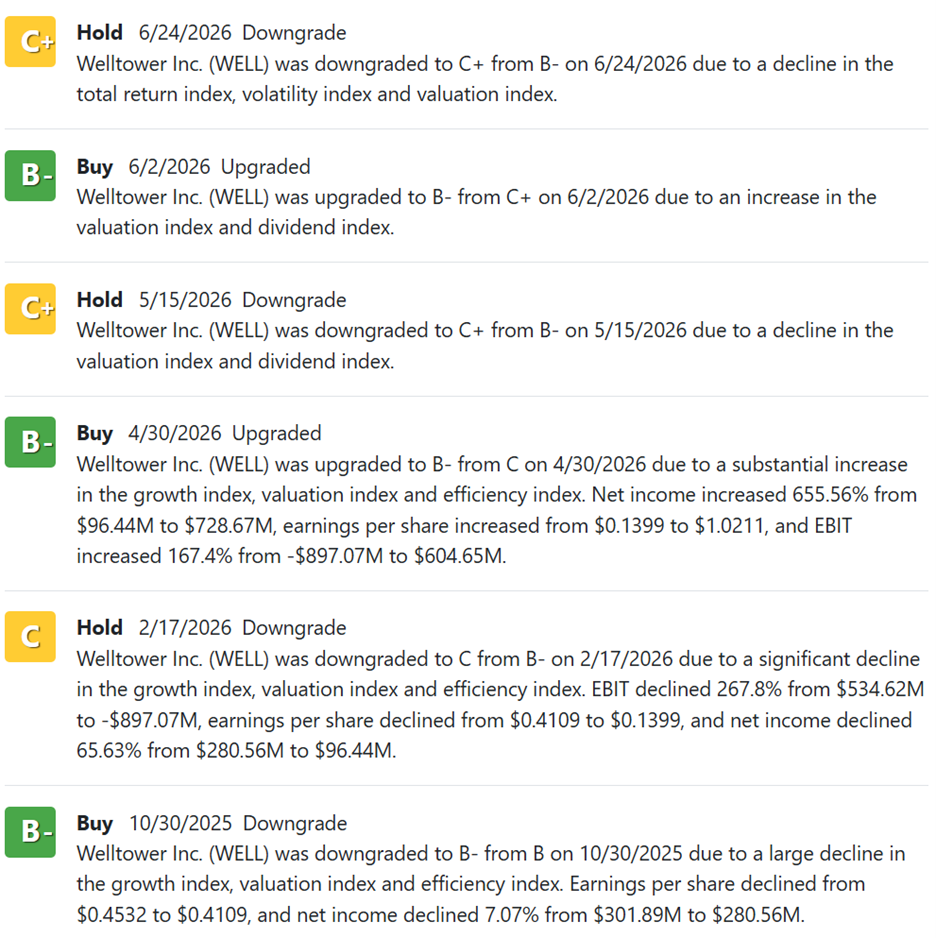
Welltower (WELL) — which has been shifting between “Buy” and “Hold” Weiss ratings since last year —posted 22.1% same-store net operating income growth in senior housing during the first quarter, with occupancy up 370 basis points to 89%.
Second quarter same-store growth for the segment remained very strong at 20.5%.
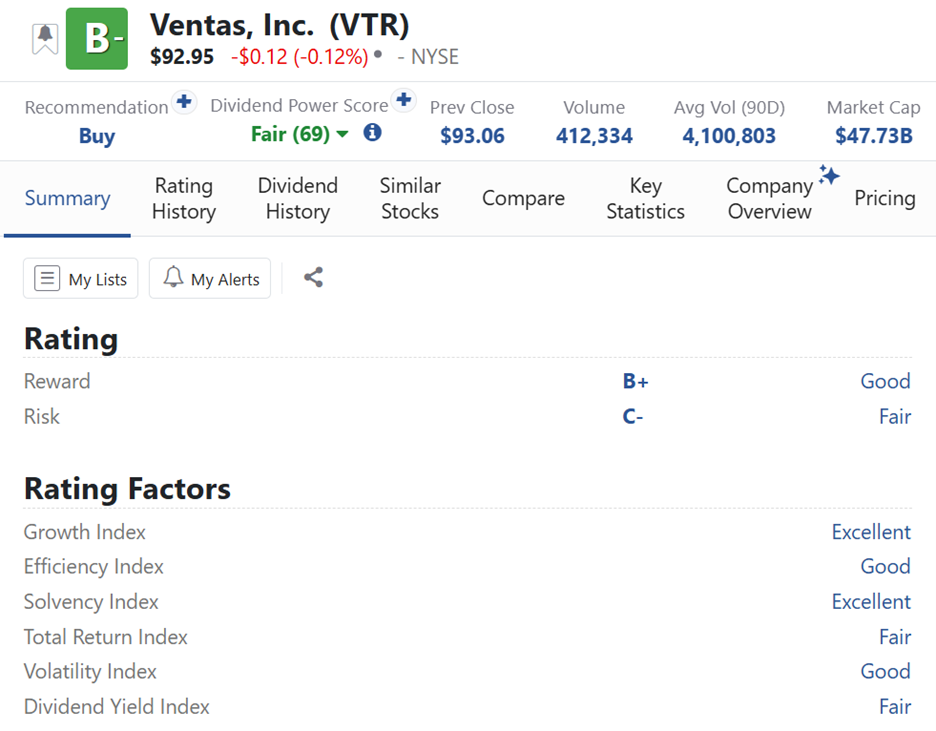
Another recently upgraded Weiss “Buy” — Ventas (VTR) —grew normalized funds from operation for senior housing 9% year over year on 16% same-store NOI growth.
Those look like growth-stock numbers.
Meanwhile, annual inventory growth has slowed to historic lows (under 1% nationally), and construction starts have dropped significantly (down roughly 70% to 77% from previous peaks) due to high financing and material costs.
Bottom Line
U.S. listed equity REITs are a $1.3-1.4 trillion market that spent two years being left for dead.
Now, a global wave of moratoriums, audits and backlash is handing the incumbent landlords greater pricing power.
The risks are equally plain.
If inflation re-accelerates and the Fed's dissenters win the argument, the 2022 playbook is likely to return.
And the same freeze that protects today's landlords throttles tomorrow's buildout. Both can't run forever.
As always, I recommend you do your due diligence.
Cheers!
Gavin
P.S. Our recently revealed “U-AI” system takes all of this into consideration, as it uses individual stock models across all our rated securities.
In fact, just a few days ago, it signaled three turbo-charged trades involved in the data center real estate boom. You can learn more here while this video remains online.