 |
| By Jim Nelson |
The S&P 500 just passed a new threshold. And for savers and retirees, it’s a bad one.
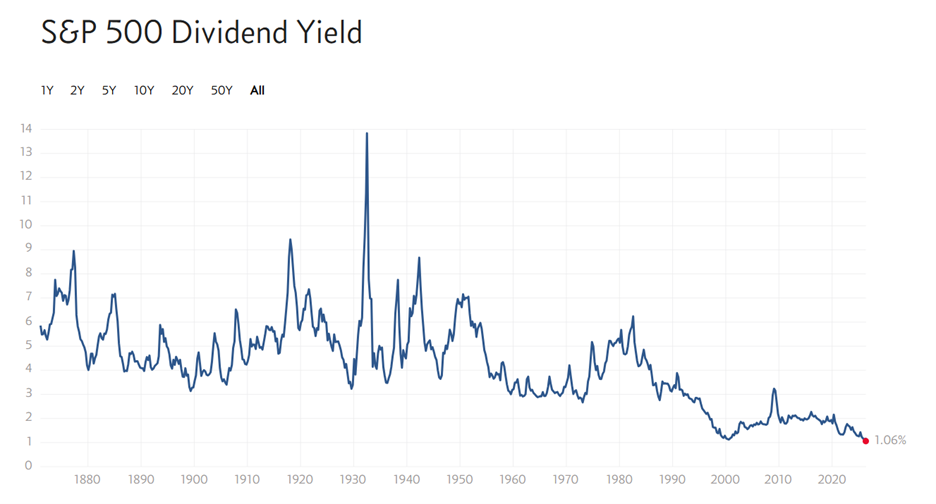
The index, which measures some of the largest U.S. stocks in the market, just saw its dividend yield hit an all-time low.
Historically, the average S&P company paid more than 4% in any given year. In the 1960s, that came down to 3%.
Since then, it has been slipping ever lower. Its previous low was 1.09% at the peak of the Dot-Com Bubble.
Today, it’s 1.06%:
Even if the Fed was able to actually achieve its 2% inflation target, today’s dividend landscape would result in a real-world loss on your investment.
And the Fed is far from able to achieve even that.
We still haven’t seen the full effect of this year’s rapid price increases from higher energy and transportation costs.
Yet, official inflation sits at 3.3%. And as Nilus Mattive noted yesterday, that’s far below the real number.
The main reason for the lackluster dividend yields is the makeup of the S&P these days.
Nvidia (NVDA) and other tech giants like Broadcom (AVGO) might have slipped earlier this year, but they still make up one-third of the index.
And tech companies are not known for paying large dividends.
Now, you may be thinking that since the S&P 500 is near its all-time high, who needs dividends? You can get all your profits from capital gains.
That has been true. But will it continue?
After all, if the market does slip, which stocks do you think will be the first to fall?
Dividend-paying stocks are viewed as defensive, which is incredibly important if the market hits a rough patch.
With concerns ranging from AI’s unprecedented spending to long-term entanglements in the Middle East, a market correction could turn into a full-blown panic.
That brings up another problem in the current dividend landscape: many unsafe payouts.
In previous market crashes, dividend payers have generally outperformed nonpayers.
However, that’s when many are at their riskiest.
During the Financial Crisis in 2008, the S&P 500 had 68 of its 500 companies cut their dividends.
During Covid, 27 companies decreased or suspended payouts.
More challenging, even during the past few years of positive market performance, 25 S&P 500 constituents cut their dividend from 2023 through last year.
What happens when the next panic arrives? 25 cuts might sound good. And 68 could even be too low.
Fortunately, Nilus has a solution.
At 2 p.m. Eastern today, he will show select readers his “Friday Income Machine.”
- It pays out nearly every Friday morning.
- It doesn’t rely on any company to continue paying dividends.
- It doesn’t matter if inflation continues or which direction the market heads next.
- In fact, it works in up, down and sideways markets.
Dividends may never return to the pre-1960s level, but this system often produces yields double or even triple those ones.
So, if you want income in a world without many options, you’ll want to attend. Just click here for the link to the event.
I’ll certainly be watching. I hope you join me.
Sincerely,
Jim Nelson